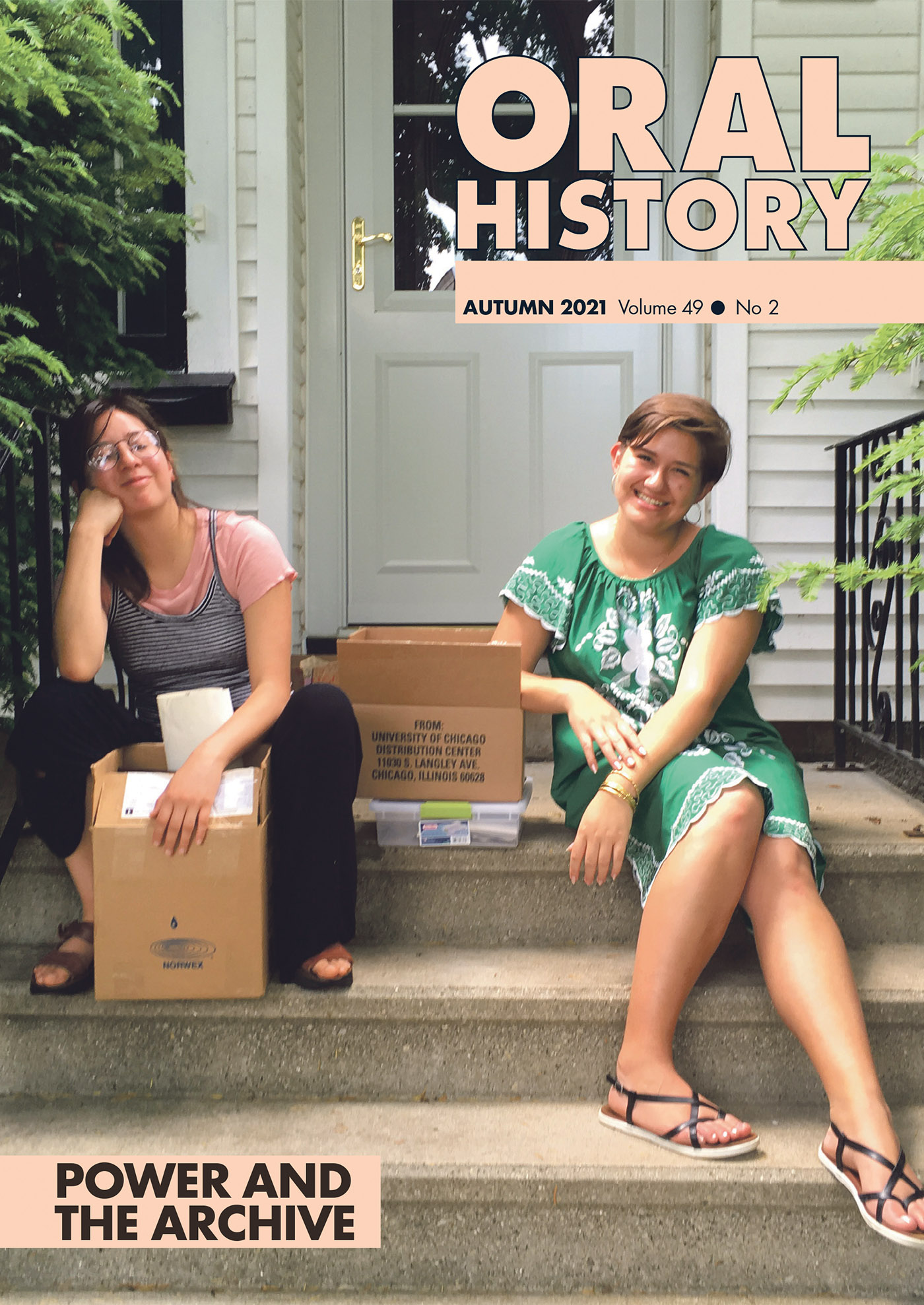
Power and the Archive
Volume: 49, Issue: 2 (2021)
Articles
The disappearing child: observations on oral history, archives and affects
This article reflects on the relations between archives, power and oral history by explicitly calling on a dynamic, relational idea of power as capacity: power to do, to affect and be affected by. It draws on ideas from affect theory, particularly the concept of the assemblage, to explore the circulation of affects across the practices, processes and products of oral-history-based research. It situates the interviewees, interviewers, the memory story, public historical discourses and narratives, interview situations and locations, archival documents, archives as institutions and research outcomes (among other things) as component parts of an oral history assemblage, each with the power to affect and be affected by each other: the archive is just one element among many. Two case studies illustrate these processes, both based on interviews with women who were children in France during the Second World War. Archives are shown to have the power to make children disappear, as people and as children, but are also part of what enables them to reappear inside more complex assemblages which include oral history and oral historians.
Author(s): Lindsey Dodd
Keywords: affect theory; history of childhood; assemblage; France; intersubjectivity
Fleshing the archive: reflections on Chicana memory practice
The Chicana por mi Raza Digital Memory Collective is a multimedia online archive which includes hundreds of oral histories and some 10,000 digital items (short films, letters, newspapers, scrapbooks, posters and photographs) documenting the development of Chicana feminism in the 1960s, 1970s and 1980s. Launched in 2009 by Mar�a Cotera and Linda Garcia Merchant, the project is self-sustained (not supported by an institutional collection) and foregrounds collaborative and horizontal relations of knowledge production in its approach to collection, digitisation and curation. This article discusses the origins of the project as a response to the erasure of Chicana feminists in histories of the Chicano movement and the women�s movement, and reflects on the methodological and epistemological dimensions of memory-keeping as a feminist praxis in which knowledge is produced and disseminated horizontally by a broad community of interlocutors both inside and outside of the university.
Author(s): Mar�a Eugenia Cotera
Keywords: Chicana feminism; civil rights; digital humanities; archive; memory
Romani pride, Gorja shame: race and privilege in the archive
There exists a dispersed digital archive of British (specifically here English and Welsh) Romani oral histories. Some recordings are held in museums and archives; others are available online. The purpose of such oral history projects is ostensibly to preserve and share a cultural heritage among Romanies/Gypsies, Roma and Travellers and to educate non-Romanies (or Gorjas) about these communities. The article affectively reframes the concept of white guilt as Gorja shame, and considers the role this plays in listening to Romani oral histories. In rethinking the power of Romani pride in the oral history archive, it displaces the long-held scholarly authority of the non-Romani with interest in Gypsy culture, using shame productively to become a different kind of listener.
Author(s): Jodie Matthews
Keywords: Gypsy; whiteness; guilt; affect; ethnicity; community
�This, too, is history�: oral history, the 1947 India�Pakistan partition and the risks of archival re-ordering
Drawing on interviews from my oral history project focussing on the 1947 India�Pakistan partition, in this article I critically examine the process through which an individual oral history interview becomes part of an archive. I suggest that this process involves an extraneous stabilising, or re-ordering of meaning. The way we use oral histories that we collect, I argue, risks reinforcing some of the problematic political power dynamics that oral history has hoped to combat. The process of incorporating an oral history interview into an archive is a process of ordering, ironing out ambiguities of meaning, voice, authorship and authority.
Author(s): Anindya Raychaudhuri
Keywords: archive; power; order; disorder; consent
Documenting narratives of violence: archives, oral histories and constructing absences
This article looks at discourses formed around domestic violence operationalised in the Protection of Women from Domestic Violence Act (PWDVA) through the critical reading of two sources: the official archives of complaints filed and the oral histories of survivors of violence. Archives are instruments of creating a mainstream discourse of domestic violence, directly influencing the evaluation of state policies. The article also explores the scope of feminist oral history interviews as a way of problematising the discourses of the official archives and uncovering the politics of the archive. But oral interview methods, too, are not free of power relations, as is evident in questions of authorship/ownership, meanings and the process of consent in archiving them for future research. Looking at the inherent tendency of record-making methods to create narratives along the lines of existing power structures, we see how each creates its own discursive history of domestic violence, which, while illustrative on many counts, is marked by absences.
Author(s): Supurna Banerjee
Keywords: women; silence; domestic violence; narratives; discourse
Recomposing the archive? On sound and (hi)story in Damara / ?N?khoe pasts, from Basel to west Namibia
We explore interconnected texts in a �coloniser archive� of stories, songs and historic narratives in Khoekhoegowab, recorded by German linguist Ernst Dammann and his wife Ruth in Namibia in 1953-1954 and housed in Basler Afrika Bibliographien, Switzerland. We outline the �re-ordering� strategy enabling us to �release� information caught by the Dammanns, and work towards culturally contextualised understandings of the pasts spoken of by their interviewees. We engage with a specific recording as a multivalent object prompting recall of both autobiographical and cultural/collective memory, sharing an initial recomposition of a song from this recording as an initiative to amplify its content and reach through a contemporary mix drawing on electronic music-making possibilities. We close by reflecting briefly on pragmatic copyright issues arising through this reworking of the archived Dammann recordings.
Author(s): Sian Sullivan and Welhemina Suro Ganuses
Keywords: Khoekhoegowab; sound recordings; recomposition; music; Namibia
Public History
Windrush: The Years After. A community legacy
When Kirklees Local TV (KLTV) undertook its community history project Windrush: The Years After � A community legacy on film, it became a creator and preserver of a community�s history, both a narrator and custodian of other people�s stories. It also became a curator as it gave audiences access to those oral histories. Bringing together these roles through its own strengths in community-based video production, KLTV explored gaps and silences in existing historical records, opened fresh avenues of access to the past and compiled an archive of memories unrepresented elsewhere. Undertaken after Britain�s Windrush scandal emerged in 2018, this project involved interviewing members of the African Caribbean descent community in Huddersfield, West Yorkshire. Attention focusses on how video documentary captured and communicated lived experiences and how the project negotiated the multiple lines of power that continue to influence historical knowledge, archival practice and narratives about the past.
Author(s): Milton Brown and Heather Norris Nicholson
Keywords: archive; Yorkshire; documentary; discrimination; African Caribbean
Learning
�You live the moment with the person telling your story�: young people and oral history in National Lottery Heritage Fund projects
Forming part of the ongoing discussion about oral history and young people, this article focusses on the way in which the National Lottery Heritage Fund supports the use of oral history in heritage projects involving young people. In addition, it details three projects, recommended for inclusion in this article by the Fund. Reflecting the views of those that took part, the article demonstrates mercurial definitions of oral history, which were also evident in previous discussions with teachers. This article raises two separate but interlinked questions for further work: first, an evaluation of how and in what way oral history and young people have been supported within the funding programmes of the Fund and, second, an analysis and exploration of the nature and impact of such projects which have been funded since 1994.
Author(s): Kate Melvin
Keywords: National Lottery Heritage Fund; young people; oral history methodologies
Reviews
Female Railway Workers in World War II
Author(s): Susan Major
Manchester City Women: An Oral History
Author(s): Gary James
Mem�rias Afro-Atl�nticas (Afro-Atlantic Legacies)
Author(s): Gabriela Barreto (director), Xavier Vatin and Cassio Nobre (researchers/screenwriters)
London�s Aylesbury Estate: An Oral History of the �Concrete Jungle�
Author(s): Michael Romyn
The Rio Tape/Slide Archive: Radical Community Photography in Hackney in the 80s
Author(s): Tamara Stroll, Andrew Woodyatt, Alan Denney and Max Leonard (eds)
Child Survivors of the Holocaust in Greece. Memory, Testimony and Subjectivity
Author(s): Pothiti Hantzaroula