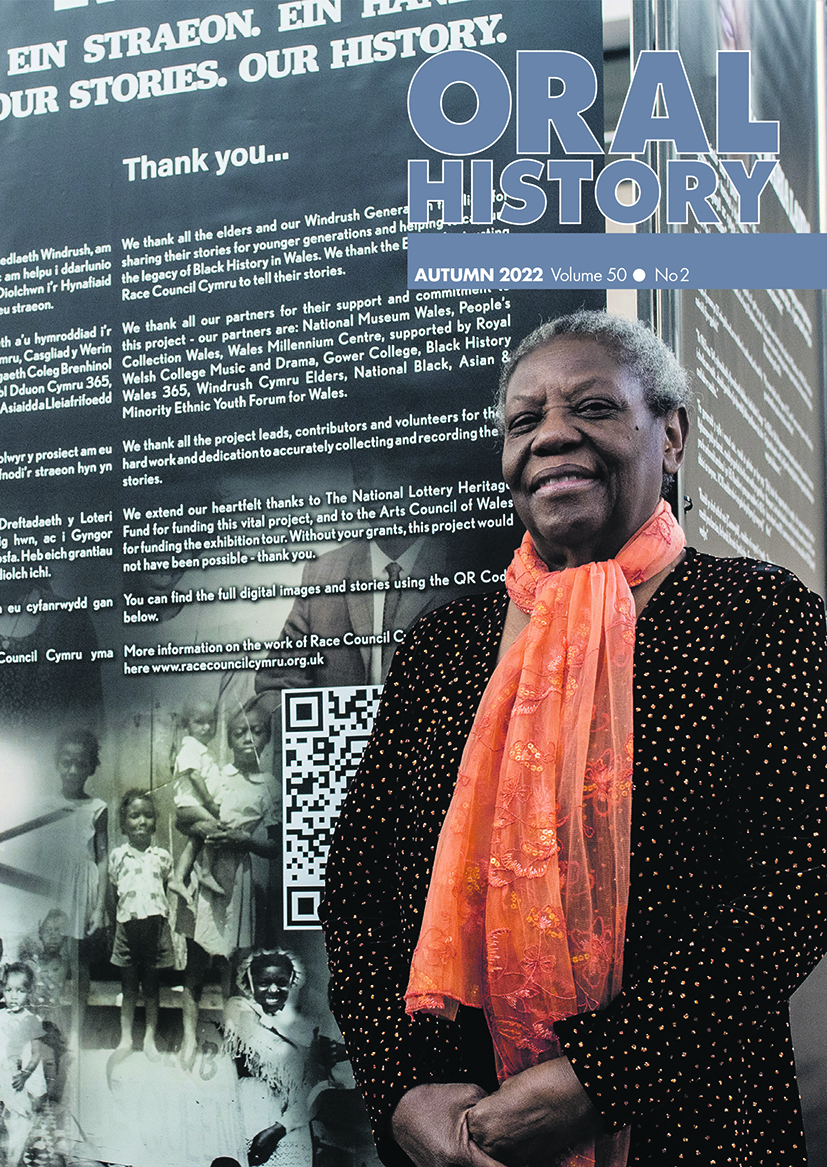
Autumn 2022
Volume: 50, Issue: 2 (2022)
Articles
Remembering Nora: interpreting the oral testimony of a Magdalene laundry survivor through the lens of collective memory
This article explores the capacity of collective memory theory to guide interpretations of the oral testimonies of survivors of Irish institutional abuse. Based on an oral history case study of Nora, a survivor of the Good Shepherd Institution at Sunday�s Well, Cork, it explores the fragmentary and non-linear nature of oral recollections of institutionalisation. It then connects these recollections to theories of autobiographical memory, arguing that the denial of relationships with family and friends within Irish institutions had a detrimental impact on survivors� ability to develop a coherent autobiographical identity. The article argues that the apparent imperfect nature of their oral testimonies can be viewed as symptomatic of the legacy of abuse inflicted on survivors of these Irish religious-run institutions.
Author(s): Sarah O�Brien
Keywords: Ireland�s Magdalene laundries; autobiographical memory; family memory; communicative memory
Haunting pasts: traumatic memory, performance and inter-subjectivity in a forced labour camp survivor�s life-story
This article explores the effects of trauma on the construction of the self through the narration of a life-story. It is based on the testimony of Maria (not her real name), a tobacco worker in Volos, Greece, who was deported to Ravensbruck and K�penick. By analysing the testimony in parallel with the interview process, the following questions are addressed: How can traumatic memories be interpreted in conjunction with the narrative performance of self? Under what conditions is the image of the self shaped through a blurred narrative, characterised by a disrupted relationship between the past and the present? Which patterns are reiterated and what do they signify? Finally, how do the identities of the interviewer and the narrator affect the interview?
Author(s): Antonis Antoniou
Keywords: traumatic memory; performance; inter-subjectivity; Volos; Ravensbruck
�You were on your own�: pregnancy, birth and early parenthood in Britain during the first months of the Covid-19 pandemic
The 2020 Covid-19 pandemic changed the lives of parents with young children in the UK in an unprecedented way. This article is part of a wider project exploring the experiences of these parents and focusses on oral history interviews undertaken during 2020 with women who were pregnant and gave birth in the early stages of the first 2020 UK lockdown, and with women with young babies in those early months of 2020. It begins to develop an understanding of the emotions involved in how parents navigated pregnancy, birth and early parenthood in lockdown and the early stages of the pandemic, thus exploring oral testimonies from a key population group at an important juncture in history.
Author(s): Alison Chand
Keywords: motherhood; pregnancy; birth; emotions; crisis oral history interviewing
Sticklebacks and Gandalf�s Garden: an oral history of 1970s British environmental activism
This article explores the emergence of the modern British environmental movement by drawing from oral interviews with fifty individuals who joined PEOPLE/the Ecology Party (subsequently the Green Party) during the 1970s. The use of oral history to understand British feminist campaigners� routes to activism is very well developed. This study addresses the more limited application of such approaches to environmental politics. Interviewees described how their consciousness of environmental problems, and the political implications of this, developed from experiences in education and work, personal encounters with environmental threats and exposure to an emerging discourse on the environment. The latter included a burgeoning set of intellectual influences.
Author(s): Mitya Pearson
Keywords: environment; activism; green parties
Working Up Top: employment at Mayday Hills Mental Hospital, Beechworth, Victoria, 1960-1995
In this article, we explore employment practices at Mayday Hills Mental Hospital, Beechworth, Victoria in the thirty years or so before its closure in 1995, principally through the eyes of staff. Beechworth was an isolated country town and the hospital was a major employer. While psychiatric hospitals struggled to attract staff, two factors operating at Mayday Hills served to mitigate this shortage. Local people were familiar with its environment, with generations of families working there, and government jobs offered security. However, the complex pattern of relationships built up over generations between staff and in the town meant that conformity to unwritten norms was rigidly enforced through pranks, hazing and trade union activity.
Author(s): Eileen Clark, Jenni Munday and Alison Watts
Keywords: Beechworth, Australia; psychiatric hospitals; employment practices; conformity
Public History
The art of the intimate interview
This article, which derives from Steve Humphries� keynote speech at the 2021 Oral History Society Conference, discusses the author�s enduring passion for filming people�s life stories. It covers his work across forty years, filming around 1,500 interviews and asking intimate, in-depth questions on the most difficult subjects such as sex, war, personal tragedy, disaster and the secrets that lie behind the respectable image of family life. These have formed the backbone of more than 200 social history and life-story documentaries that Steve has produced and directed. In this public history article, he discusses how he and his team at Testimony find the people who are ready tell their extraordinary stories, how they persuade them to appear on camera, how he interviews them and how their testimony is used. He discusses his most important techniques to encourage people to open up, one of which is to let people tell their story at length, in every last detail. Even though they are hard to edit, such interviews deliver extraordinary moments of emotional intimacy, impossible in a shorter, more structured interview.
Author(s): Steve Humphries
Keywords: television; testimony; sex; love; war; heroes
Learning
Learning and doing oral history in higher education in the midst of the Covid-19 pandemic
This article discusses the opportunities and challenges that arose from delivering the �Hidden Memories of Mental Healthcare� heritage project remotely rather than in person in the midst of the pandemic. Postgraduate students in higher education were taught oral history methodology at a distance in order to collect oral history interviews remotely. This article seeks to highlight innovative and collaborative approaches to teaching oral history methodology to young people in higher education in order to generate primary source material and co-produce digital mental healthcare histories at a distance. It discusses how the project met its stated outcomes by pivoting to online delivery. It examines the practical and ethical challenges and the unexpected outcomes and rewards that arose from this process.
Author(s): Verusca Calabria
Keywords: Covid-19; young people; blended learning; co-production; remote interviewing
Reviews
The �usable pasts� of de-industrialisation: three new histories of twentieth-century labour
Author(s): Jack Saunders
Scottish Coal Miners in the Twentieth Century Edinburgh: Edinburgh University Press, 2019, 336pp; �24.99 paperback, �90 hardback, �25.99 eBook.
Author(s): Jim Phillips
Coal Country: The Meaning and Memory of Deindustrialization in Postwar Scotland London: University of London Press, 2021, 324pp; �25 paperback, �40 hardback, open access eBook.
Author(s): Ewan Gibbs
Making Cultures of Solidarity: London and the 1984-85 Miners� StrikeAbingdon: Routledge, 2021, 250pp; �34.99 paperback, �120 hardback, �26.24 eBook.
Author(s): Diarmaid Kelliher