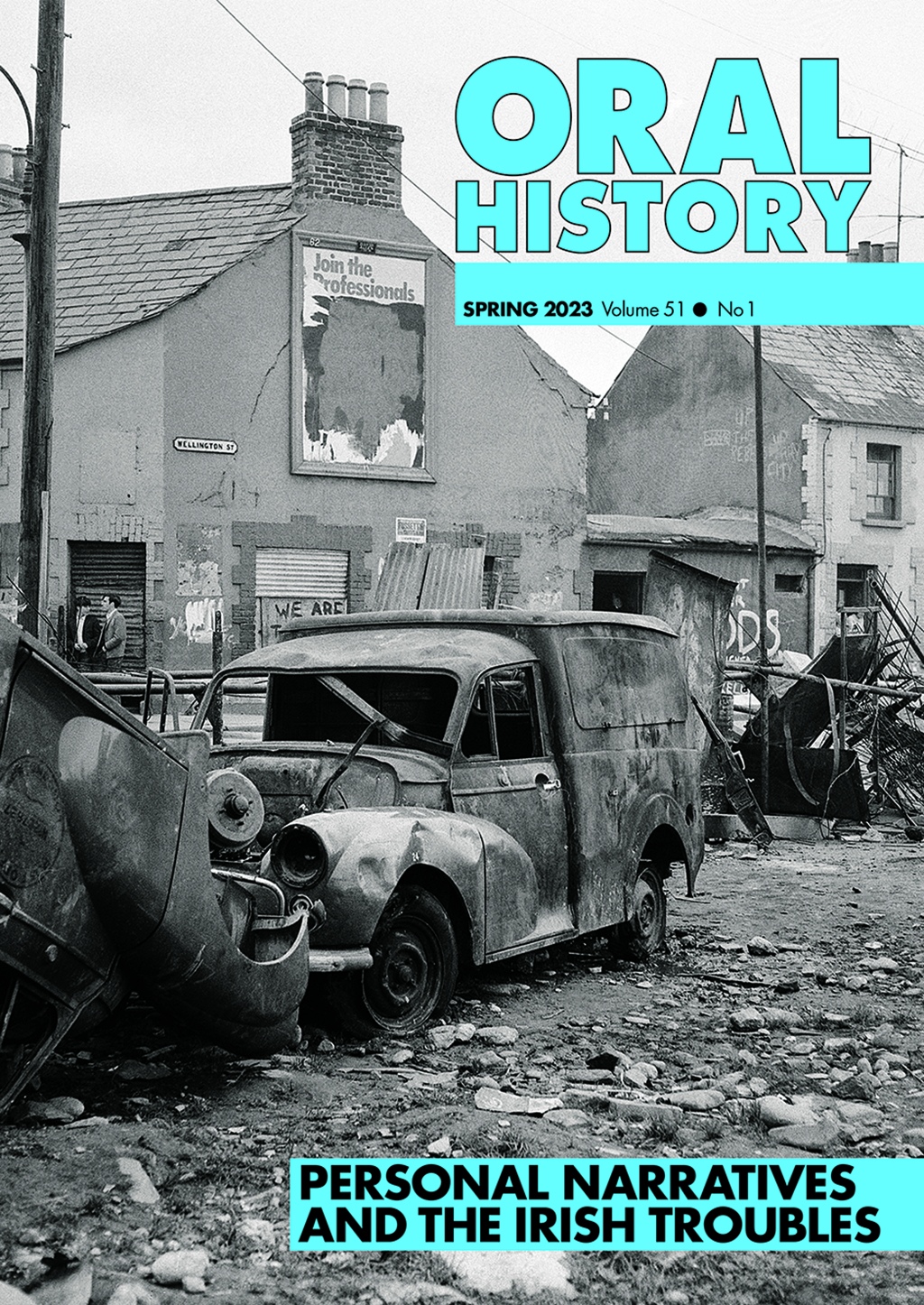
Personal Narratives and the Irish Troubles
Volume: 51, Issue: 1 (2023)
Articles
Everyday experiences of the city in memories of the Belfast punk scene
This article draws on interviews with a number of people who took part in the punk scene in Belfast during the Troubles. It argues that the scene can be understood, in part, as an engagement with sectarianised space and segregation in the north of Ireland. Reading the narratives of former punks for the felt and affective geographies of segregated and sectarianised space helps to give us a clearer sense of everyday life for young people during the war.
Author(s): Fearghus Roulston
Keywords: Belfast; punk; the Troubles; sectarianism; segregation
Emotional journeys: Belfast and the oral history of joyriding
This article explores the highly controversial history of joyriding in Belfast using a transnational perspective and emerging scholarship on emotion in oral testimonies to reflect on a research project that has been twenty years in the making. It is a journey through the emotions created by joyriding, from the buzz that motivated so many young offenders through to the grief of families bereaved by car crime. It offers evidence from several testimonies but focusses on one interview with the mother of a dead joyrider to examine what it tells us about probing emotions more adeptly. This case study of joyriding suggests a new, more complex, approach to the cultural politics of popular memory of the Troubles and their aftermath.
Author(s): Sean O�Connell
Keywords: emotions; joyriding; Belfast; popular memory
Joy and resilience: oral histories of finding a gay community amid the Troubles in Belfast, 1968-1982
From 1968, the Troubles engulfed Belfast and fundamentally transformed the lives of residents of the city and beyond. In the 1970s the pervasive British military presence on the streets, army checkpoints in commercial and residential areas, paramilitary attacks, civilian deaths, neighbourhood curfews and government breakdown were inescapable aspects of life for everyone. The gay community faced similar struggles to others throughout the country, but pervasive homophobia coupled with the ethno-sectarian conflict resulted in additional challenges. Lesbians and gay men in Northern Ireland could also face workplace discrimination, familial rejection, anti-gay violence or arrest if their sexual orientation became known. As a result of these overlapping and intersecting difficulties, histories of the Troubles are often histories of trauma and conflict. However, this common narrative flattens and minimises the multifaceted experiences of gay men and lesbians during the Troubles. This article acknowledges the fears, struggles and distress caused by the Troubles and homophobia while also emphasising the joy found amid an accepting gay and lesbian community and the resilience that it fostered. The gay community had unique experience of, and responses to, the Troubles. They carved out a space for themselves in the divided city, founded supportive organisations and developed loving relationships, both romantic and platonic. The rampant homophobia of both Catholic and Protestant communities also resulted (according to some interviewees) in less sectarianism within the gay community as gay men and lesbians took part in cross-community socialising and organising. This article encourages readers to consider the ways that activism and community-building provided hope, joy and resilience for lesbians and gay men navigating the Troubles.
Author(s): Rachel Wallace
Keywords: joy; resilience; gay; lesbian; the Troubles; Belfast; trauma
Navigating cultures of silence with survivors of Northern Irish mother and baby institutions
Through original oral history interviews with survivors of the Northern Irish mother and baby homes, this article offers an insight into the ways in which oral history deals with both the past and the present, and how this might manifest in an interview. It considers how an oral historian might use oral history while investigating a phenomenon of silence, in which society was complicit. The birth mothers disclosed expected and unexpected trauma, which underlined how traumatic subject matter has little generality, and that as researchers, we must adapt in an interview to the intricacies of an event and the individual narrator. This research underlined that oral history interviewers need to be flexible, reciprocal and allow the boundaries of the interview to be dictated by the narrator.
Author(s): Olivia Dee
Keywords: trauma; feminism; reproductive politics; stigma, silence; mother and baby homes
The politics of storytelling and storylistening: policy and memory in post-conflict Northern Ireland
The ways in which individual experiences of conflict have been elicited during the peace process in Northern Ireland suggest a dynamic relationship between memory and policy, which has consequences for both. How do policy frameworks position storytelling in relation to other ways of dealing with the past? Conversely, how does storytelling influence and work as a response to absent or piecemeal policy frameworks? This article conceptualises the assemblages of accounts of conflict and policies to deal with the past as a politics of storytelling and storylistening in the ongoing peace process. It first considers memory and policy in terms of scapes: memoryscapes and policyscapes, in order to highlight the crowded and contested terrains that have to be negotiated in Northern Ireland. It uses memoryscapes as a way of emplacing storytelling projects, before examining these projects� changing place in the Northern Ireland policyscape since 1998. Superimposing these scapes on to each other, the article turns to examining two storytelling projects, the Ardoyne Commemoration Project (2002) and Unheard Voices: Stories of Loyalist Women Growing up in Northern Ireland (2022), in order to discuss the evolving temporal politics of storytelling and -listening.
Author(s): Sara Dybris McQuaid
Keywords: storytelling; politics of listening; Northern Ireland; memoryscape; policyscape
Composing personal histories of Operation Banner: memory, emotion and temporality in British veterans� accounts of the Troubles
This article opens discussion on the roles oral history might play in addressing the omission of military accounts within debates over the legacies of the Troubles. Eschewing the identarian politics which saturates these debates, it argues that �post-positivist� approaches to oral history supply rich resources for developing a critical history of veteran memory focussed on the workings of �non-identity�. Based on intensive analysis of a single veteran account, it integrates perspectives drawn from memory studies and the history of emotions with theories of agonistic reconciliation to show how such an approach yields new insights into military experiences of the Troubles, unexplored aspects of the conflict�s social and cultural history in Britain, and the dynamics of cultural encounter in post-conflict times.
Author(s): Barry Hazley
Keywords: Operation Banner; veterans; composure; agonism; non-identity
Public History
Dealing with the legacy of the past: oral history and museums in Northern Ireland
This article contributes to ongoing debates around the role of oral history in dealing with the legacy of the past as part of the Northern Ireland peace process. Drawing on work at the intersection of the museum sector and academia, it endorses the importance and value of oral history to future strategies. However, in setting out the need for an effective delivery model, it explores how methodologies are currently understood and deployed in this context. The authors propose the development of a model anchored around a central archival hub with local spokes, acknowledging that this is a distributed story requiring extensive collaboration. Drawing on methods being prototyped by National Museums Northern Ireland, it sets out an approach that combines the merits of oral history set within broader interpretive and educational frameworks that utilise the concepts of agonistic memory and slow memory.
Author(s): William Blair and Chris Reynolds
Keywords: Northern Ireland; peace process; legacy; museums; agonistic memory; slow memory; memory activism
Learning
Oral history and education in Northern Ireland Kate Melvin in conversation with Anna Bryson, Denver Charles, Lesley Emerson, Alan McCully and Sean O�Connell
Author(s): Transcribed by Susan Hutton, and edited by Sean O�Connell and Rob Perks
Reviews
The past present and the present past: memory, oral history and twenty-first-century Irish republicanism
Author(s): Kevin Hearty