Boundaries
Volume: 51, Issue: 2 (2023)
Articles
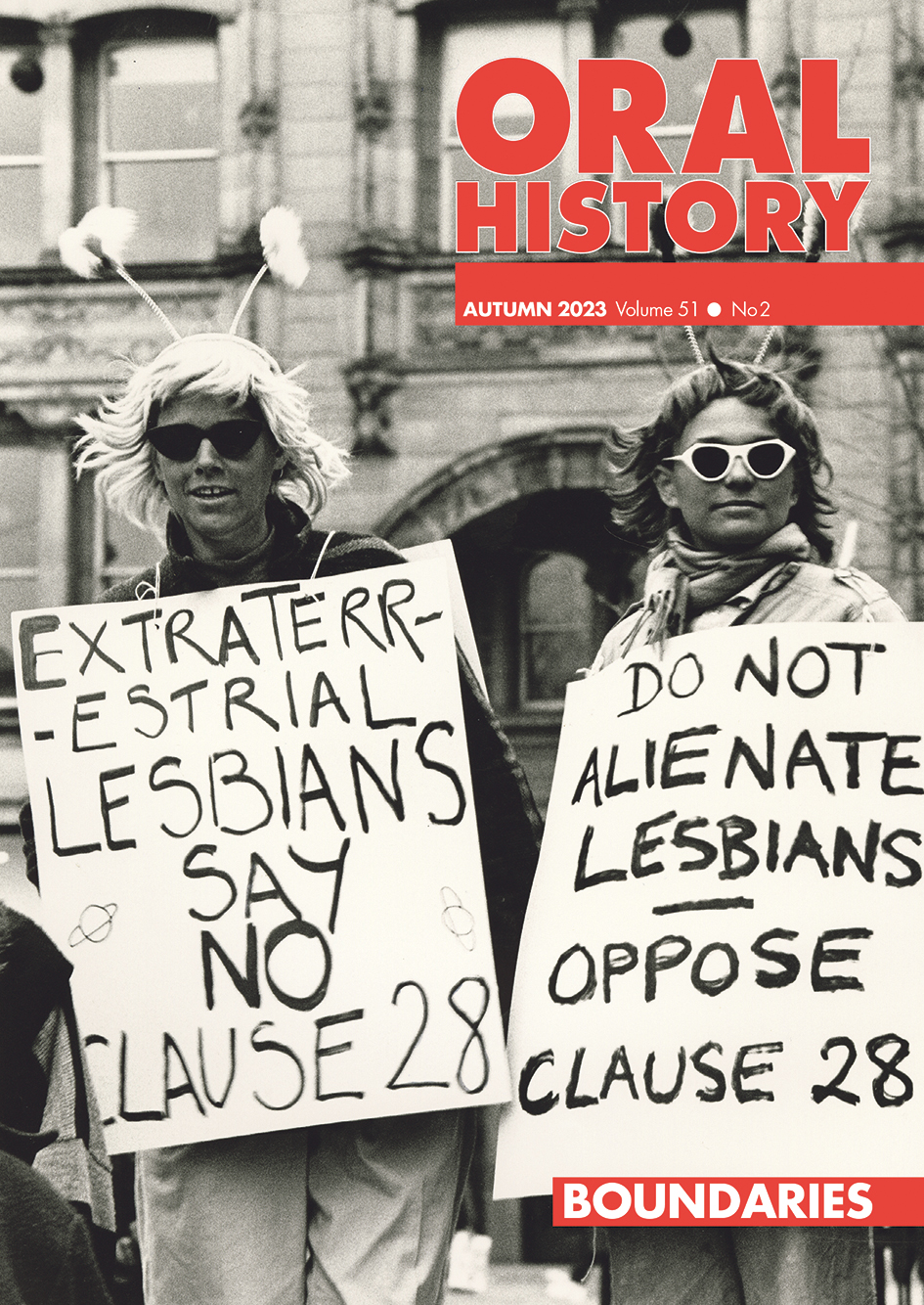
A hostile environment: affect, emotion and power in lesbian teachers’ reflections on Section
This article discusses interviews with lesbian teachers working in English schools in the 1980s during which time Section 28 of the 1988 Local Government Act (UK) became law. It examines how they were affected by and responded to this homophobic piece of legislation, focussing on the role of affect and emotion in the exercise of power. It examines the analytical potential of the concept of affective atmosphere and the use of oral history in exploring how subjects may encounter and experience atmospheres as discomforting or comforting, disempowering or empowering.
Author(s): Jennifer Harding
Keywords: Section 28; affective atmosphere; affect; emotion; discomfort; power; lesbian teachers
Inherited border regions: remembrance strategies among young adults in post-Yugoslavia and their multi-layered perspective on the past
Although it has been thirty years since the outbreak of the Yugoslavian wars of secession, the younger generation, despite not having many memories of the armed conflicts or first-hand experiences, still seems to be caught in this history and feels its presence in their everyday lives. Life-story interviews with young people of former Yugoslavia living in border regions demonstrate how they deal with the tensions and burdens of the past by establishing a multi-layered perspective. This article sets out three remembrance strategies elaborated by this generation during adolescence to create their own narratives and remembrance culture. As such, this generation translates individual experience into cultural capital, enriching the process of reconciliation.
Author(s): Eva Tamara Asboth
Keywords: generation; memory; post-Yugoslavia; post-war period; transregional
Expectations, experiences and enigmas: hearing and evaluating emigrant testimony
Human migration richly rewards exploration through oral testimony. This paper focusses on the life stories of emigrants from Scotland who left their homeland between the 1950s and 1980s. It uses their personal testimony to explore three related themes. First, it looks at the relationship between image and reality in the practical outworking of emigration. Second, it explores the ways in which expectations could be confirmed or contradicted by abstract sentiments associated with perceptions of identity and belonging. Third, and finally, it evaluates the attitudes and experiences of those who returned to Scotland, not least with reference to integration and alienation.
Author(s): Marjory Harper
Keywords: emigration; Scotland; Canada; Australia; South Africa; homesickness
‘Intellectual disability nursing, the Cinderella relation of nursing’: an exploration of marginality through oral history
This paper draws on work undertaken for an oral history project during 2018 to 2020, which sought to explore the careers of thirty-one intellectual disability nurses from England, UK and the Republic of Ireland, with at least thirty years’ experience. In both jurisdictions some participants had worked within long-stay institutions built in previous centuries, which have now all but closed, being replaced with smaller living configurations. Few practising intellectual disability nurses have experience of working in such institutions, and this makes it apposite to hear their important stories. Their narratives provide new insights into how these nurses have been marginalised from their professional group by a complex interplay of hegemonic tensions, parallel stigmatisation, recruitment issues and emotional labour.
Author(s): Paul Sutton, Colin Griffiths, Paul M Keenan, Sandra Fleming, Carmel Doyle, Helen L Atherton, Su McAnelly and Michelle Cleary
Keywords: intellectual disability nursing; marginalisation; careers
Challenging the narrative: empowerment and composure in the Dorset History Centre’s LGBTQ+ Speakout Project
The LGBTQ+ Speakout Project was an oral history project conducted by the Dorset History Centre which captured twenty-five interviews with members of the Dorset LGBTQ+ community and preserved them in an online, freely accessible archive. This article discusses the process of project design, lessons for future oral history projects and Speakout’s contribution to LGBTQ+ histories. Through the project, participants emerged as active historical actors, using their interviews as dual sites of narration and empowerment, in turn demonstrating both the diversity and complexity of the Dorset LGBTQ+ experience.
Author(s): Molly Groarke
Keywords: LGBTQ+; narrative; composure; intersubjectivity; empowerment
Public History
A question of sport: division and belonging across two oral history projects
This article explores the contribution of two oral history projects, ‘Kent’s Sporting Memories’ and ‘London Together’, both of which were designed to address an absence in the preservation of sporting heritage at a grassroots level. It also examines the projects comparatively in order to reflect on the disparities and commonalities of local historical sporting experience based on aspects of ethnicity, gender and class.
Author(s): Michael Romyn
Keywords: public history; race; wellbeing; friendship; sport
Learning
Transformative engagement in UNESCO’s Global Citizenship Education: a secondary school oral history project
This research study examines how secondary school students’ participation in an oral history project aligned with UNESCO’s Global Citizenship Education to promote peace and knowledge about human rights. Through the use of focus groups, the narratives of thirteen secondary school students who participated in the oral history project were captured. The findings of this study reveal that the oral history project examined is interconnected within Global Citizenship Education’s three domains and serves as a method for students to experience transformative engagement. By participating in the oral history project and learning the stories of veterans, Holocaust survivors and others impacted by war and global conflict, students were transformed into active global citizens committed to fostering peace.
Author(s): Taunya Wideman-Johnston, Courtney A Brewer and Mike McCabe
Keywords: oral history; Global Citizenship Education; secondary students; veterans; Holocaust survivors
Reviews
Queer oral history today: new directions?
Author(s): Nikita Shepard