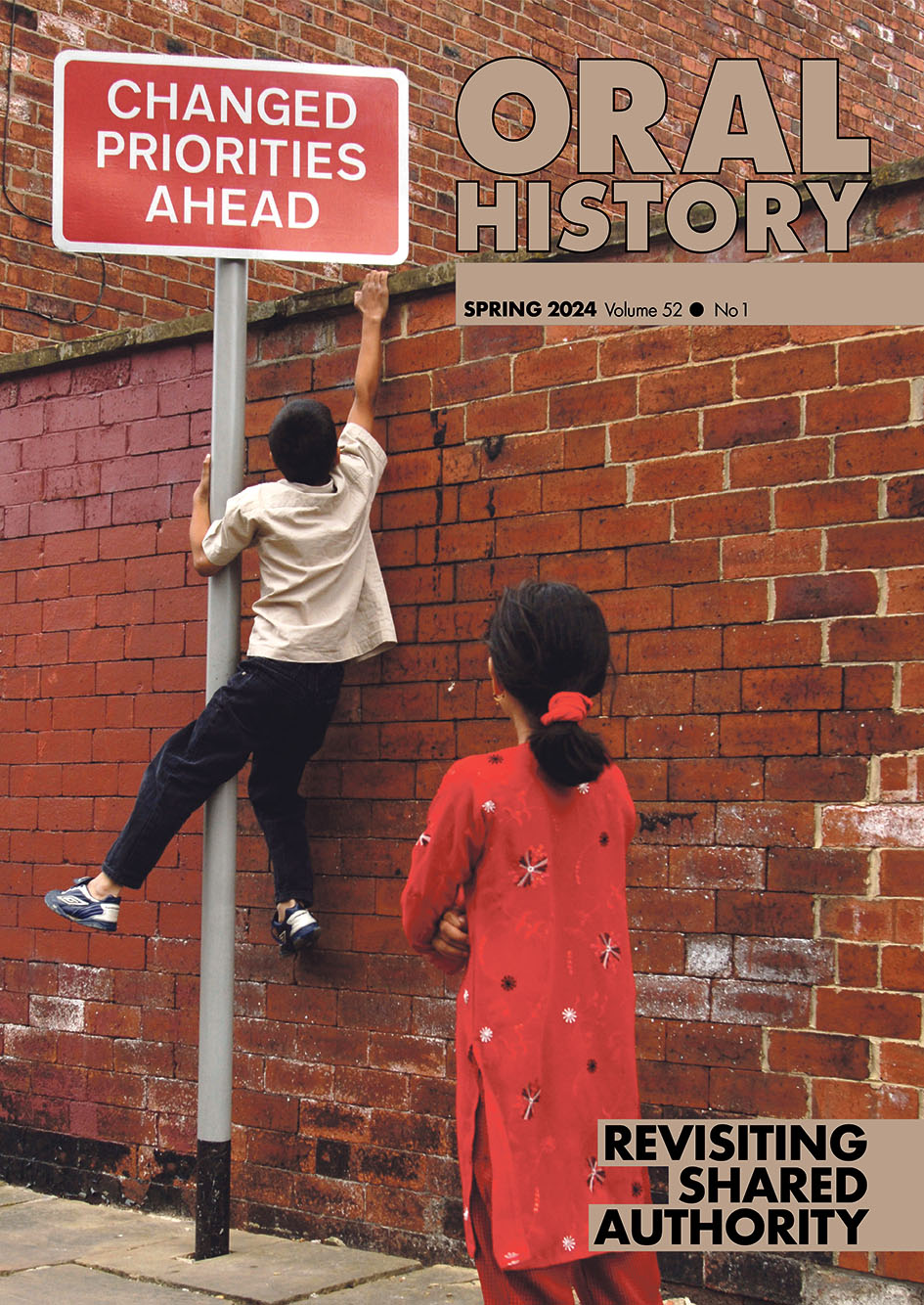
Revisiting shared authority
Volume: 52, Issue: 1 (2024)
Articles
Being a good scholar or a good person? Shared/sharing authority and the practice of taking scholarship for granted
What is the place of scholarship in oral history? What knowledge do scholarly oral historians contribute to oral history and our democratic societies? I explore these fundamental and major questions through a re-reading of articles focussing on shared/sharing authority, and via conversations with three Swedish scholars, representing three generations of oral historians. I argue that scholarship has been taken for granted, by myself and others. For the past fifty years, many of us have prioritised democratising, deconstructing and decolonising rather than developing and defending scholarship. In a way, you could say that we have fallen into the trap of populism that many oral historians warned us about, striving to be good persons instead of good scholars, and reinforcing the dichotomy of the two instead of deconstructing it. This also means that we have placed oral history, the humanities and social sciences in a vulnerable situation. I argue that it is high time to make visible the place of oral history scholarship not only in oral history but in society.
Author(s): Annika Olsson
Keywords: academic knowledge; scholarship; shared/sharing authority; democracy; humanities and social sciences
Sounding history: the work of podcasting as shareable authority
Despite many podcasts that take an oral history format or are about oral history as a method, there is very little research that critically connects podcasting to oral history or theorises about the possibilities of podcasting as an oral history practice. This article draws on recent research that argues for a focus on the work around podcasting praxis as an important site of analysis for understanding the community-building potential of podcasting work, especially in the context of migration and diaspora, where non-Western migrants are often not treated as the authorities of their own (hi)stories. In examining two episodes of Kerning Cultures and drawing on concepts from oral history, I develop the concept of shareable authority, a term that links oral history methods to digital media practice and scope. The article offers a contribution to oral history practice, as it demonstrates numerous methods for making authority more shareable between many collaborators and making the distribution of authority more transparent, both of which have implications for power-sharing and decolonial knowledge production.
Author(s): Erin Cory
Keywords: podcasting; diaspora; shareable authority; decolonial methods
Reflecting upon authority in the creation of the ‘We are proud of them’ story map
This article reflects upon authority in the creation of stories of flood resilience in the community of Tuti island in Greater Khartoum, the tripartite capital of Sudan. It focusses on ‘We are proud of them’, a story map utilised to generate a visual narrative by linking oral histories with photographs, videos, audio files, maps and spatial processes. Its primary focus is to represent and communicate the intersection of human life with the natural environment in Tuti, with particular attention to extreme flood events, a recurrent phenomenon in the island’s history. Oral history revealed the complexities of an imbued memory that links the community to past floods and takes the form of traditional knowledge practices that Tutians mobilise to manage floods. Visual and audio material from the 2020 Sudanese floods complemented the words uttered in oral sessions to create the story map. The collaborative process leading to the creation of the story map involved inhabitants of Tuti, Sudanese students and European researchers. This process, as well as the limitations with regard to shared authority between the researchers and local people, are discussed.
Author(s): Vittorio Felci, Aya Altom and Anders Høg Hansen
Keywords: Tuti island; Sudan; flood resilience; story map; shared/sharing authority; collaborative processes
Listening for moments of shared authority in archived interviews
The purpose of this article is to explore moments of shared authority when working with archived interviews and to suggest how the use and understanding of shared
authority as an analytical concept might be advanced and elaborated in conjunction with the concept of intersectionality, borrowed from another research field (in this case, gender studies). We aim to hear and acknowledge the different voices, dialogues and silences of those who documented and those who are documented. We listen to their archived voices and dialogues to find moments of shared authority and analyse how the shared authority plays out during the interviews through intersectional analyses of the archived interview narratives.
Author(s): Malin Thor Tureby and Jesper Johansson
Keywords: archived interviews; methods; intersectionality; shared authority; migration
‘Sharing authority’ as ‘learning together’
In a wide-ranging conversation, Malin Thor Tureby interviews Henry ‘Hank’ Greenspan about several of his projects involving ‘sharing authority’, what Greenspan calls ‘collaboration’. Collaboration has taken many forms in his work, most centrally his practice of interviewing the same Holocaust survivors multiple times over months, years, and with some survivors, decades. Unlike conventional testimony, which concerns declaration – that is, ‘this I witnessed’ – Greenspan’s approach emphasises exploration, what one survivor called ‘learning together’. Thus, in the context of deepening conversations, survivors reflected on the impact of their wartime experiences throughout the years that followed; their varying choices about what to share and not share at different times and circumstances; and their perceptions of their listeners, and popular ‘Holocaust memory’, in general. Greenspan also discusses a memoir he co-authored with a survivor, and a play, REMNANTS, which is based on his decades of conversations with survivors. He reflects on the process of co-authorship, the role of personal chemistry in interviews, the claims of the verbatim, writing in the service of conversation and the relationships between artistic and scholarly ways of knowing.
Author(s): Henry ‘Hank’ Greenspan in conversation with Malin Thor Tureby
Keywords: Holocaust survivors; interviewing; sharing authority; collaboration; performance; testimony; learning together
The value of the life story approach in recordings with creative practitioners: insights from interviews
This article explores insights gained from oral history life story interviews with theatre designers and craftspeople. Drawing on nearly twenty years of practice as an interviewer for National Life Stories (NLS), the author discusses the unique approach to interviewing adopted for NLS collections, ‘An Oral History of British Theatre Design’ and ‘Crafts Lives’. Through excerpts from interviews with creative practitioners such as silversmith Rod Kelly and theatre designer Lez Brotherston, the article highlights the significance of childhood influences, the intimate relationship between makers and their tools and materials, the life story approach as a method for uncovering hidden aspects of the design process, and the complex social networks integral to creative success. It offers a nuanced understanding of the interplay between personal narratives, professional practices and the broader context of theatre and crafts by focussing on specific moments and reflections on interviewing practice.
Author(s): Elizabeth Wright
Keywords: theatre design; crafts; silversmithing; interview methods
Why the life story is different: a case study researching Holocaust testimonies
This article examines the application of the life story methodology to interviews with Holocaust survivors. It explores some of the varied ways in which projects and archives have approached recording the testimonies of Holocaust survivors and the extent to which these differing approaches are or could be considered life histories. Using the testimonies of one survivor, Barbara Stimler, as a case study, the article goes on to look at what distinguishes the National Life Stories approach from other types of interviewing. It also considers what is captured in a life story interview that is missing in other types of testimony, as well as some of the factors that inhibit the use of the methodology in a testimonial setting.
Author(s): Madeline White
Keywords: Holocaust survivors; testimony; biography; life story; Jewish community
The artist’s life story: Hew Locke in conversation with Hester Westley
Artist Hew Locke discusses with Hester Westley, project director for ‘Artists’ Lives’, the motivation for making his life story recording for National Life Stories. The conversation considers the benefits of the long-form recording format as well as the possibilities opened with the option of time-sensitive closures on the recording itself. Locke explains why the methodology of the ‘Artists’ Lives’ approach is different from any other type of interview. He describes who he considers the audience to be for his life story recording and for whom he is making the recording. Locke considers the ramifications of the mixed-race intersubjectivity of the interview process and reflects widely upon the nature of the recording experience; he also extends advice for future generations of artist practitioners.
Author(s): Hew Locke/Hester Westley
Keywords: Artists’ Lives; artist life stories; artists of colour; intersubjectivity; British art world
Reflections
Shared authority and the digital turn
Author(s): Michael Frisch
Conference Proceedings
Panel Discussion: Democratising access? The interface of new technologies and archived life stories
Author(s): Andrew Flinn with Doug Boyd, Charlie Morgan and Julianne Nyhan
The life story in oral history practice: closing plenary discussion
Author(s): Donald A Ritchie with Doug Boyd, Indira Chowdhury, Alexander Freund, Rob Perks, Mary Stewart and Alistair Thomson
Public History
Shared authority in a public history museum
This article examines exhibitions as an arena for shared authority in a public history setting, based on the ‘Remember the 1970s’ exhibition at The Old Town, an open-air museum for urban cultural history in Denmark. The museum has collaborated closely with former residents in reconstructing their homes, and residents are pivotal in communicating the narrative of their youth in films shown in the apartments. The article discusses how the former residents appear as authorities in the exhibition and how the museum supports their memory work and role as authorities. It demonstrates the close connection between authority and authenticity, and stresses that shared authority requires careful consideration of both the context and the choice of communication form.
Author(s): Iben Vyff
Keywords: shared authority; memory work; museums; witness to history; public history
Learning
‘What They Can Teach Us’: curating archived oral histories for secondary and post-secondary education
We argue that a carefully curated and contextualised collection of oral histories can be an effective learning tool in secondary and post-secondary education. We present ‘What They Can Teach Us’, an online educative resource that re-uses four interviews from 1993 with German women who migrated to Canada in the 1950s. By applying source criticism to extant oral histories, we explore some of the complexities around the interpretation and multi-temporality of the interviews. Using so-called historical thinking concepts in the lesson plans, we show that even short oral history excerpts can allow students to engage deeply with processes of historical thinking. It encourages them to question the veracity of sources and analyse the retrospective and changing nature of memory and narrative.
Author(s): Sofia Bach and Alexander Freund
Keywords: source criticism; historical thinking; educational resource; Canada; German-Canadian
Reviews
Sharing authority when confronting past injustices: the use of oral testimony in redress processes
Author(s): Malin Arvidsson