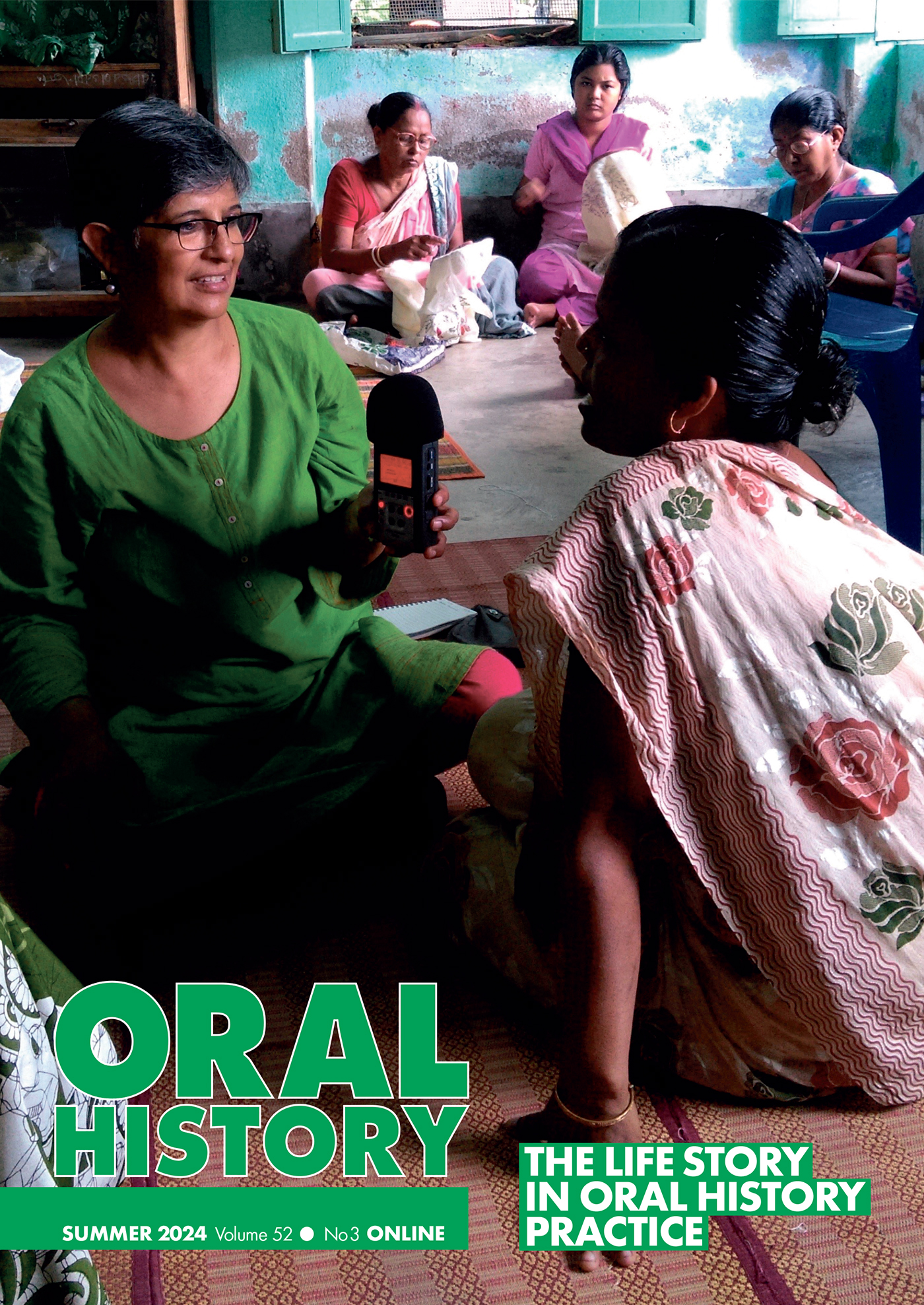
The Life Story in Oral History Practice
Volume: 52, Issue: 3 (2024)
Articles
Inclusion or imposition? The life story interview as knowledge production
This article considers the implications of conducting life story interviews. It argues that the life story interview is a method of knowledge production that is based on a number of underlying assumptions about what constitutes a life story, how it is best captured, and who can and should tell a life story. The life story interview produces knowledges through several phases, including the interview, its archiving and its online dissemination. While the underlying assumptions of life story interviewing are generally understood to make this particular oral history practice more inclusive, this article asks what kinds of impositions this practice places on interviewees (as well as interviewers and audiences).
Author(s): Alexander Freund
Keywords: life story interview; interviewing; knowledge production; narrative; archiving
Doing life story interviews for institutional archives: an inhospitable landscape?
Life story interviews in the Indian context need an approach that negotiates between collective and individual identities. This is particularly important within the setting of institutional archives in post-colonial India. This article suggests that the institutional background might be a difficult terrain for the life story interview. Some of the associated problems might emanate from institutional narcissism while others might stem from the individual’s disinclination to insert their life stories into the story of the institution. The article suggests that perhaps one needs to rethink the nature of the life story interview conducted in an institutional context and open it up for other forms of self-exploration.
Keywords: collective identity; memory; post-colonial India; institutional history; history of science; organisational history
Author(s): Indira Chowdhury
Keywords: collective identity; memory; post-colonial India; institutional history; history of science; organisational history
Using life story interviews: the researcher experience
This article focusses on the value for research of the long life story interview. It considers both the ‘whole of life’ interviews favoured by large public archives like the British Library and the National Library of Australia, and shorter topic-focussed oral history projects in which interviews focus on a particular topic while also covering key elements of each narrator’s life story. It notes some of the challenges of the life story interview and offers some suggestions about how to manage the challenges and optimise the research value of life story interviews. The article also considers how oral historians can ensure their life story interviews are as useful as possible for future researchers. It draws on examples from the author’s oral history interview projects in Britain and especially Australia, and from archived oral history collections the author has used while researching a variety of historical topics.
Author(s): Alistair Thomson
Keywords: life story; life history; interview methodology; archives; secondary analysis; re-use of data
Life stories: a field review
While historians readily adopted life review interviews, many social scientists regarded them as anecdotal and subjective, preferring to use structured questionnaires. This review of the literature, primarily from the United Kingdom and United States, examines the resistance, acceptance and application of the methodology. It further appraises the different formats that authors, oral history series and podcasters have adopted for presentation. The review also considers the enduring tension between data-driven empirical research and human experiences revealed through oral history.
Author(s): Donald A Ritchie
Keywords: quantitative and qualitative research; life story writing; oral biography; oral history publication
‘HIV of old’: reflections on the scope, re-use and narrators in long-form oral history
This article contributes to debates about long-form oral histories using HIV as a case study. It examines the scope of HIV oral history to date and questions whether existing collections offer a balanced history or reveal inequalities in digital and archival resources. It considers re-use over time, stressing the importance of stable archives that can manage long-term access, imaginative ways to tune in to aural meanings and the need to improve sharing of anonymised interview access conditions. It suggests that longitudinal oral histories raise questions about consent, funding, technological change, meaningful time periods and different needs for long- or short-form interviewing. Capturing young voices highlights new challenges in sharing long-term authority.
Author(s): Wendy Rickard
Keywords: HIV; longitudinal interviews; long form; re-use; young people
Reflections
Life stories in organisations
Author(s): Niamh Dillon
Conference Proceedings
Introduction: Democratising access? The interface of new technologies and archived life stories
Author(s): Charlie Morgan
Introduction: oral histories of science and the environment at the British Library
Author(s): Sally Horrocks
Life stories of agricultural-environmental change
Author(s): Paul Merchant
Discussion: Life stories of agricultural-environmental change
Author(s): Jon Agar, Fiona Harvey, Sally Horrocks and Paul Merchant