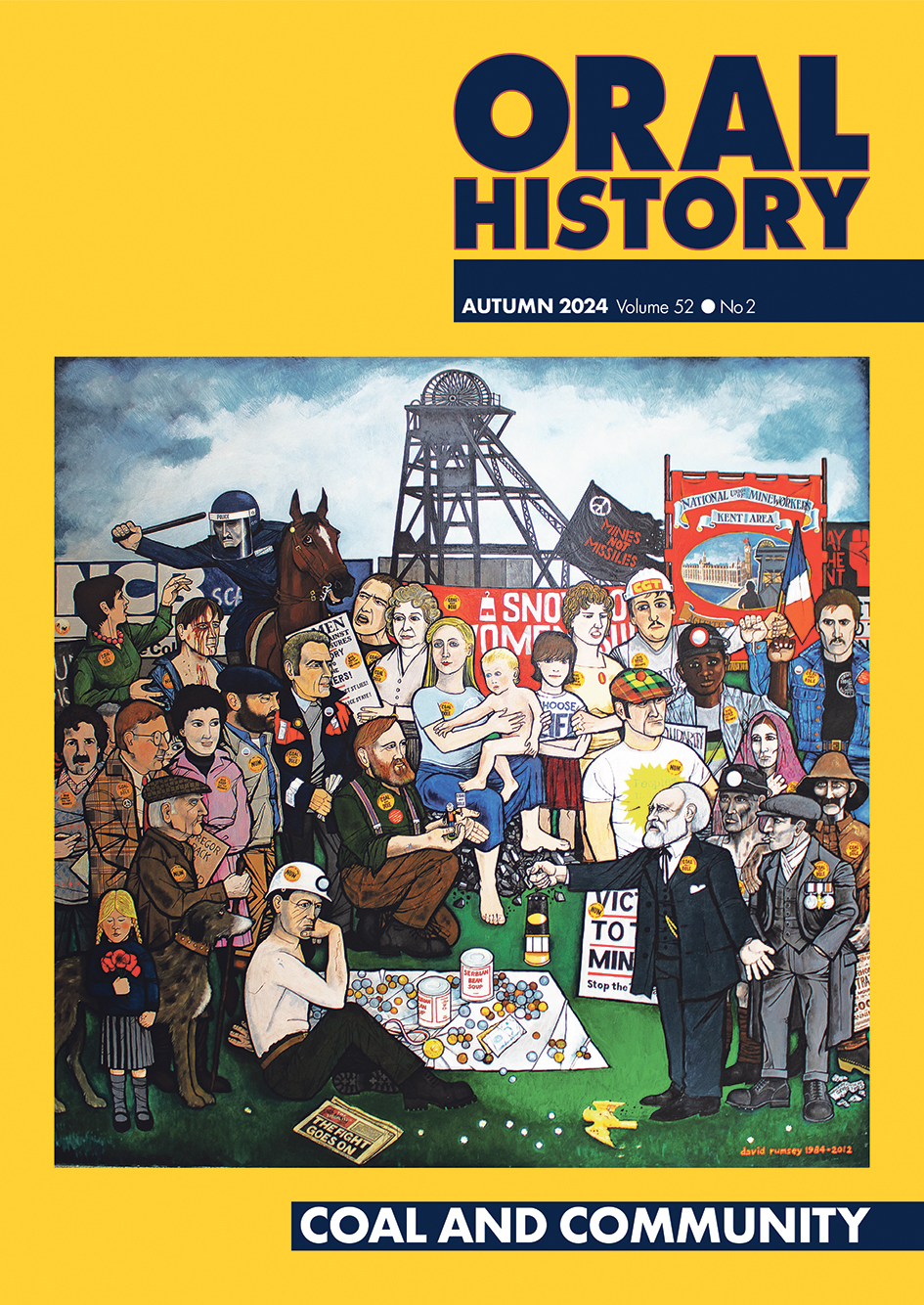
Coal and community
Volume: 52, Issue: 2 (2024)
Articles
Staying with it: undertaking oral history with veteran strikers in British coal communities
Slow research in the British coalfields has been immensely rewarding. More than 150 interviews with veteran miners, their family members and supporters have enriched our understanding of the year-long 1984-1985 strike in Britain and its aftermath as an immense collective injustice with varied national, regional and local contingencies. ‘Staying with it’ is our shorthand for a patient method that might be used in other projects on painful historical episodes with complex and long-lasting effects.
Author(s): Robert Gildea and Jim Phillips
Keywords: miners’ strike; mining communities; slow research
‘They really did us proud’: legal solidarity and the 1984-1985 miners’ strike
The 1984-1985 miners’ strike was one of the most fiercely contested industrial conflicts in British history. With thousands of arrests and an extraordinary amount of civil litigation, the strike transformed the courts into intense legal and political battlegrounds. While the role of law and legal institutions in undermining the strike is well documented, the contributions of lawyers in furthering the miners’ cause are largely unexamined. Drawing on archival research and oral history interviews conducted by the author, this article explores the legal victories and defeats of this period, and the ongoing campaigns for justice and accountability. In doing so, it reveals the remarkable networks of legal solidarity that emerged during the miners’ strike, and the impact of these explosive experiences on those who took part.
Author(s): Joanna Gilmore
Keywords: miners’ strike 1984-1985; legal solidarity; radical lawyers; cause lawyers; legal mobilisation
‘They’re still fighting the fight on Facebook’: the landscape of social media remembering and the British coal industry
Facebook has become a critical location for discussions of the past and part of the cultural circuit in which oral history interviews take place. Despite this, oral historians’ discussion of social media has focussed on recruitment and dissemination. This article uses oral history interviews to explore Facebook remembering of the British coal industry: from groups with thousands of members to conversations between two people. Our interviewees referred to Facebook and those discussions of Facebook posts form the evidence base of this article. We show that Facebook memory practices influence how coal mining is remembered offline and use the metaphor of a landscape to demonstrate their complexity. We conclude that attention to social media’s impact on cultural circuits is a matter of urgency for oral historians.
Author(s): Grace Millar, Ben Curtis, Keith Gildart and Andrew Perchard
Keywords: social media; coal; mining; memory
‘We didn’t realise our language was part of our heritage’: oral histories with east Midlands coal miners
This article draws on oral history interviews carried out with miners from around the East Midlands. In a project which examined local and regional variation of mining terminology, miners discussed the differences in the language they used, both within the region and when miners moved into the area from around the UK, particularly north-east England. We found that the interviewees had an extensive knowledge of the differences as well as the links between local dialect and mining language, but that they did not realise how much their language use actually mattered. This article argues that language should be considered an essential part of our cultural heritage.
Author(s): Natalie Braber
Keywords: East Midlands; coal mining; language; identity; camaraderie; heritage
Conversations at the ‘end of history’: revisiting the 1998 oral history of Mary Docherty, revolutionary coalfield communist
This article revisits an archived oral history interview with Mary Docherty, an active member of the Communist Party of Great Britain throughout the twentieth century, conducted in 1998 by a journalist and a trade unionist in Fife, Scotland. I explore the contrasting ways in which moments from Mary’s past were re-interpreted during her interview and also afterwards, during the editing of interview and letter excerpts to feature in the press. During the interview, Mary recalled herself as a political subject, while her interviewers primarily constructed the young Mary as a gendered subject. When Mary’s memories were edited for the press, they both echoed and contributed to the dominant versions of history that circulated in the late twentieth century. Revisiting this archived material provides insight into how the cultural reproduction of narratives unfolds.
Author(s): Amber T Ward
Keywords: Scotland; communism; gender; subjectivities; re-use of oral history
Second World War childhood evacuation to Australia and Canada: two Glasgow experiences
What might be called the definitive account of the Children’s Overseas Reception Board (CORB), the government-sponsored evacuation of children from England, Scotland and Wales to Australia, Canada, New Zealand and South Africa in 1940, was written by former evacuee Michael Fethney in 1990 and revised in 2000. By drawing on two interviews with former evacuee children from Glasgow, this article demonstrates the power of oral history to illuminate evacuee experience in greater depth than Fethney’s broad, questionnaire-based approach permitted. It uses the experiences and reflections of two children evacuated to relatives: Nessie to Australia and Dan to Canada. Four phases are discussed: the hurried preparation for the outbound journeys, the children’s voyages during the wartime conditions of 1940, life in the destination countries, and the challenges of readapting to life in Scotland upon their return as teenagers. This article brings focus to the specific memories and testimony of the two Scottish evacuees at a time when surviving evacuees of 1940 are diminishing in number.
Author(s): Iain Hutchison
Keywords: CORB; children; Second World War; overseas evacuation; Glasgow
Public History
Coal and community: an oral history of Binley Colliery
‘Memories of Binley Colliery’ was a collaborative community/public history project led by Warwickshire Wildlife Trust and supported by Warwick University’s Oral History Network. From 2018 to 2021, it collected ten interviews with current/former residents of Binley (Coventry) and combined these with archival research to produce a sixteen-page booklet. It revealed detailed and intimate stories about life in an under-researched area in coal-mining history, which support recent literature disassociating industrial closure and community decline. Methodologically, the project showed the benefits of collaborations between universities, third-party organisations and local communities, including the involvement of undergraduates in research, and represented a successful conducting of oral history and public engagement amid the challenges of Covid-19.
Author(s): Pierre Botcherby
Keywords: coal mining; community; local history; Coventry; Covid-19
Learning
Women in the miners’ strike: a pedagogical template for school pupils doing oral history
In recent years there has been a movement for historians and history teachers to recognise, and learn from, the specific role that each group fulfils in the creation and communication of history. Here, I describe a collaboration, between myself, an historian and a history teacher to create classroom resources that engage Key Stage 3 school pupils (aged twelve to thirteen) with women’s memories of the miners’ strike. Our hypothesis is that these pupils would not only benefit from knowing the substantive content of these women’s experiences through studying professional historians’ research, but also from wrestling with the process by which oral historians plan and prepare for interviews, and then collect and analyse their data. While Covid-19 interfered with us testing this hypothesis fully, the development of the resources, and their subsequent adaptation, have revealed an appetite for pupils studying a thought-provoking module focussing on oral history.
Author(s): Will Bailey-Watson
Keywords: history teachers; pupils; collaboration; women’s experiences; classroom resources
Reviews
REVIEW ESSAY Oral history and the miners’ strike. Reviews included are below
Author(s): Robert Gildea
FROM A ROCK TO A HARD PLACE: MEMORIES OF THE 1984/85 MINERS’ STRIKE Cheltenham: The History Press, second edition, 2022, 127pp, £14.99, paperback.
Author(s): Beverley Trounce
EDUCATION, WORK AND SOCIAL CHANGE IN BRITAIN’S FORMER COALFIELD COMMUNITIES: THE GHOST OF COAL London: Palgrave Macmillan, 2022, 268pp, £89.99, hardback.
Author(s): Robin Simmons and Kat Simpson (eds)
WOMEN AND THE MINERS’ STRIKE, 1984-1985 Oxford: Oxford University Press, 2023, 279pp, £35, hardback.
Author(s): Florence Sutcliffe-Braithwaite and Natalie Thomlinson
THE BRITISH MINER IN THE AGE OF DE-INDUSTRIALIZATION: A POLITICAL AND CULTURAL HISTORY Oxford: Oxford University Press, 2024, 328pp, £35, hardback.
Author(s): Jörg Arnold