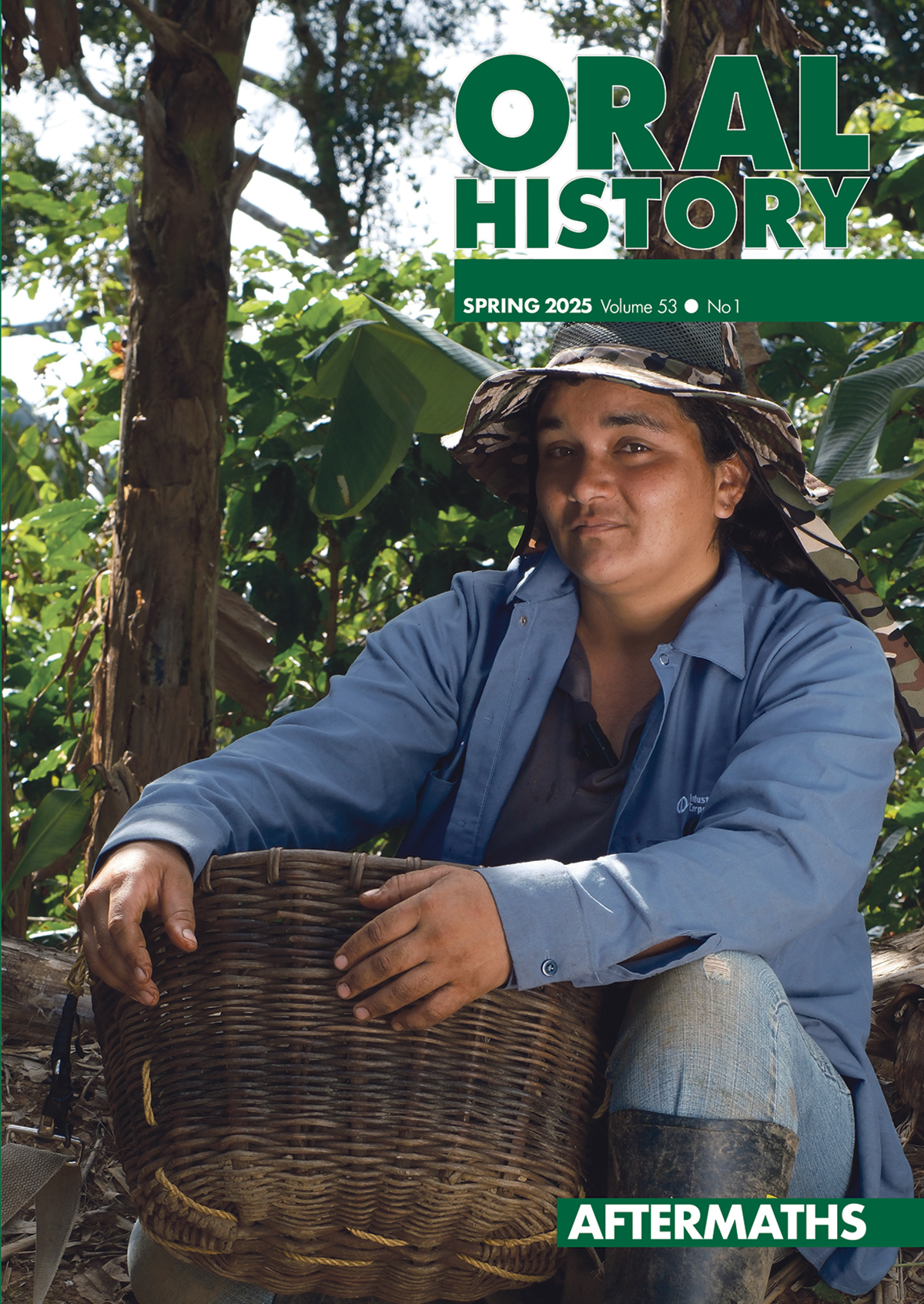
Aftermaths
Volume: 53, Issue: 1 (2025)
Articles
‘We have an affinity, Fiona, haven’t we?’: tracing intersubjectivity in oral history interviews with British nuclear test veterans and their descendants
This article explores my experience of interviewing British nuclear test veterans and their descendants. As the granddaughter of a test veteran, I consider how this position shaped the interviews that I conducted with veterans, who would often position their experiences and my understanding around my grandfather’s experience. I also examine how interviews with fellow descendants were predicated on my own health, which was used to frame a complex debate about the health consequences of Britain’s atmospheric nuclear testing programme. In this way, the article considers non-linear concepts of power which exist within oral history interviews and presents a nuanced understanding of intersubjectivity.
Author(s): Fiona Bowler
Keywords: intersubjectivity; emotion; health; nuclear testing
Going back: motives, meaning(s) and memories in British war veterans’ accounts of returning to the Falkland Islands
British veterans of the Falklands War of 1982 have returned to these remote islands in surprising numbers. Veterans’ return to sites of wartime service are seen as the opportunity for meaning-making in relation to their experiences and the rekindling or reinforcement of military camaraderie, and are often framed by Falklands returnees and veterans’ groups as having a therapeutic psychological benefit. This article contributes to a growing body of work that examines how former military personnel seek to interact with the places where they fought. It argues that, rather than seeking closure, many veterans return to contextualise and validate memories of their war within the war as a whole and, in doing so, recompose their memories.
Author(s): John Beales
Keywords: Falklands War; war veterans; pilgrimage; memory; composure
Skin disease: interrogating chronic illness through oral history
This article analyses the oral history interviews of Savithri Rajeevan, a poet grappling with hereditary psoriasis as well as fibromyalgia and spinal tuberculosis. The narrative intertwines personal experiences with cultural and historical contexts, notably the revitalisation of ayurveda (an alternative medicine system with historical roots in the Indian subcontinent) in the early twentieth century, illuminating its role in shaping India’s medical practices. It underscores the temporal and metaphorical imagination of illness reflected in Savithri’s poems and underlines the modes of subjectivity. The article argues for an inclusive approach to the history of medicine, advocating the consideration of diverse temporal constructions and narratives. Blending personal stories with historical insights, this work contributes to a holistic understanding of the intersections between individual health narratives, cultural contexts and evolving medical practices.
Author(s): Pooja Sagar
Keywords: medical diversity; pluralism; illness narratives; cultures of medicine; chronic disease; ayurveda
Conforming to or contesting the ideal? The ‘strong woman’ myth in the life-story narratives of Finnish second-wave feminists
One of the main demands of the second-wave feminist movement was to liberate women from the traditional role of housewife and allow them full access to the labour market. For many young feminist women of the 1960s and 1970s, these demands also represented their need to differentiate themselves from the women’s role of their mothers’ generation. In this article, based on oral history interviews, the identity of Finnish second-wave feminists is discussed by analysing the role of the myth of ‘the strong Finnish woman’ in their life-story narratives. The interviewees named their hard-working mothers as important role models for their feminist identity. However, their life-story narratives demonstrate how the myth conceals patriarchal power structures and the way in which feminist ideology has been an important source in defining their own identity as independent and strong women.
Author(s): Arja Turunen
Keywords: feminist identity; second-wave feminism; life story narrative; working-class; agrarian culture
Public History
‘Refugee Boulevard’: bringing Holocaust survivors’ post-war stories to Montreal’s streets
‘Refugee Boulevard: Making Montreal Home after the Holocaust’ is a multimedia oral history project. Consisting of an audio tour with an accompanying booklet and website, it tells the stories of seven child Holocaust survivors who arrived in Montreal’s St Urbain Ghetto in 1948. Rooted in a collaborative ethos, the audio tour explores how one neighbourhood enables a deeper understanding of survivors’ life stories. ‘Refugee Boulevard’ invites participants to share a physical, affective, historical and narrative journey so they can build their own connections with survivors as they hear their stories about movement and arrival as well as community coherence and dislocation. This article speaks to the strengths and challenges of the project’s collaborative process and how it shaped its results.
Author(s): Nancy Rebelo, Anna Sheftel and Stacey Zembrzycki, with Eszter Andor
Keywords: Holocaust survivors; Montreal, Canada; mobile methodologies; collaboration; place-based remembering; multimedia
Learning
Voices of Partition: unlocking the potential of oral history for teaching India’s independence and Partition
This article explores teachers’ and students’ experiences of using the online resource ‘Voices of Partition’, which launched in November 2022. These resources include oral histories and archival documents from the British Library which document some of the key events leading up to independence from British rule, creating the new states of India and Pakistan. We explore how teachers and students can consider the methodology of oral history and the questions these sources unveil. The article discusses the ways in which teachers and students have responded to the resources and the extent to which the richness and texture of the oral testimonies enable a more complex and nuanced understanding of Partition.
Author(s): Debbie Bogard, Chandan Mahal and Sara Patel
Keywords: Partition; archives; historical thinking; teacher development; web-based learning materials
Navigating precarity and ethical practice: an early career perspective of oral history in UK higher education
This article presents a series of personal reflections about ethical approaches to oral history from the perspective of a casualised early career researcher working in UK higher education. It explores the challenges of following an ethics of care approach to my postgraduate studies as I struggled to share authority with participants in a politicised research setting while navigating the pressures of academic precarity. Recent work has highlighted the need to defend the place of oral history in the academy. This article considers the extent to which the casualisation now entrenched in universities restricted my capacity as an oral historian for the time-consuming, self-reflective work essential to the rigour of our discipline. It argues for more open reflections on the influence of precarity in research processes as a vital step towards challenging its impact over oral history.
Author(s): Isabelle Carter
Keywords: ethics of care; casualisation; precarity; UK higher education; early career research; stigmatisation
Reviews
Feminist Lives: Women, Feelings, and the Self in Post-War Britain
Author(s): Lynn Abrams
Sound Writing: Voices, Authors, and Readers of Oral History
Author(s): Shelley Trower
Where Are the Fellows Who Cut the Hay? How Traditions From the Past Can Shape Our Future
Author(s): Robert Ashton
Politics of the Past: Inter-War Memories and the Making of British Popular Politics, 1939-2009
Author(s): David Cowan
Flowers through the Concrete: Explorations in Soviet Hippieland
Author(s): Juliane Fürst