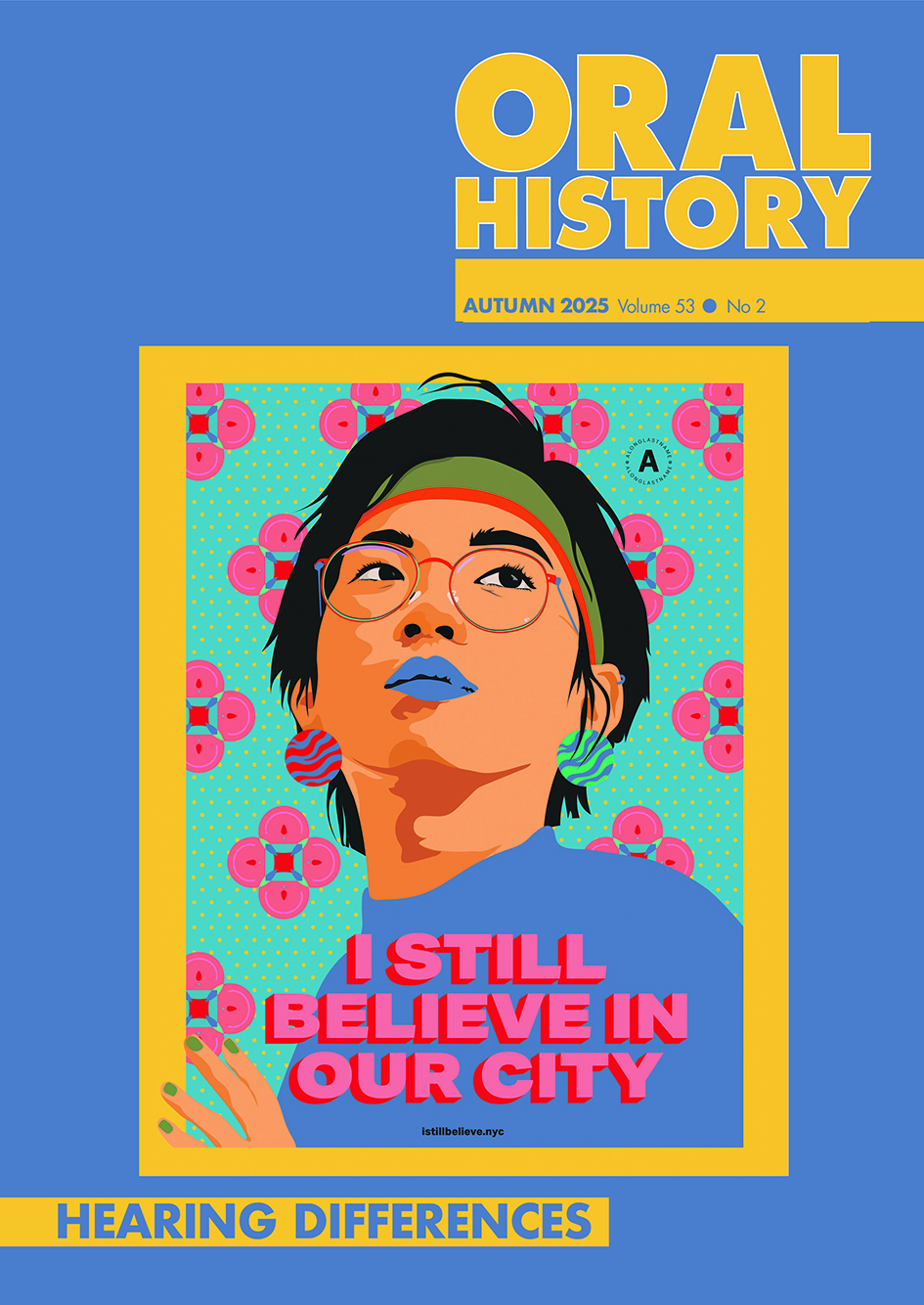
Autumn 2025
Volume: 53, Issue: 2 (2025)
Articles
Revisiting the orphanage: place, memory work and renegotiation of the past
This article focusses on orphanages as buildings and their significance in the memories and memory work of people with lived experience of institutionalisation. Based on oral history interviews with former residents and inspired by phenomenological studies of memory and materiality, this article explores the tangible bodily and narrative processes that take place during and after revisits. We argue that the revisits involve a confrontation with the socialisation that was enacted within the buildings and thus enable a renegotiation of the self. The article contributes to oral history by conceptualising and illustrating the importance of place for situated memory practices and memory work.
Author(s): Stine Grønbæk Jensen and Jacob Knage Rasmussen
Keywords: childhood memories; memory work; institutionalisation; orphanages; revisits
A people’s archive of food memories: oral histories from India in pandemic times
In spring 2020, we faced a challenge of completing oral interviews on changing food cultures in India’s capital, Delhi, in a context of political upheaval and the Covid-19 pandemic. Our response was to conceive a ‘People’s Archive of Food Memories’, by which ‘student ethnographers’ from a local college were recruited and trained online to gather oral histories at home from family members in lockdown. The focus here is methodological, emphasising the opportunities and challenges of this improvised approach in terms of the interview sample, trust and intimacy, research outputs and the families involved. Defining the archive are migrant food histories that come alive through an attention to cooking and eating, not just as subsistence but as sensuality, pleasure, caring and belonging.
Author(s): Siobhan Lambert-Hurley and Saumya Gupta
Keywords: India; food; migration; pandemic; Delhi
‘Des blancs comme vous’: intersubjectivity and colonial nostalgia in Congolese memories of Lovanium University
This article explores the potential and limits of my efforts, as a young Belgian researcher, to gain an understanding of Congolese memories of Lovanium, the first Congolese university (1954). By reconsidering my interviews with former students of medicine about how they experienced their alma mater, I uncover not only the memories they shared, but also why and in what context they remember. The article argues that the complex intersubjectivities at play during my interviews generated recollections that exist within a colonial discourse which still resonates within the academic community of Kinshasa. This underscores the broader challenge of critically integrating oral material to create nuanced and balanced histories of late Belgian colonialism.
Author(s): Reinout Vander Hulst
Keywords: Belgian Congo; colonial medicine; higher education; imperial intermediaries; Luc Gillon
‘Things change, don’t they?’ De-industrialisation, working-class solidarity and gender in the life story of a shipyard wife
This article considers the under-represented experience of women living in shipyard communities of North East England during and after the de-industrialisation disputes of the 1980s. While this period is mostly remembered for the 1983-1984 miners’ strike, other heavy industries faced challenges at the same time. Two wives of shipyard workers were interviewed in a 1984 film campaigning against shipyard closures. One of these women, Sandra Cuskin, was more recently interviewed twice to reflect back on that period and her life as a whole, bringing the historical moment of the shipyard closures into broader perspective. This article considers the ways that working-class women have negotiated and renegotiated gender roles and expectations alongside the men in their lives across the turn of the twenty-first century.
Author(s): Alison Atkinson-Phillips
Keywords: North East England; women; feminism; activism; film
Resisting oral history’s silence on youth
How does oral history sound different when seen through the eyes of children and young people? How is it different if those young people are involved in co-producing, collecting and creatively sharing their own sources? This article reflects on these questions by drawing on a case study of the accounts of young people from a UK HIV oral history collection (Positively Spoken, 2021-2023). Through an analysis of project processes, young people’s oral history extracts and reflections on involvement, it shares learning about how transitioning oral history towards meaningful youth participation challenges the wider system. It seeks to further extend questions about oral history’s sonic focus on older age groups, resisting a sonic silence on young people’s voices in the archives.
Author(s): Wendy Rickard, Mustafa D, Amanda Ely, Eli Fitzgerald and Ruth M
Keywords: young people; children; HIV; co-production; participation
Public History
On the street: empowering marginalised voices through ‘Hear, Here’
‘Hear, Here’ is an innovative audio-documentary project utilising oral histories to insert under-represented narratives into urban space. By calling a dedicated phone line displayed on a street sign, a passer-by can engage with the hidden histories of their neighbourhood. The act of presenting marginalised voices challenges conventional historical records which are dominated by Christian, white, elite, heteronormative and settler-colonial narratives. Using open-access technology, ‘Hear, Here’ democratises storytelling and fosters community engagement and critical dialogue. Its global expansion underscores its adaptability and capacity to mobilise social change by confronting uncomfortable truths and promoting inclusivity through oral history. Ultimately, ‘Hear, Here’ serves as a vanguard for the scholarly exploration of storytelling and technological mediation in forging a more equitable societal landscape.
Author(s): Ariel Beaujot, Joëlla van Donkersgoed and Michelle A Hamilton
Keywords: audio-documentary; public history; urban landscape; street intervention; democratisation
Learning
Covid-19 Asian American Oral History Project: reflecting on identity and oral history at a community college
In this article, I share narrators’ stories from the Covid-19 Asian American Oral History Project based at LaGuardia Community College, CUNY, to illustrate how Covid-19 and increased anti-Asian hate during the pandemic shaped Asian American and Pacific Islander (AAPI) identities in Queens, New York. Narrators’ stories shed light on how Black Lives Matter impacted their own understanding of race and racialisation, particularly as AAPI identity and race relate to the Model Minority Myth. This project also laid the groundwork to develop a broader oral history culture at the college, developing faculty pedagogy to incorporate oral history interviews and interviewing into their curriculum.
Author(s): Thomas Cleary
Keywords: community colleges; Asian American; New York City; Covid-19
Reviews
Emotional Labour in Oral History Research: The Hidden Toll
Author(s): Jennifer Harding and Verusca Calabria
Community Relations and the Troubles in Northern Ireland: A Policy History
Author(s): Joana Etchart
Refugees and Forced Displacement in Northern Ireland’s Troubles: Untold Journeys
Author(s): Niall Gilmartin and Brendan Ciarán Browne