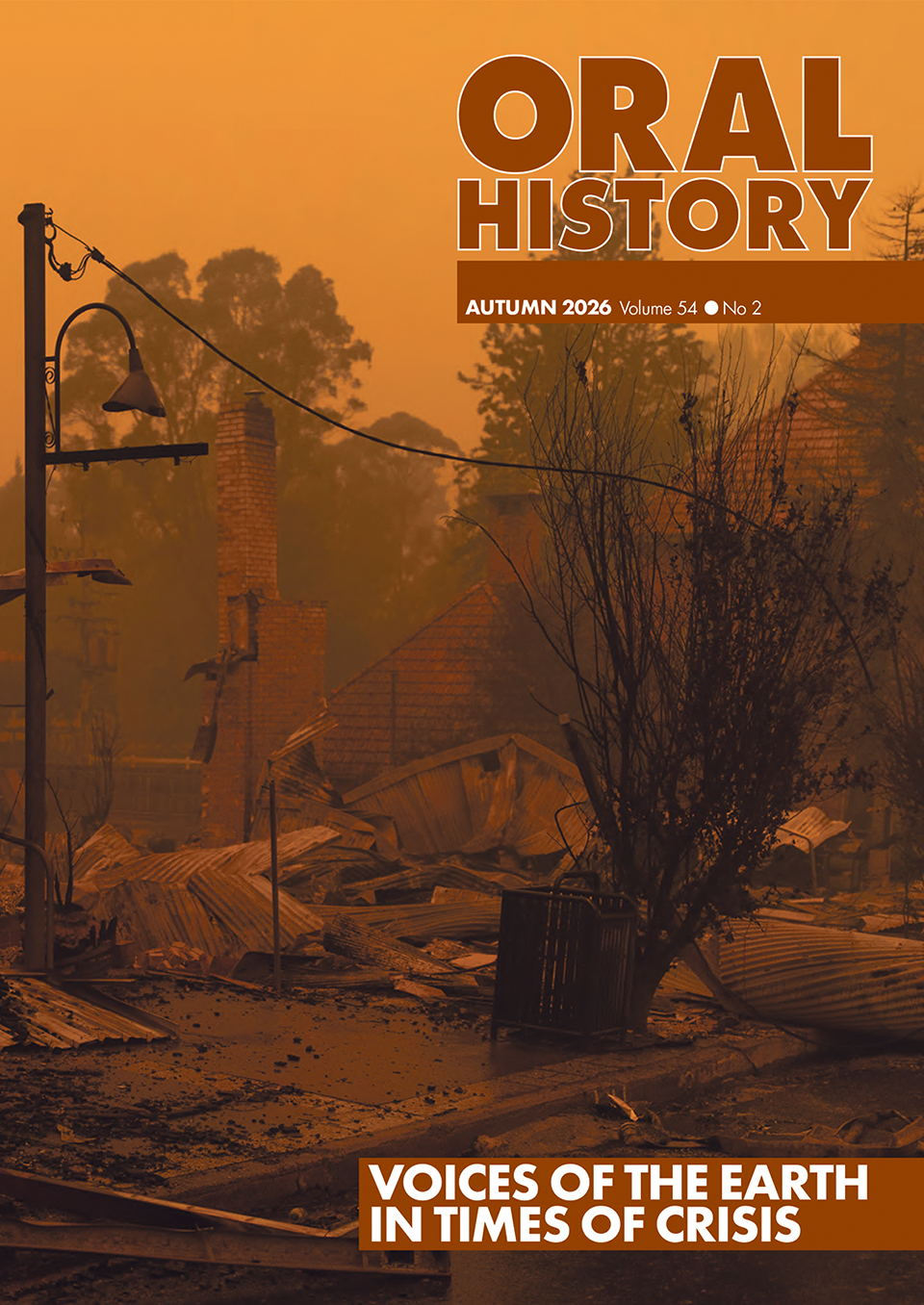
Voices of the Earth in Times of Crisis
Volume: 54, Issue: 2 (2026)
Articles
Community resilience and traditional ecological knowledge: narratives of a traditional erva-mate system in southern Brazil
Environmental oral history provides an epistemological and methodological framework for examining how rural communities build resilience in the face of socio-environmental transformations. This article analyses the experiences of family farmers who maintain traditional and agro-ecological erva-mate systems in southern Brazil. Faced with pressure from agribusiness and the expansion of conventional high-productivity monoculture, these communities mobilise intergenerational knowledge and adaptation strategies that guarantee the preservation of biodiversity and maintenance of traditional ways of life. Through environmental oral history, this study highlights the centrality of community narratives in constructing environmental memories and identities as well as the formulation of sustainable alternatives to the predatory logic of the contemporary global market.
Author(s): Robson Laverdi, Evelyn Roberta Nimmo and Alessandra Izabel de Carvalho
Keywords: environmental history; agro-ecology; climate change; memory; GIAHS
Oral history and climate change: testimonies of weirding
It is clear from scientific evidence that human-induced climate change is now upon us. The weird and powerful effects are felt by all of us, although to very unequal degrees. For some, those effects are already traumatising. This article argues that testimony from many parts of the world may go beyond the scientific data in raising awareness of how the climate crisis is having profound impacts on the way humans live, work and feel. It may also play a part in helping people adapt to the changes that are coming, mitigating some of the worst effects of environmental degradation.
Author(s): Rib Davis
Keywords: environment; climate change; emotions; identity; trauma; fossil fuels
Eating in crisis: social capital and post-disaster food security
How do we eat in the aftermath of disaster when our access to food, preservation, systems of procurement and means of communicating are undermined? This article posits that mutual aid organisations grow from personal, intergenerational, hyperlocal or granular systems, those that exist beyond the more visible established organisations with boards and budgets. Interviews recorded by members of the Oral History Lab at the University of Puerto Rico at Mayagüez trace the development of such organisations to histories of social capital, reciprocity networks and an ethics of care at the community level that is transformed by needs that are often left unaddressed by the government. Beyond hundreds of years of colonialism and inter-related environmental racism shaping the lived experiences of its people, the Puerto Rican archipelago has been facing a series of stratified disasters – those layered on top of each other – since the 2017 rapid-succession landfalls of Hurricanes Irma and María, which were followed by an earthquake swarm, Covid-19 and additional climatological events set against a backdrop of government corruption and economic depression. How did mutual aid organisations that formed or dramatically scaled up their work in the aftermath of disaster adapt to the new needs of other crises? One answer lies in tracing the roots of mutual aid work to the social capital that their leadership built in their families, religious communities and educational experiences. This article draws on three interviews with mutual aid organisers to understand how food security is cultivated even in states of chronic crisis.
Author(s): Ricia Anne Chansky
Keywords: Puerto Rico; mutual aid; climate; women; reciprocity networks
Stories of ice and snow: oral tradition, assemblage and Arctic resilience in the face of a changing climate
In early twentieth-century Arctic Canada, Vilhjalmur Stefansson and his Inuit guide Natkusiak (Billy Banksland) developed a collaborative partnership grounded in mutual respect. Focussing on the Stefansson–Anderson Expedition (1908-1912) and the Canadian Arctic Expedition (1913-1918), this article draws on Natkusiak’s oral traditions, Stefansson’s publications and family oral history to argue that Inuit survival practices, hunting expertise and environmental knowledge were essential to expedition success. Using assemblage as an analytical framework, the article examines how knowledge emerged through relationships among people, animals, tools and the environment while highlighting the contemporary relevance of Indigenous knowledge for Arctic climate challenges.
Author(s): Roxanna Banksland
Keywords: assemblage; Arctic exploration; Inuit knowledge; Natkusiak; climate change
Urban flood memories in a new realm: resilience of riverine communities before and after the 2015 Samarco disaster, Brazil
Rivers and cities constitute complex, dynamic systems that interconnect materially and symbolically in an urban-fluvial socionature. In Governador Valadares (Brazil), urban floods are vivid experiences etched in the memories of the riverine dwellers. This article draws on those memories to understand the social dynamics of resilience, aid, solidarity and trauma associated with the Rio Doce floods, by comparing descriptions of living experiences of flood before and after the Samarco mining disaster on the Rio Doce of 5 November 2015.
Author(s): Bruno Capilé, Patrícia Falco Genovez, Eunice Sueli Nodari and Lise Fernanda Sedrez
Keywords: memory; floods; riverine communities; Rio Doce; Samarco disaster; Governador Valadares
Public History
The Badja Forest Road Fire oral history project: narratives of community action, agency and climate change during Australia’s Black Summer bushfires, 2019-2020
Between December 2019 and January 2020, Australia’s devasting Black Summer bushfires reached their horrifying apex during the country’s hottest and driest recorded year. The deadliest bushfire was the Badja Forest Road Fire, with significant loss of lives, habitat and property. In the devastating aftermath, the fire-affected communities were subjected to relentless media attention. This article analyses a collaborative oral history project between impacted communities and the National Library of Australia between 2022 and 2023. It explores the ways impacted communities utilised oral history to foreground community agency and considers diverse climate change narratives. It investigates ways that both resilience and trauma intersect in oral histories and considers what this unique project reveals about ecological best practice during climate crisis.
Author(s): Shirleene Robinson and Scott McKinnon
Keywords: bushfire; wildfire; climate crisis; disaster recovery
Learning
Building narrative alliances with climate disaster survivors
Climate change has frequently been framed as a global environmental problem that will happen in the future, creating a psychological distance described as a barrier to climate action. Oral history can reframe it as a local human problem happening now. Yet existing oral history frameworks have not fully conceptualised how trauma connected with the human aspects of climate change should shape that work. This article describes a theoretical framework grounded in psychiatrist Judith Herman's four stages of trauma recovery that creates the conditions for a narrative alliance – one in which narrator and interviewer become allies in the socio-political aims of recovery – and demonstrates how providing narrator control operationalises that framework.
Author(s): Sean Holman, Aldyn Chwelos, Francesca Fionda, Sandra Engstrom and Maria Vukovich
Keywords: climate change; weather-related disasters; shared authority; trauma-informed practice; literary journalism
Reviews
REVIEW ESSAY: Listening on Earth
Author(s): Deb Anderson
HANDBOOK OF GLOBAL ORAL HISTORY Brill, 2026, 710pp, £169.48, hardback
Author(s): Mark Cave and Selma Leydesdorff (eds)
LISTENING ON THE EDGE: ORAL HISTORY IN THE AFTERMATH OF CRISIS Oxford University Press, 2014, 316pp, £40.49, paperback.
Author(s): Mark Cave and Stephen M Sloan (eds)
TELLING ENVIRONMENTAL HISTORIES: INTERSECTIONS OF MEMORY, NARRATIVE AND ENVIRONMENT Palgrave Macmillan, 2017, 344pp, £99.40, paperback.
Author(s): Katie Holmes and Heather Goodall (eds)
THE LAND SPEAKS: NEW VOICES AT THE INTERSECTION OF ORAL AND ENVIRONMENTAL HISTORY Oxford University Press, 2017, 322pp, £41.99, paperback.
Author(s): Debbie Lee and Kathryn Newfont (eds)
ORAL HISTORY AND THE ENVIRONMENT: GLOBAL PERSPECTIVES ON CLIMATE, CONNECTION AND CATASTROPHE Oxford University Press, 2023, 320pp, £25.99, paperback.
Author(s): Stephen M Sloan and Mark Cave (eds)