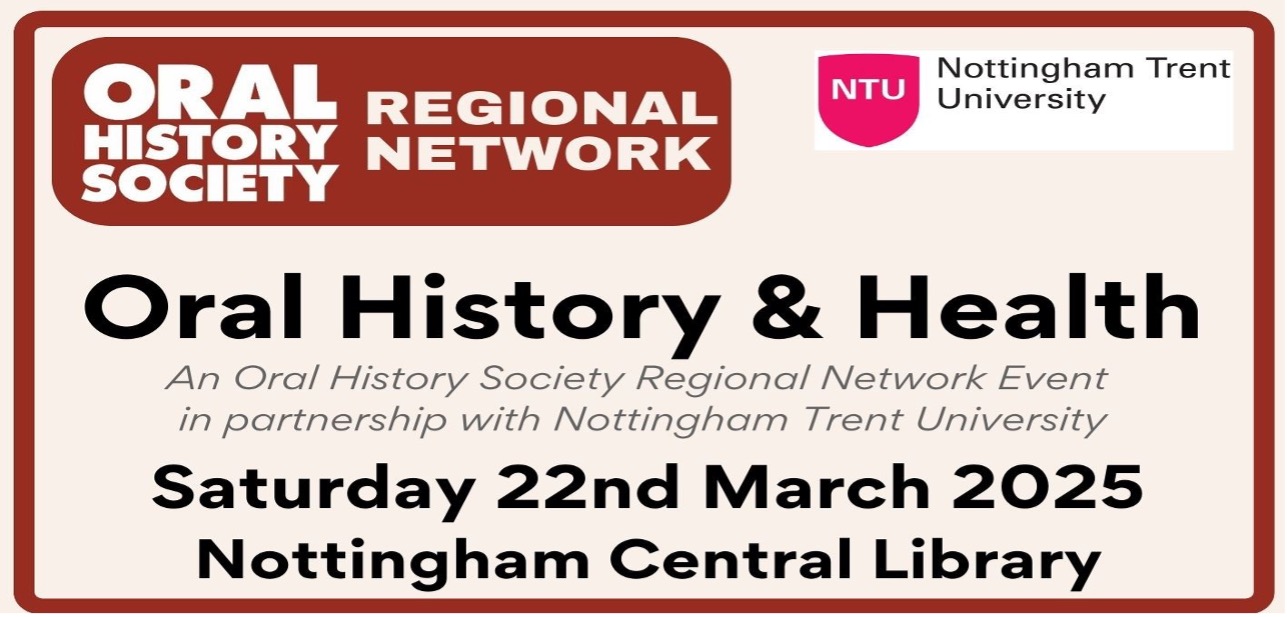
Oral History & Health: an Oral History Society Regional Network event in partnership with Nottingham Trent University
Venue: Room 7, Nottingham Central Library, Carrington Street, NG1 7FH
Programme (DRAFT)
| 9.45am | Arrival & Refreshments |
| 10.00am | Welcome
Juliana Dempsey & Sarah Gudgin, OHS Regional Network |
| 10.10am
|
Coproducing Mental Health Histories
Dr Verusca Calabria, Associate Professor, Nottingham Trent University |
| 11.00am | Coffee break |
| 11.20am | Understanding oral history in palliative and supportive care using constructivist grounded theory research
Dr. Sam Smith, University of Sheffield Concealed trauma in oral history Martin Bisiker, Founder of the Legasee Educational Trust |
| 1.00pm | Lunch* & Networking *Lunch not included |
| 2.15pm | Healing Dialogue: Oral History as a (Potential) Tool in Mental Health Recovery
Ms Nicola Benge, Hidden Histories |
| 2.55pm | Comfort break |
| 2.55pm | Reflections & Discussion |
| 4.00pm | End |
Session Details:
Coproducing Mental Health Histories
Dr Verusca Calabria, Associate Professor, Nottingham Trent University
This session aims to illustrate how a participatory oral history project that embraced the arts enabled people with long-term psychiatric disabilities to improve their capabilities while also learning new skills. ‘Fifty Years of Middle Street Resource Centre: the Heritage of Wellbeing’ explored and documented the rich and hidden heritage of a mental health day centre in Nottingham in partnership with service users, staff, volunteers and young people. The co-produced outputs, including artwork, exhibitions and a film documentary, have helped to bring about positive behaviour change, not only by improving the wellbeing of participants with lived experience of mental illness but also by changing perceptions of mental health and care in the wider public. The session will evidence how people with psychiatric disabilities took ownership of the research by actively shaping the content and nature of the outputs through coproduction. The short film documentary showcasing the project can be viewed here: https://www.mentalhealthcarememories.co.uk/documentary.
Understanding oral history in palliative and supportive care using constructivist grounded theory research
Dr. Sam Smith, University of Sheffield
In this presentation Sam discusses working as an oral historian in palliative and supportive care and how his PhD develops a grounded theory for understanding the topic. He explains the different steps he took for his PhD, starting with conducting a literature review and deciding on the constructivist grounded theory approach as a qualitative research method. He then discusses his study, the coding processes for analysis, and findings. Finally, he discusses his grounded theory and explores how it could be used in practice by oral historians and health care professionals. For the research he conducted research interviews with oral history service participants, their volunteer interviewers and the referring health care professionals. The research was the first to look at how oral history is experienced at the end of life from various perspectives and offers a deeper understanding for the wider oral history community about conducting interviews in these sensitive settings.
Concealed trauma in oral history
Martin Bisiker, Founder of the Legasee Educational Trust
Martin Bisiker will discuss moments when hidden traumas surfaced during his interviews with civilians and military veterans. He will reflect on the impact these moments had on both himself and the interviewees. How do viewers perceive these emotions, particularly when comparing the emotional expressions of men and women?
Recommended previewing: The Veteran’s Voice – filmed interviews with British military veterans
Healing Dialogue: Oral History as a (Potential) Tool in Mental Health Recovery
Ms Nicola Benge, Hidden Histories
The talk, The Healing Dialogue: Oral History as a Tool in Mental Health Recovery, will explore the role of oral history in supporting mental health recovery through the Living Histories project, a project embedded in a mental health NHS Trust. This project documents the personal stories of mental health service users and staff, spanning from the closure of old asylums in 1990 to the impact of the Covid pandemic in 2020. The presentation will highlight how these personal narratives offer deeper insight into mental health care, emphasising empathy, healing, and resilience. It will address trauma-informed practices, including creating a safe environment for participants, ensuring informed consent, and managing capacity challenges for oral history interviewers. The talk will also share insights into the project’s adaptation to delays, the ethical complexities of oral history, and the lessons learned from collaborating with interdisciplinary teams, touching on the creative development of the oral histories into podcasts, exhibitions and resources. Attendees will be encouraged to consider how oral history can be integrated into their own work in health fields to offer learning, foster understanding and healing.