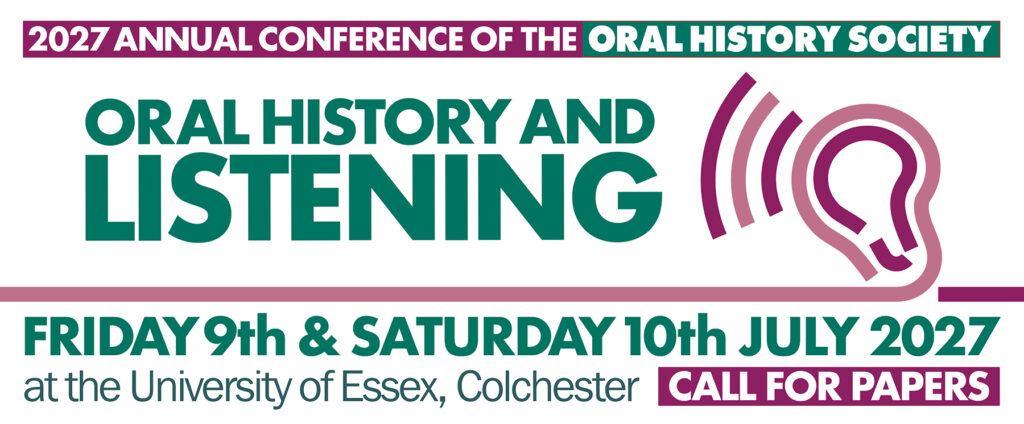
CALL FOR PAPERS
for next year's conference
at the University of Essex
9 - 10 July 2027
Put the date in your diaries!
2027 Annual Conference of the Oral History Society
Oral History and Listening
FRIDAY 9th & SATURDAY 10th JULY 2027
an in-person conference at the University of Essex, Colchester
Listening underpins oral history practice, but we rarely bring it to the forefront of our discussions in the oral history community. This conference attempts to redress this by centering listening as its key theme. We use the term ‘listening’ in the broadest sense that includes visual and physical communication and language, such as sign language and lip reading.
We aim to explore the listening encounter in all aspects of oral history work: research, interviewing, analysis and project outputs, transcription, archiving, and re-use across time. How and why do we listen? What skills do we use and how has this changed with technological advances? And – in an increasingly ‘noisy’ world – how do we encourage others to listen? We welcome oral historians from all backgrounds and levels of experience to discuss and reflect together.
The two-day conference will be at the University of Essex – an iconic place for oral history in the UK and around the world as the institutional base of the Society and journal for our first three decades.
Potential themes/topics for discussion and presentation include:
Listening in the interview encounter
What skills do we need and how do we develop them? How do interviewees describe the sense of listening as they narrate? How do we listen across differences? What do interviewees think about being the focus of intense listening in oral history? What do we do when it is hard to listen (and hard for interviewees to think they will be listened to)? How is listening connected to ‘sharing authority’? How do we listen with our ‘full body’ in the interview, such as gesture and expression?
The impact of listening
Listening to interviews on difficult topics – as the interviewer, researcher or archivist – can have profound effects. How do we look after our own wellbeing when undertaking this kind of oral history work? What skills can we draw on to ‘listen to ourselves’ in tricky interview situations as we face dilemmas in shaping our questions – and how can/should these interviews be shared more widely?
Listening when documenting
With the advent of AI which can render audio into increasingly accurate text, what does this mean for the skilled art of transcription? What can experienced transcribers bring to our practice through their listening skills? Are there ways to ethically incorporate AI tools into the documentation workflow?
Listening to a body of interviews
How do we analyse a collection of interviews: what techniques can we use to find patterns and whose voices are not included/listened to? Can new technology help? AI-based large-scale search methods can offer opportunities by revealing material for analysis and deep listening, but can these methods also discourage listening by rendering oral sources into text? And what is lost in the process?
Listening across time
We welcome those exploring the re-use and secondary analysis of oral history, the perspectives of archivists, and those examining the politics of listening across time. How do we ethically listen and judge past worlds, language and social contexts with our ‘contemporary ears’? How is listening affected by the particular moments in time we inhabit, both during and after the interview? How have developments in technology changed the listening experience over time – and what impact has this had for interviewees, interviewers, researchers and those working in archives?
Exploring the listening experience
How can we promote listening in public settings: in teaching (in schools, higher education and beyond), museums, the media, campaigning and policy making? What are the ethics involved in listening to oral history in these diverse contexts? How do we incorporate reflective listening in these settings: full interviews, clips, audio montages, podcasts? How do we avoid listening out of context? How do projects encourage intergenerational listening, or listening across generations and divides?
Listening to each other and the wider world
Where is oral history now and what unites us as a discipline/research method/movement? How do we best strive to listen to each other – and why is this important? Social media has transformed the ways we often communicate with each other and engage with the world. Do oral historians have a responsibility as the ‘ears of the world’ to bring about change and a better understanding of the past that drives our societies?
PROPOSALS
The deadline for submission of proposals is Monday 25th January 2027.
Each proposal should include a title, an abstract of 250-300 words, your name (and the name of any co-presenters, panellists etc), your institution or organisation (if applicable), your email address, and a note of any special requirements. Abstracts should demonstrate how the paper would as far as possible include illustrative extracts or clips of oral history materials. You may also wish to submit a proposal for a panel.
We are looking for a wide variety of contributions delivered in a variety of formats. We would encourage contributors to submit abstracts addressing the conference themes, presented as talks, workshops, theatre, film/photography, art, or other kinds of installations. Please think about what format might work best for you and your work.
As usual, we welcome proposals for individual papers and for panels, including from community groups and oral historians working outside of universities.
- Please submit your proposal via the online submission form. Proposals will be assessed anonymously by the conference organisers. Presenters will be contacted by the end of March 2027.
ORGANISING GROUP: Adam Bell, Rib Davis, Tracey Loughran, Sarah Lowry, Kate O’Neill, Rob Perks, Rosa Schling, Mary Stewart, Amy Tooth Murphy, Michelle Winslow.