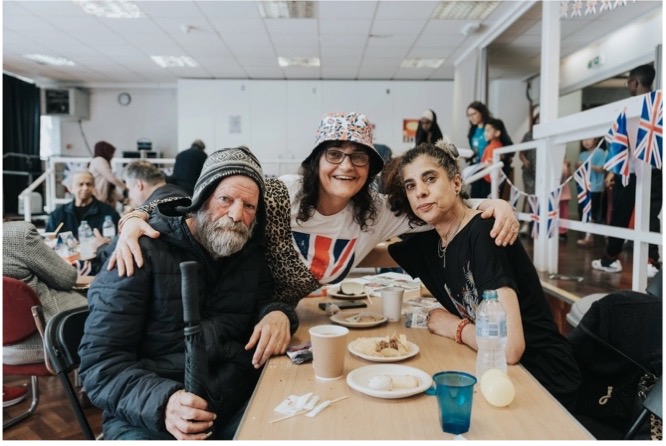
Featured image: Coronation Party, 2023. Photo: Adam Rowley
For a further discussion of the project and the issues raised in this post please see ‘Intersecting Lives: class community and change on the Andover estate’ Oral History 54/1 Spring 2026 by John Gabriel, Gulser Rose Kaya and Alya Khan.
Oral history is often framed as an act of preservation: recording stories, archiving voices, and protecting memories from loss. This work is vital, particularly for communities whose histories have rarely been heard or valued. Yet the Life on the Andover Estate project shows that preservation is only the starting point. In addition to forty oral history interviews, conducted between 2022-4, a number of films and photographs were commissioned. One short film of the estate gives a taste of the area and its residents. The project team have also published an article for the 2026 Spring issue OHJ.
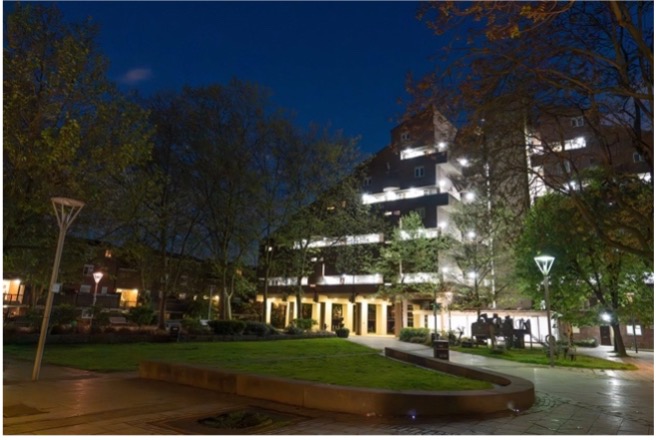
The OHJ article explores how class and community on a north London council estate have changed over time. What emerged from the project was an understanding of oral history not simply as a record of the past, but as a way of grasping how social change is lived in real time, how pressures accumulate, interact and are endured. Here you can listen to an interview extract in which one of the residents, Ashley (anonymised) talks about offering advice to parents whose children were getting into trouble with the police and courts. Such acts of solidarity formed the basis of new communal links amongst women of diverse heritage backgrounds.
The interviews with residents revealed the inseparable nature of class, gender, race, heritage and health. These experiences could not be neatly categorised. While quantitative data can identify patterns of deprivation, the oral history interviews show how those patterns are felt: managing insecure work alongside chronic pain, housing stress, caring responsibilities or experiences of violence.
Health emerges as a central thread in the interviews, deeply entangled with employment and housing. Many participants described not a single crisis, but a slow unravelling in which ill health undermined work, loss of income and destabilised housing, and ongoing insecurity worsened physical and mental wellbeing.
Alongside hardship, the interviews also spoke of routines of sociability, everyday pleasures, often recounted with humour. These experiences did not negate hardship, but existed alongside it and sometimes born of it, offering ways of enduring pressure and sustaining connections. Such accounts, reinforced by observational data collected during the course of the project, reveal how communities are actively made and sustained both in spite and because of a hostile enviornment.
Seen collectively, these stories make visible the systems shaping everyday life. The article in Oral History Journal has resisted a tendency to reduce interviews to abstract themes, instead presenting five individual narratives that hold both shared class experiences and significant differences shaped by migration, gender and health. This approach reflects the distinctive strength of oral history: its capacity to hold complexity.
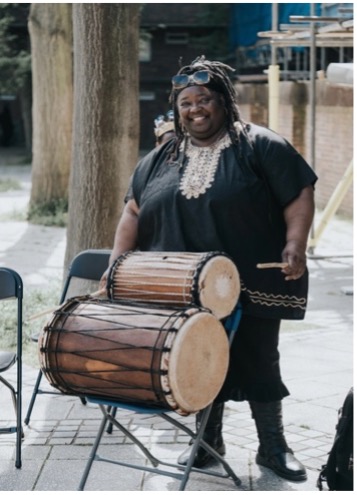
The Project team’s continued presence on the estate, through volunteering and collaboration with local organisations, helped to build trustful relations and create a listening process that felt reciprocal rather than extractive. Sharing insights back with participants allowed oral history to build relationships as well as knowledge. MJ’s account captures the intersection of gender and African heritage, and the significance of women’s mobilisation for change.
A theatre project, funded by the Arts Council, is further evidence of this continuing commitment to bring the stories to wider audiences of residents, politicans and other change-makers. Extracts from the interviews will used in a verbatim performance of ‘Life on the Andover Estate’ planned for the summer of 2026.
Intiatives, such as the theatre project, move us beyond the archive and raise questions of impact. If oral history is to inform policy or practice, this needs to be considered from the outset, without stripping stories of context or meaning. Change rarely follows from a single compelling account, but from many voices pointing towards the same pressures and possibilities. In this sense, oral history is not a finished product, but an ongoing practice, one that can help redistribute expertise and turn lived experience into meaningful change.
Going beyond the archive is important because preservation alone does not address the unequal conditions that shape whose lives are recorded, how those lives are interpreted, or what happens to those stories once they are deposited. When oral histories remain static objects, their political and social force is often blunted. For communities experiencing ongoing precarity, the value of telling a story lies not only in safeguarding memory for the future, but in whether that telling can shift understanding in the present, among institutions, policymakers, and professionals whose decisions continue to shape everyday life.
The Life on the Andover Estate project moved beyond the archive by treating oral history as a collaborative and relational process rather than a one-off act of collection. Interviews were embedded within sustained engagement on the estate, allowing conversations to develop over time and be informed by trust and familiarity. Analysis focused on presenting whole narratives rather than extracting isolated themes, and findings were shared back with participants and community partners. In doing so, the project positioned residents not simply as sources of data, but as holders of expertise whose lived experience offers critical insight into how social, economic and health inequalities are produced and sustained.