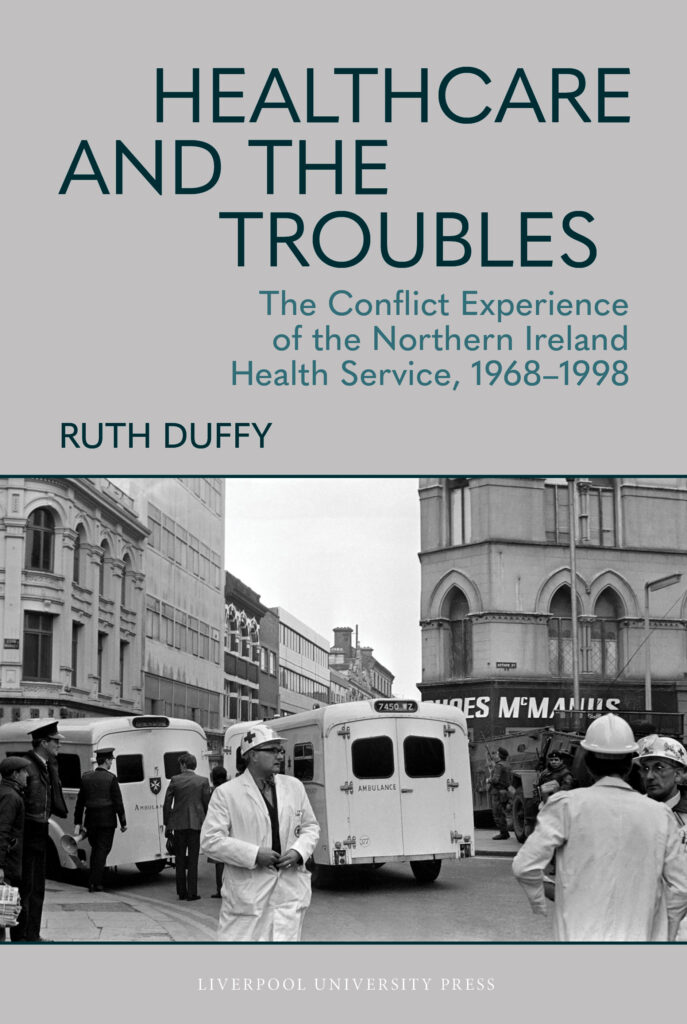
by Ruth Duffy
Liverpool: Liverpool University Press, 2024, 240pp, ISBN:9781837641444 (Hardback), £84
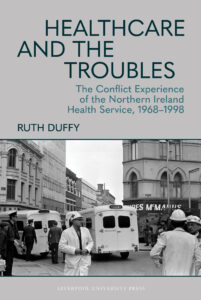
Histories of Northern Ireland and the Troubles have been dominated by studies on political and communal violence, constitutional questions and the main political players. The wider social and cultural impact of the Troubles remains relatively under-researched, although recent work on children killed, key workers such as firefighters and punk music helps to address this imbalance.[i] This original and excellent work is the first large‑scale study to examine the experience of healthcare professionals, arguing that their practice was shaped by dilemmas that challenged medical neutrality and ethics. In doing so, it makes a highly significant contribution to the history of Northern Ireland.
Methodologically, this work is based on oral history interviews with twenty-nine hospital workers including doctors, nurses, allied medical staff and administrators. Oral histories are challenging in a Northern Irish context, as was evident when testimonies of former paramilitaries collected in a project by Boston College were subpoenaed by the Police Service of Northern Ireland. More relevant to this work, oral histories are made difficult by the lack of a shared collective memory in such a divided society; also, oral evidence can be distorted by the biases of participants or retrospective knowledge of the past. Furthermore, Northern Irish interviewees’ evidence can be overly politicised or look to avoid perceptions of sectarianism. This book impressively addresses such challenges by handling oral evidence judiciously while also interweaving and testing testimonies with original archival evidence.
The book explores the ethical dilemmas faced by medical professionals in the National Health Service, in what many believed was a ‘war zone’. The period was marked by allegations of abuse of prisoners and the overuse of CS gas and plastic bullets by the authorities. Faced with these ethical controversies medics could stay quiet or speak out. Many medics remained silent and were undoubtedly aware of abuses, illustrated by one interviewee who believed that abuse of prisoners probably ‘wasn’t that bad’ (p102). Some medics were inevitably morally compromised, and their silence may be viewed as complicity in abuses.
Speaking out was often ineffectual, exposed individuals to attack, and could place medics in a precarious situation. Dr Irwin was a senior medic in the Castlereagh Holding Centre who raised concerns about the maltreatment of detainees in 1978-79. After airing his concerns publicly, Irwin suffered an insidious campaign in sections of the media which smeared his professional and personal life. Other medics did raise questions about the actions of the authorities, often independent of political or religious bias. This was evident when Protestant surgeons from the Royal Victoria Hospital presented research, initially suppressed by the government, demonstrating that rubber bullets were unsafe. As this work shows, speaking out was undoubtedly perilous, but some did come forward.
The work considers the neutrality of doctors during the Troubles when healthcare was inevitably politicised. Hospitals were legally bound to inform the authorities if they suspected a person had been injured or killed by a firearm or explosive device. Doctors had to manage legal demands alongside caring for patients, sometimes leading to arrests and the view that medics were informers for the state. In turn, nationalists often avoided hospitals such as in Derry/ Londonderry where those injured during riots travelled across the Irish border to county Donegal to receive medical treatment.
Hospitals could also be sites of conflict. Paramilitaries attacked patients and employees in hospitals, such as in 1977 when part-time member of the Ulster Defence Regiment and porter in the Royal Victoria, Gerald Tucker, was killed by the IRA in the hospital. Medics often treated paramilitaries in the presence of heavily armed police and soldiers. Located in the predominately nationalist and republican west Belfast, the Royal Victoria was the site of much violence. British Army posts at the rear of the hospital and on top of the nurses’ accommodation were subject to bomb and gun attacks. This made it impossible for medical facilities to remain a neutral space while also placing staff at risk.
It was in prison medicine that medical ethics were most severely tested. Medics faced a ‘dual loyalty’ dilemma, where obligations to patients often conflicted with responsibilities to their employers. Medics were forced to walk an ethical and legal tightrope as paramilitary prisoners and prison authorities became enveloped in battles about conditions and political status. The withdrawal of special category status for paramilitary prisoners in 1976 triggered a series of protests which escalated into ‘dirty protests’ where prisoners smeared excrement on their cell walls. With the protests considered to be a health hazard, doctors participated in ‘forced bathing’. Many prisoners believed this was a form of punishment, which further compromised doctors’ perceived neutrality.
The role of medical professionals in prison settings became even more pronounced during hunger strikes. Hunger strikes raised ethical dilemmas for medics whose Hippocratic Oath expects that doctors normally will not provide treatment against a patient’s wishes. Force-feeding was considered a form of torture by some medical ethicists and prisoners, while medics themselves were divided on the issue. The force-feeding of Irish republicans in English prisons, including the highly publicised case of the Price sisters, involved in IRA bomb attacks in London in 1973, and the death on hunger strike of another republican, Michael Gaughan, led to the Declaration of Tokyo in 1975, which deemed force-feeding unethical and reversed the government’s policy.
Force-feeding was not a feature of Northern Irish prisons, but the hunger strikes of the early 1980s, which resulted in the death of ten republicans, greatly strained medics. Many were severely impacted by watching over people who were slowly starving themselves to death, an experience considered a significant factor in the death by suicide of Dr Ross in 1986, who had overseen the care of many hunger strikers. Medics remained steadfast in refusing to administer treatment against a prisoner’s consent, intervening only at the request of the family once the individual had lost decision‑making capacity. There was also a general acceptance that medical attention provided to hunger strikers was of a high standard and overall prisoners viewed prison doctors more favourably than in the past.
The work’s focus on the impact of the Troubles on the financing of healthcare and service provision is the least developed aspect of the study . The Troubles aligned with major healthcare reforms including the integration of health services and personal social services in 1973, uniquely in Northern Ireland. The Conservative hegemony of 1979–97 in the United Kingdom is generally viewed as a watershed moment for the NHS, marked by restrained public spending, the imposition of market and business principles and the embedding of new public management. How these substantial reforms played out in the context of the Troubles is largely overlooked. This work’s real strength does not lie in a systems account of healthcare, but in its focus on front-line workers of this unprecedented period, and on how they experienced and navigated the complex ethical and moral dilemmas they faced.
[i] Frey McClements and Joe Duffy, Children of the Troubles: The Untold Story of the Children Killed in the Northern Ireland Conflict(Hachette Ireland, 2020); John Wilson, Firefighters during The Troubles: The Men and Women on the Frontline Tell their Stories(Belfast: Blackstaff Press, 2019); Fergus Roulston, Belfast Punk and the Troubles: An Oral History (Manchester: Manchester University Press, 2022).