By Jim Phillips
Edinburgh: Edinburgh University Press, 2024, 238pp, £14.99 (paperback), ISBN: 9781399536509
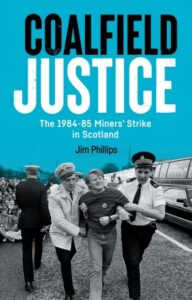
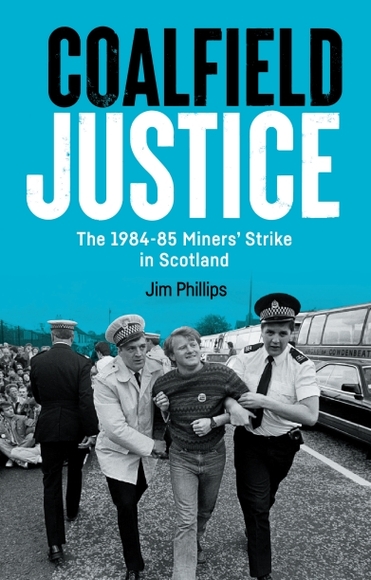
Among the many titles that have been published in the run-up to the fortieth anniversary of the British miners’ strike, Jim Phillips’ monograph stands out. Written by an eminent expert on Scottish labour history and the history of deindustrialisation, Coalfield Justice combines astute scholarship with deep political engagement. Chronological sections alternate with thematically arranged chapters, spanning the period from the onset of the coal crisis in the late 1950s to the early 2020s, with the 1984/85 strike and its long aftermath at the book’s core. Throughout, Phillips’ blend of authoritative empirical knowledge and conceptual clarity makes for fascinating reading, while the extensive use of oral history adds special poignancy to the narrative. Indeed, Phillips is as much an agent as a historian of the story told here. As both academic historian and committed citizen, he played an active role in the Scottish miners’ long struggle for justice following their bitter defeat at the hands of the British state in 1984/85, as becomes clear as the narrative progresses.
‘Justice’ is the organising principle of Coalfield Justice. The concept is employed both in a broad societal sense and in a more narrowly defined legal sense. In the first part of the book, ‘justice’ is understood in moral economy terms as fair management of social and economic change. Chapter one describes the history of the coal industry in Scotland before 1979 as a ‘just transition’ out of coal (p14). This was, Phillips argues, because the contraction under the Labour governments of Harold Wilson and James Callaghan was managed in a socially responsible manner, with the miners’ union as a respected and influential voice. The unwritten contract between the miners and the state did not last, however. With the advent of Margaret Thatcher’s neoliberal government in 1979, the miners’ collective voice was turned from legitimate partner into an ‘enemy’. Meanwhile, the moral economy of the coalfields was abrogated. Here, Phillips draws on the theorising of Marxist philosopher Antonio Gramsci to explain the policies of the Conservative government and the National Coal Board (NCB). The miners’ collective voice was delegitimised ideologically as part of the government’s ‘war of position’ while the powers of the state and the judiciary were used to wage a ‘war of manoeuvre’ against the miners (p44).
It was to defend the ‘moral economy’ of the Scottish coalfields that the miners engaged in ‘legitimate and lawful’ strike action in March 1984, the book argues (p43). Unlike in England and Wales, the strike was declared legal in Scotland, and besides carried ‘overwhelming moral authority’ across the United Kingdom (p69). As chapters three to six demonstrate, striking miners suffered social, economic and legal injustices at the hands of NCB management, the Conservative government and the British state — at mass-picketing flashpoints such as Ravenscraig steel works, Hunterston coastal terminal and Orgreave in Yorkshire; at their own colliery gates, and most painful of all, as a consequence of the NCB’s Return to Work campaign, in their own communities. Indeed, as Phillips shows, despite the legality of the strike in Scotland, the criminalisation of strike activists by the authorities was particularly pronounced. Police arrests and convictions were regularly followed by workplace dismissals, thus turning relatively minor incidents into life-changing events for the striking miners. A clear pattern was discernible of the authorities singling out union leaders and strike activists to undermine the morale of the strikers.
Chapter seven details the accelerated rundown of the industry after the miners’ return to work in March 1985, while the concluding chapter chronicles the strike activists’ long fight for public recognition for the injustices that they suffered in 1984/85. It is in this final chapter that Phillips’ dual role as historian and participant becomes most apparent. Together with fellow historian Ewan Gibbs, Phillips supported the activists’ quest for justice in numerous ways, for example by discussing the historical evidence with government officials (p190). His close identification with the cause is underlined by the use of the collective pronoun ‘we’ when speaking about the campaign (p161). An important victory was achieved when the Miners’ Strike (Pardons) (Scotland) Bill was finally passed by the Scottish parliament in the autumn of 2022.
The narrative moves skilfully between the national, the regional and the local, balancing analytical passages with rich empirical detail, often drawn from powerful oral testimony. As Phillips explains in the introduction, thirty-seven interviews were used for the book, some of which were recorded by Willie Thompson in the immediate aftermath of the strike while the majority were conducted by the author over two periods between 2009 and 2011 and (with Robert Gildea) between 2021 and 2023. While paying tribute to the work of colleagues, the book makes an important and original contribution to our understanding of the 1984/85 strike and the history of de-industrialisation. Although the focus is on Scotland, Coalfield Justice offers important qualifications to more general histories, particularly in the assessment of the Labour governments of the 1960s and 1970s, the legitimacy of the national strike, and the link between de-industrialisation and the rise of authoritarian populism in the twenty-first century. It bears some resemblance to Huw Beynon & Ray Hudson’s The Shadow of the Mine (2021) and Robert Gildea’s Backbone of the Nation (2023) but is distinct in both geographical focus and argument. Indeed, Phillips engages vigorously with the work of Beynon and Hudson, offering important qualifications to their argument about the link between de-industrialisation and the collapse of the Red Wall in the general election of 2019. In the Scottish coalfield, anger over the dismantling of the nation’s industrial base was channelled into progressive nationalism rather than populist xenophobia, as Phillips points out.
Coalfield Justice represents engaged scholarship, and very consciously so (p6). Phillips makes clear throughout which side he is on: his sympathies lie with Scotland’s striking miners, and, in particular, their activist core, referred to throughout the text by first names. Those looking to understand the motivations and experiences of non-striking miners (referred to as ‘strike-breakers’ in the text), and of those who returned to work before the strike was called off, will have to look elsewhere. Likewise, we learn little about the daily routines of the non-activist strikers, of the many who, in miners’ leader Peter Heathfield’s words, ‘hid behind their lace curtains’, or of other bystanders in coalmining communities. Phillips contends in the introduction that ‘strike-breakers are hard to reach’ and that in Scotland at least, they were outsiders (p6). In any case, due to Phillips’ ‘fundamental sympathy with the aims of the strikers’ (p6), the book was never intended as a comprehensive history of the strike, warts and all, so one should not quibble too much here.
Scottish miners’ leader Mick McGahey’s famous adage that a ‘movement that stops moving becomes a monument’, receives repeated tribute to in the text. In this spirit, the book is perhaps best understood as both: as a monument to the integrity, courage and perseverance of Scotland’s striking miners, and as a contribution to an ongoing movement for social justice — in the former coalfields and all across the world where ordinary people resist their victimisation by the powers that be. Coalfield Justice deserves a wide readership.