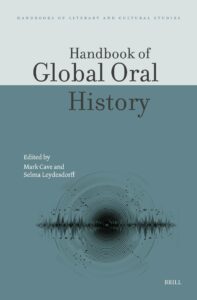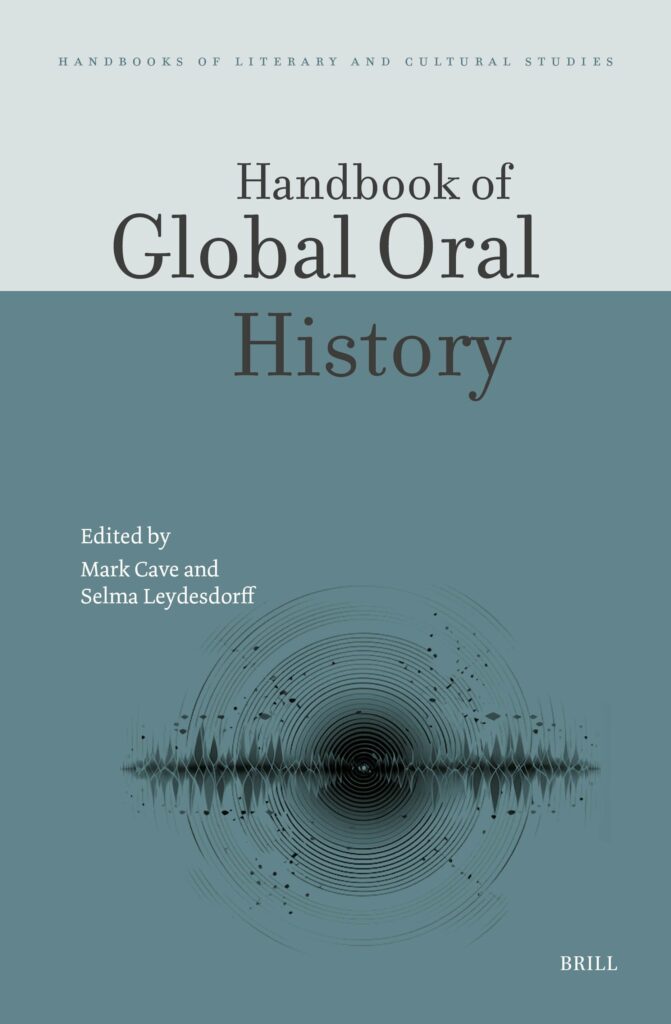
Mark Cave and Selma Leydesdorff (eds), Leiden & Boston: Brill, 720 pp, £169.60, hardback.
When the introductory chapter of a book featuring the global nature of oral history draws inspiration from a Nobel prize winner, it is impossible for the reader not to engage. Ukrainian born oral historian Svetlana Alexievich was awarded the prestigious accolade in 2015. In an excerpt from her acceptance speech quoted by editors Mark Cave and Selma Leydesdorff, the laureate characterises her work as collecting ‘the everyday life of feelings, thoughts and words […] the life of my time […] the everyday life of the soul, the things that the big picture of history usually omits or disdains […] In telling a story, humans create, they wrestle with time like a sculptor does marble’ (p2). For Handbook of Global Oral History this represents a powerful statement of intent.
Throughout this illuminating text, the contributors not merely sustain but augment Alexievich’s vision of oral history by allowing the reader to revel in the diversity, delights and depths of the practice in action on the world stage. The overall message of this new text is abundantly clear. Oral history has a universality that no other method of documenting history can match and we ignore its power to give a voice to the voiceless at our peril. The herculean effort in realising the vision for Handbook Of Global Oral History is noteworthy in its own right. In their mission to achieve a global reach for oral history work, the editors have shown sound judgement. Each of the twenty-nine chapters of this comprehensively researched manuscript are categorised under three interrelated themes: ‘landscapes of memory’; ‘the archive’ and ‘transformation.’ Every chapter of this authoritative collection provides unique insights into the lived experiences of those whose stories have been marginalised, rewritten by others with their own ideological goals in mind or omitted entirely from existing accounts. The end result is a formidable collection of robustly researched reflections anchored in oral history practice.
This anthology is written to be savoured by the reader, to be picked up when inspiration beckons or be consulted when the desire for international collaboration presents. Whether one is new to oral history developing a first project or a seasoned practitioner, the text is laden with observations which compel the reader to reflect on their own practice. Part one, ‘landscapes of memory’ features amongst others Jan Jansen’s skilful representation of West African griots. In chapter four, Jansen deftly deconstructs the dismissive European characterisation of this distinctive form of storytelling by showing the high-level competencies required by griots to perform their craft. ‘When griots give an account of a situation, they will do so in relation to a real (emphasis in original) audience, since they are the artisan who work through (emphasis in original) an audience’ (p85). Chapter six evokes the work of another Noble prize winner, the American poet and essayist Louise Glück. In the final line of her poem ‘Nostos’, Glück writes: ‘We look at the world first – in childhood. The rest in memory.’ Here, the Greek oral historian Pothiti Hanzaroula’s provides us with a haunting critique of children’s experiences in the Bergen-Belsen concentration camp and the deep-seated generational trauma which ensued. Her work is a poignant reminder of how the Nazis desecrated cemeteries leaving the remains of beloved family members scattered widely with nowhere to pay their respects. She writes: ‘There are life histories of survivors who became totally uprooted and never found a place where they could belong as was the case with many children who survived’ (p143). Hanzaroula reminds us we must never take for granted the physical entities which allow us to mourn our loved ones, the lieux de mémoire (sites of memory) described in the writings of Pierre Nora to ensure we do not forget.1
Part two of the handbook, entitled ‘The Archive,’ contains ten succinctly written chapters many of which highlight both the methodological challenges and rewards implicit within oral history. In chapter twelve, for example, Alejandro Castillejo-Cuéllar provides a penetrating analysis of the testimonies gathered as part of the Colombia Truth Commission. The author uses a pioneering ‘multidimensional and integrative listening approach to reveal previously undisclosed insights into the brutal realities of everyday life in the wake of violence (p293). The power of oral history to challenge the dominant narratives perpetuated by market driven journalism following Hurricane Katrina (2005), the Deepwater Horizon oil spill (2010) and the COVID-19 crises forms the focus on Mark Cave’s thesis in chapter seventeen. Cave reminds us that the sharing of stories within our communities provides an arsenal of learning for the future, better equipping groups to deal with future calamities. But equally, he counsels, we need to remain mindful of memory as a process: ‘The proper application of oral history in crisis settings is dependent on awareness and understanding of the forces at work in the collective process of memory creation’ (p406).
The third and final section of the text entitled ‘Transformations’ allows the reader to explore further innovative approaches to the practice. The oral history work conducted by Tomoya Nakao reviewed in chapter twenty-four shows the importance of the researcher’s positionality when exploring the enduring trauma experienced by former Japanese Prisoners of War and their families. The intimate nature of the interviewer and narrator’s relationship is appropriately highlighted throughout, thereby yielding excellent insights for others as their oral history practice evolves. Nakao writes: ‘…your complete existence becomes intricately entwined with that of another person, making it challenging to establish a mature rapport without the requisite level of involvement’ (p592). Trust is integral to the oral history process and special measures need to be in place when recording the stories of those who have experienced traumatic events. Melissa Sloan and Stephen Sloan’s adroit exploration of the ethical challenges encountered when conducting oral histories with survivors of atrocities in Bosnia, Darfur, Cambodia and Rwanda/Burundi in chapter twenty-eight describes how mental health and oral history professionals may work together in eliciting memories of the past. But, as the authors remind us, with the privilege of connecting our narrators with the past comes a suite of ethical responsibilities: ‘Trauma defies simplification. Oral historians must be conscientious in their approach, not promising to deliver what may be beyond the grasp of oral history’ (p674). Oral history requires an ongoing management of both the narrator and interviewer’s expectations. As oral historians, therefore, we must be prepared to adapt both the method itself and methodology we design to honour those who generously share their experiences so that we too are part of the discipline’s ever evolving story.
Inevitably, the editors needed to be selective when determining which regions would be included in the text. That said, some countries were conspicuous by their absence. It was surprising that, for example, neither mainland China nor Canada featured. But these omissions will help the case for further volumes of this valuable and timely contribution to oral history scholarship. Meanwhile, be sure to keep this extraordinary review of global oral history practice close to hand. It will not let you down.
1 Pierre Nora, ‘Between memory and history: Les lieux de mémoire.’ Representations, no 26, Spring 1989, Special Issue: Memory and Counter-Memory, pp 7–24.