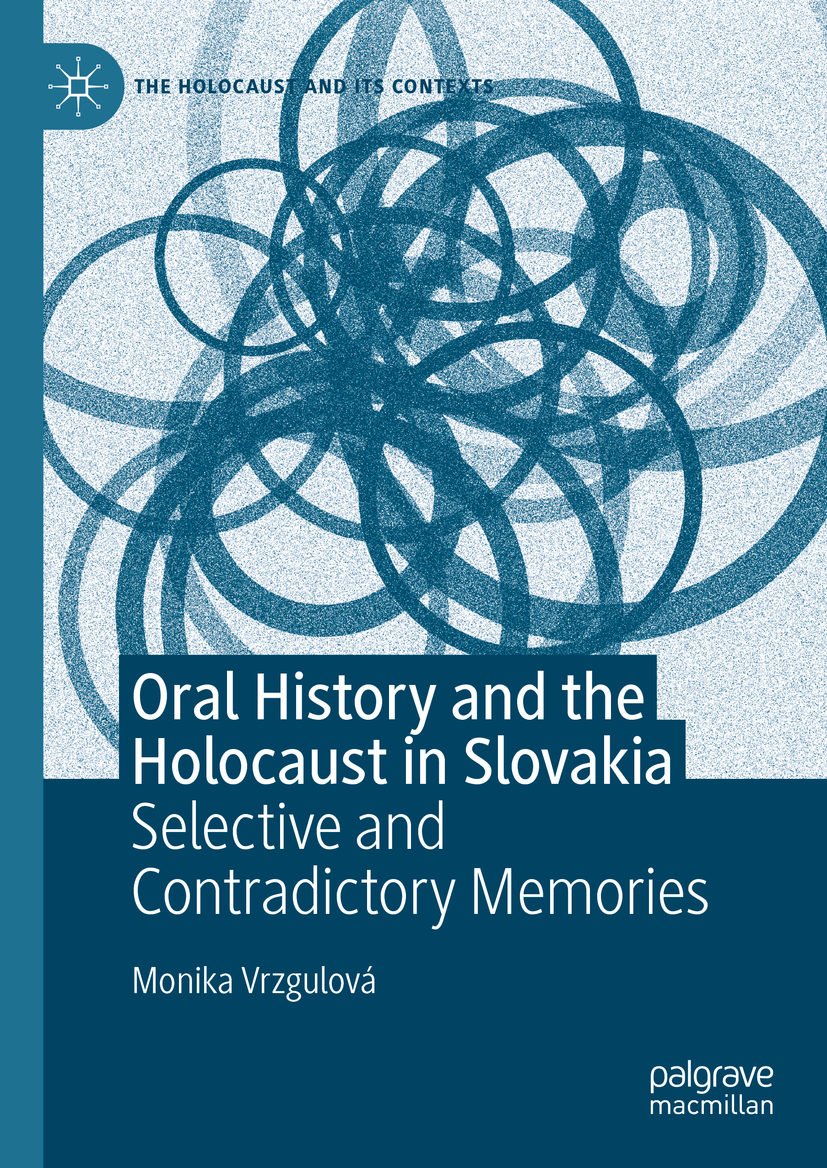
by Monika Vrzgulová
London: Palgrave Macmillan, 2024, 165pp, £109.99, IBSN: 3031736745
The aim of Monika Vrzgulová’s book Oral History and the Holocaust in Slovakia, she writes in the conclusion, is ‘to describe the evolution of oral history research into the Holocaust in Slovakia’ (p153). Considering she has been involved in efforts to document the Holocaust in Slovakia through oral history almost since they began in the early 1990s, she is certainly qualified for the undertaking. But Vrzgulová does more than simply describe this evolution. She accomplishes her aim by providing a reflective and insightful analysis of the painful and still incomplete personal and collective journeys of individuals and a nation struggling to find voice and meaning after decades of oppression. One of the strengths of the book is that Vrzgulová directly addresses the emotional impact of the work of gathering oral histories of the Holocaust (or, indeed, any traumatic event) for both interviewees and interviewers. After thirty years of doing this work, she acknowledges that ‘intense emotions have become a staple of my research interviews’ and that they are ‘an essential element of listening’ (p23). Her ethics of listening – influenced by psychologist, oral historian and playwright Henry Greenspan, and characterised by ongoing conversations and knowing and learning with the interviewees (p31) – is evident throughout the book, starting with the introduction.1
Early in the introduction (Chapter One), Vrzgulová prefaces two major transformations during her career: one personal and the other professional. Like most Slovaks of her generation, she knew very little about the Holocaust when she began the work in 1995. Moreover, as a non-Jew, she knew almost nothing of Jewish life. Likewise, she and her colleagues were unfamiliar with the method of oral history. She foreshadows the entangled transformations that took place when she describes how her focus over time shifted from the content of the interviewees’ memories to ‘how the interviewees were formulating their memories and why they were doing so’ (p2, emphases in original). Before moving on to how she documents these transformations in the main chapters, it is worth noting that the introduction includes an especially useful timeline of key events and developments mentioned in the interviews.
Chapter Two most explicitly addresses her stated aim of describing the evolution of oral history research into the Holocaust in Slovakia, a journey entangled with Vrzgulová’s evolution as a person and scholar. Multiple sections in this chapter address the ethics of interviewer-interviewee relationship. With unflinching honesty, she reflects on the emotional turbulence she experienced while interviewing non-Jewish eyewitnesses of the Holocaust (pp43–45). ‘I was so exhausted and overwhelmed by the stories I was hearing that I became filled with anger, bitterness, and shame over the witnesses’ patent lack of self-reflection’, she writes, before acknowledging, ‘It occurred to me that I was judging the interviewees, and I was surprised at that realisation’ (p44). Working through challenges like this enabled her and her colleagues to ‘[unravel] certain myths concerning the Holocaust in Slovakia’ (p45), such as that of ignorance among the majority population about the persecution of their Jewish neighbours (p46).
Scholars of the Holocaust and its aftermath will especially appreciate Chapters Three and Four, which provide a deep dive into the testimonies; first, in Chapter Three, of Holocaust survivors’ memories of the non-Jewish majority, and second, in Chapter Four, of non-Jewish eyewitnesses’ memories of their Jewish neighbours. Vrzgulová’s focus in Chapter Three is on ‘how our interviewees described situations that represented a redefinition of the boundaries of difference’ (p55). This redefinition, according to the testimonies, took place in the late 1930s, when the non-Jewish majority became active bystanders to the genocide of Slovakia’s Jewish population (pp81–82). This is reflected in the oral histories of the non-Jewish eyewitnesses, discussed in Chapter Four, which show that with the advent of anti-Jewish policies and restrictions, Jews went from being neighbours of the non-Jewish majority to others whose alienation and eventual disappearance benefitted the majority (p98).
Vrzgulová’s reflexivity comes into play again toward the end of Chapter Four, when she acknowledges a shortcoming of the oral history method: its incompleteness. She writes, for example, ‘The [non-Jewish] interviewees involved in our research project make up only an insignificant fragment of the actors of the age. The project, therefore, summarises only the memories of those who were willing to talk’ (p114). She also implicitly acknowledges another limitation of oral history; namely, that it frequently stands alone against embedded narratives. In this case, the oral history of the Holocaust in Slovakia stands against forty years of a postwar Communist narrative that was silent about the Holocaust (p83 and p112). Even thirty-seven years after the fall of the Communist regime, the consequences of this narrative are still evident in how the role of the non-Jewish majority in Slovakia during the Holocaust remains underexplored (p116). Vrzgulová carries through on this argument in Chapter Five, which focuses on Holocaust remembrance in Slovakia since the end of the Second World War. She argues ‘that decades of controlled remembrance and more or less explicit antisemitism during the Communist regime had a decisive influence on the promulgation (or lack thereof) of Jews’ and non-Jews’ individual memories of the Holocaust’ (p121). This chapter maintains the personal nature of previous chapters with her description of two initiatives undertaken by memory institutions in Slovakia that she was a part of.
This brings us to the conclusion (Chapter Six), which opened this review. While Vrzgulová more than achieved her aim for this book – describing the evolution of oral history research into the Holocaust in Slovakia (p153) – her view of the present and future is not optimistic. Myriad factors are working against oral history in this and other contexts. As she puts it, ‘The process of a society’s reckoning with its dark past involves a host of dynamic impulses, factors, and situations. Most of all, it is framed by the domestic and international political situations’ (p158). Revisionism, misinformation, populism and antisemitism are hardly of the past and threaten the still-nascent understanding of the Holocaust in Slovakia and elsewhere.
In short, Oral History and the Holocaust in Slovakia is an important contribution to both oral history and the history of the Holocaust and will be of interest to scholars of both.
1 See, e.g., Henry Greenspan, On Listening to Holocaust Survivors: Beyond Testimony, second edition, St. Paul, Minnesota: Paragon House, 2010, p 218.