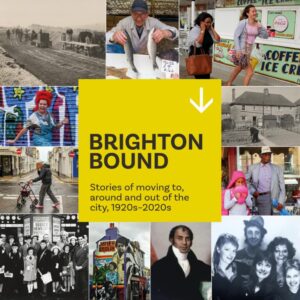
by Cath Senker, Ben Rogaly, and Amy Clarke
QueenSpark Books, 2025, 160pp, £12, paperback, ISBN 978-1-999-6699-7-3
This is an exceptional book which should open the minds of oral historians. This is not only through its demonstration of how migration issues link local currents and international movements, and social class and religion are all also linked in complex ways. More strikingly, with its use of colour photography, Brighton Bound is a model of presentation, a really beautiful book to hold and explore. The multiple images on the cover and of the young Brightonians in the early pages lift the heart and lead you on to earlier black and white images ranging from ongoing council slum clearance, as originally depicted in the best-selling QueenSpark publication, Back Street Brighton (1989), to the distinguished black migrants brought into the city’s social history by local researcher and community advocate, Bert Williams MBE.
While in this most recent publication by QueenSpark Books oral history interviews are used extensively as a key source, its earlier books were based mainly on combining text and photography. Founded in 1972 on the initiative of Stephen Yeo, and having since published 120 books, QueenSpark have their own history and loyal set of followers, with several of the early books still selling. Queen’s Park today is a middle-class suburb entered through a classical archway, in no way an ex-slum, but the publisher became a radical symbol. This was at a time when History Workshop were inspiring very large national meetings in Brighton, also backed by trade unionists like Andy Durr, who created the Fishing Museum under the seafront arches.
The interviews vividly convey the special characteristics of Brighton before the legalisation of male gay sex in 1967. Women were also affected by the typical need in most parts of Britain to be secretive about sexuality. ‘Word was secretly spreading, passed on small pieces of paper and whispered from ear to ear. Lesbians and gay men came from all over the country to holiday and settle down, often seeking refuge from situations of intolerable homophobia in their hometown’ (p12). Brighton was known as ‘the gay capital of the south coast’ with its big annual pride march starting in 1972, which still continues, but then generated more intense feeling in its defiance of persecution. As Sandie recalls, ‘We’d never seen gay people en masse like that before […] We actually saw gay boys that we could identify as gay boys walking in couples along the shopping streets […] It was an emotional and heart-warming feeling to be meeting and marching with so many like-minded people’ (p64).
Brighton has been welcoming minorities since 1782. Beginning in 1787, the Prince Regent transformed the then fishing hamlet with his grandiose, Mughal-inspired domed Pavilion for luxurious entertainments. From the mid-nineteenth century Hove had a large Jewish community, and among other religious groups the Coptic Christians found their refuge in the same neighbourhood. Artist Leah, who moved to Brighton after thirty years in London described how this multiplicity made it much easier for her to settle in Brighton, ‘where it’s firstly you exhibit, so you’re already a little community. But then, I am connected with the artists in my own area, and we have open evenings to see each other’s work. Here people walk in, the door is open, anyone can come and go’ (p63). John, another immigrant from London, summed up why he came: ‘Brighton was a good-time place, where the clubs and entertainments were fun, relatively cheap and – a change from London – broadly trouble-free’ (p157).
Brighton Bound focusses especially on the involuntary migration brought through the council’s slum clearance and re-housing policies. After 1945 there was briefly militant action through squatting led by ex-service ‘vigilantes’, but otherwise those being re-housed had little choice. Certainly some interviewees were pleased with their new situation, as Victor recalled: ‘These houses were like Buckingham Palace compared with the Preece’s Buildings, with running water, a bath-room, plenty of living and sleeping space and electric light with just a switch’ (p21). Some of those who grew up in the new housing as children remembered ‘the field and the parks as an abundance of wild flowers, violets, bee-orchids, tottle grass and cowslips […] In the season we picked blackberries and wild raspberries, and these were made into jam for our Sunday tea’ (p34).
However, the rehousing programme had no space for listening to individual needs and was slow to provide shops or a pub on the town’s edge. Mrs Jackson told how her mother ‘was moved to Moulsecoomb. She hated it there because she had none of her old neighbours with her […] “You could die out here and no-one would know”’ (p16).
As these brief extracts suggest, oral historians will treasure this wonderful book.