by Rebecca S. Miller
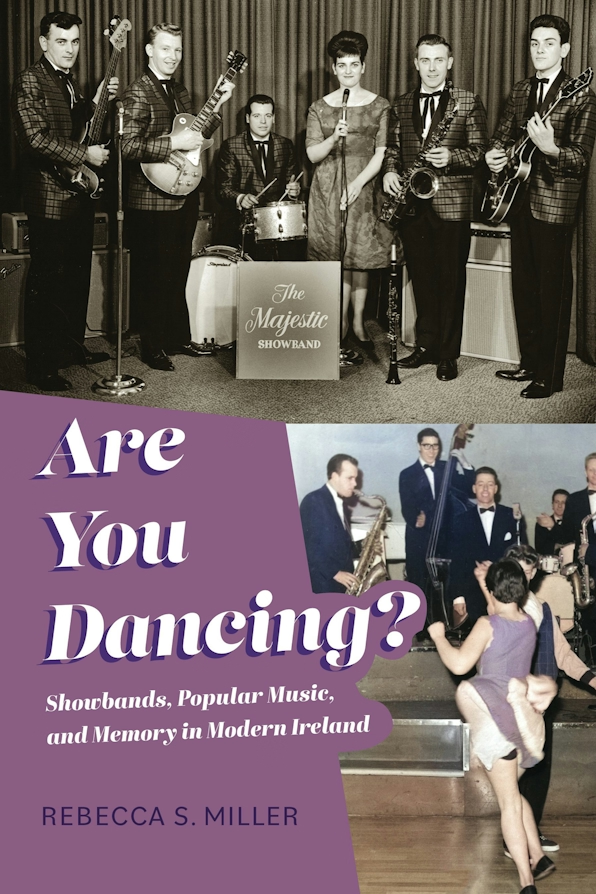
Bloomington, Indiana: University of Indiana Press, 2025, pp290, £76 hardback, £26.10 paperback, £26 ebook, ISBN-10: 0253072352
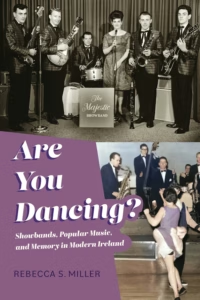
For the best part of two decades, from the mid- to late- 1950s until the end of the 1970s, showbands dominated the popular music scene in Ireland, on both sides of the border. Outside the cities, this hegemony was unchallenged and even in the allegedly more sophisticated environs of Dublin, Belfast and Cork, bands such as the Dixies (from Cork), the Freshmen (Belfast) and the Miami (Dublin–based) did not lack for audiences. While there was competition from rock and blues bands in these cities, and from folk acts surfing the ballad boom inaugurated by the Clancy Brothers, in terms of audiences and revenue, the showbands dwarfed both. There is an often-quoted figure (originally by Power 1990/2000, also here) of 600 bands of various degrees of professionalism touring a country that, for most of this period, had a population of 4.5m. While there were probably this many bands – and more – across the period, I doubt if there were ever that many at one time. Nevertheless, when one looks at the itineraries of these bands, and observed the lifestyle the more successful practitioners enjoyed, it is clear that this was a substantial industry in a country that was, at least south of the border, underemployed and significantly worse off than its neighbour.
For many, the showbands were a mark of Irish cultural inferiority; settling for bands playing covers to dancers rather than following the lead of the forward-looking and imaginative rock and pop being produced in Britain at the time. Early works documenting the history of Irish rock in the wake of the rise of U2 are generally dismissive of the showbands, and even more sympathetic accounts, such as Smyth (2005) see them as a stage in the development of a more robust domestic music industry, able to translate domestic success internationally. They are to be respected for the opportunity they provided future stars such as Van Morrison and Rory Gallagher to hone their craft, not for anything admirable or even interesting in themselves.
This dismissive attitude is reflected in the relative paucity of academic work looking at the showband scene (but see Power 1990/ 2000, Erraught 2021). There has been a modest popular revival of interest with some recent TV documentaries (Ballroom Blitz RTÉ 2024 / The Showbands: How Ireland Learned to Party BBC 4 2021) cashing in on a burgeoning nostalgia around the era. Into this relative desert, a book like this is especially welcome. Rebecca Miller is American and stumbled upon the showbands accidentally and after the event, which gives her book an admirable objectivity and rigour, free of either nostalgia or condescension. It bears witness to her archival work, but even more than that, to the fruits of over 100 interviews conducted over nearly a decade. Given the age of many of the people who played in these bands, who promoted them in the Spartan and dry halls, or who danced to them, these interviews are vital and timely as a record of an age passing out living memory. Miller is particular excellent in digging out the back story of the showbands, its roots in the sit down orchestras that played the dinner dances, the Céilí bands, and in the vigorous amateur drama groups that permeated rural Ireland from which much of the ‘show’ of the showbands originated. Some of the commentary on this scene has worked backwards from what is seen as the achieved modernity of rock – Miller is alive to cultural life beyond popular music.
Miller gives equal weight to all facets of what Christopher Small calls musicking, building a picture of practices that were as modernising within the existing social and cultural dispensation in Ireland as rock music was next door, but lacking in subcultural capital or the appearance of resistance. This, for the very good reason that, in an underpopulated and still largely rural country, the conditions for youth culture were all but absent. Instead, at a time when there was still a surfeit of single men, thanks to the asymmetrical patterns of emigration that prevailed and where people married late, the showbands played to an audience that was not defined by youth. The question in the title of this book would as likely be popped by a man in his 30s to a single woman of the same age as by an awkward teenager.
The modernising influence was not confined to what happened on the dancefloor or on stage; in a country that was undercapitalised, and where banks were risk averse and snobbish about lending beyond the professional middle-classes, hire-purchase agreements were integral for musicians buying equipment, for financing bands, and so on. The dances – and many people recall going to more than one a week – put into circulation cash that financed many other ventures off the back of the showband business. Ireland after the war was a country where a majority of the working age population were not wage earners but worked on the family farm or in the family business; by the end of the 1970s, most working people earned a wage. This transformation was led by the industrialisation policy inaugurated by the Lemass government but also required the stimulus of demand – people needed something to spend it on, to make the effort worthwhile. It also played a role in stalling, at least for a while, the lure of emigration, something the Catholic Church was not slow to recognise. While some priests saw temptation lurking as the lights dimmed, for others, a dancehall was seen as both a social cement that would sustain their parish and as a way of making money to sustain its material fabric. At a time when vocations to the priesthood were at an all-time high, many priests were energetic and intelligent young men, freed from the necessity of making a living and with the time to commit to building community capital, both social and financial.
Miller captures all of this and more. She pays particular attention to the role of women, both as performers and as audiences, and demonstrates how, in a deeply misogynistic society, the showband scene provided one arena at least where women could build careers, beyond and outside marriage.
The showbands cannot, however, be reduced to simply a social phenomenon. While their recordings came a distant second to the bread and butter of live performance, their openness to a wide range of musical influences and their commitment to entertainment brought musical forms such a rock ‘n’ roll, soul and later, country, into every corner of the country in vivid and exciting detail. They brought the outside world into focus in a country – the Republic at any rate – that had often wilfully turned inward during the first half century after independence. Miller captures all of this brilliantly and puts to bed the notion that these bands were, in Bob Geldof’s words ‘the enemy’ and, as Bono said in agreement with Geldof, ‘part of Ireland we wanted no part of’ (p11). Miller quotes John Waters to the effect that the ‘blind imitation’ of the showbands was indicative of a ‘postcolonial condition’, a felt inadequacy (p94); one wonders who, in fact, is post-colonial here? Perhaps it’s the would-be hipster wishing for the approval of the metropolitan music press?
Works cited:
Erraught, Stan (2020) ‘The Country and Irish Problem’ in Popular Music 39 (3-4) pp 568 -584
Power, Vincent (1990./2000) Send ‘em Home Sweatin’ : The Showband Story Cork: Mercier Press.
Smyth, Gerry (2005) Noisy Island, Cork: Cork University Press
Ballroom Blitz, Sideline Productions for RTÉ (2024) 2-part series.
The Showbands: How Ireland Learned to Party, BBC 4 (2021)