My memories of this conference relate to how it fitted in to the work I was doing at the time. I was employed as Arts Manager at the Burton Street Project in Sheffield. Back then the Burton Street Project was a delightfully ramshackle organisation which encompassed projects and activities for all age groups and offering particular support for people with learning difficulties and mental health needs. The building in which it’s based (it still exists but with a different focus) started its life in 1879 as the Langsett Road School and remained open as a school for almost a century, ringing its bell for the last time in 1976. After being put to various small scale uses, it finally fell into disrepair in 1992 and by 1995 the site was scheduled for demolition. Fortunately people in the local community didn’t want to see the old school demolished so they broke in, occupied the buildings, and formed a new organisation called the Burton Street Project. Those of you who have seen ‘The Full Monty’ have seen Burton Street as that’s where it was filmed. When I worked there the main hall was still painted in two different colours – pink at one end, cream at the other – to represent different scenes in the film.
I had pretty much free rein as regards the projects I carried out and I thought the school and its history would make a wonderful oral history project. I successfully applied to the Heritage Lottery Fund for a grant, which enabled me to employ two project workers, Penny Hardcastle and Margaret Montgomerie, who began work in earnest in April 2003 and gathered a wealth of stories from local people who had memories of the building. I have just been very happy to discover that Sheffield local studies library holds two items relating to this project – ‘Down Our Street: An Oral History of Burton Street School’ by Jo Anstey, and ‘Then and Now’ by Burton Street Community History Project.
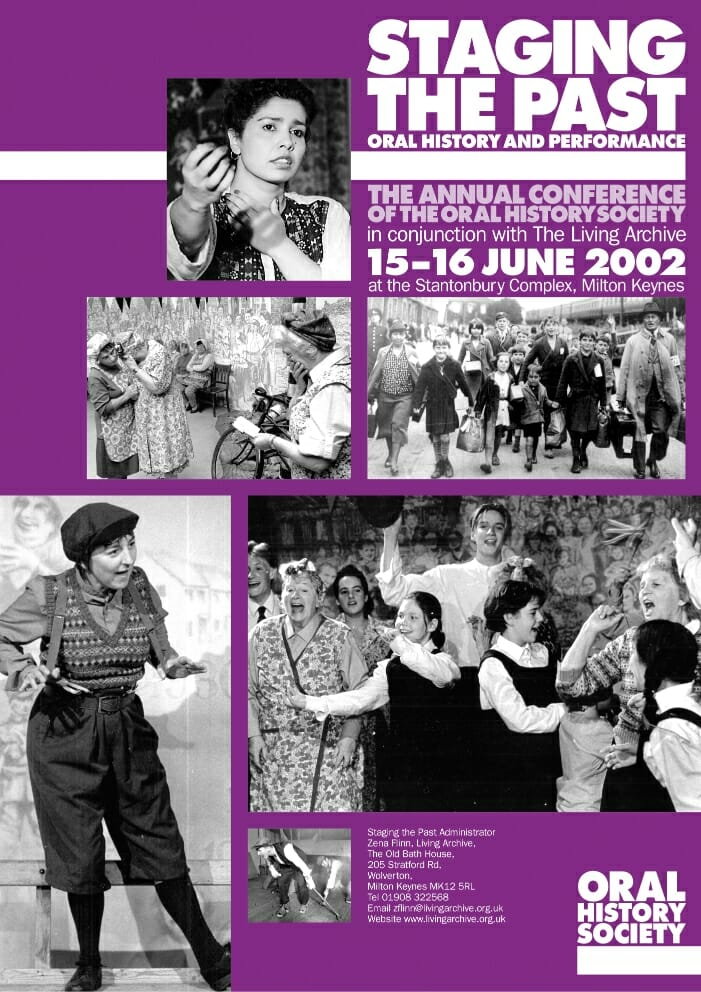
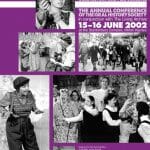
Anyway, having embarked on this project I wanted to get to know the Oral History Society – although I had worked with oral history collections in a previous job as director of Manchester Jewish Museum I had never actually run an oral history project myself. The 2002 conference ‘Staging the Past: Oral History and Performance’, held at Stantonbury Campus in Milton Keynes, proved to be ideal for me, with sessions led by actors, storytellers and song writers and showing creative ways for using the medium. The conference was coordinated by the Living Archive, based in Milton Keynes, and ended with a performance by local children who had worked with actors to create their own play which incorporated oral histories of evacuation. I was also excited to meet and hear Doc Rowe discussing the iconic Radio Ballads, as at the time Doc’s extensive archive was stored in Burton Street’s basement. Doc told us how much he had been inspired by meeting Charles Parker and getting to know his work. And Milton Keynes itself was an interesting place to stay – a bit like being on the set of ‘The Prisoner’.
I returned to Sheffield with a stack of leaflets on different projects, including the Radio Ballads, but left all these behind when I moved somewhere else in 2004. I wish now that I had kept them.
I am still doing oral history. I’m just completing my PhD at Lancaster University, and have carried out 28 interviews with people researching their Jewish ancestry to find out the impact this has had on them. All the interviews are stored in the London Jewish Museum, with relevant ones also deposited in Manchester Jewish Museum and Lancashire Archives. I’m looking forward to beginning a course in creative writing in October where I hope to be able to use oral history in a more creative way. I first joined the Oral History Society in 2002 but then lapsed after 2003 and joined again in 2017. I now look forward to continuing my association.
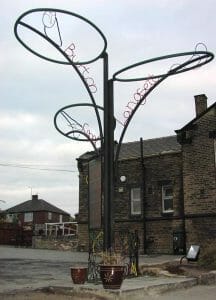
Finally, I am illustrating this piece with a photograph of ‘The Directree’. It is a large stainless steel tree-like sculpture which stand in the centre of Burton Street’s grounds and is intended to orientate visitors to the site. It was designed and produced by artist Gillian Brent, with the help of pupils from Bents Green School, Longley School and Pye Bank School, and some of the adults who attended the training project. Happy memories!