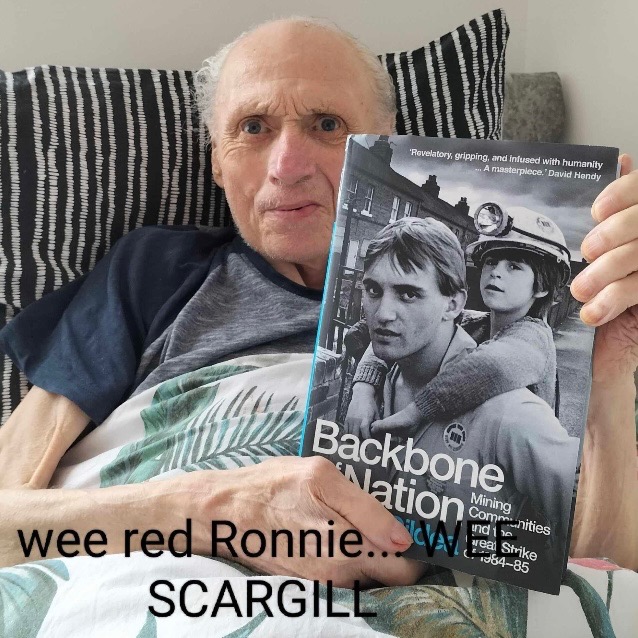
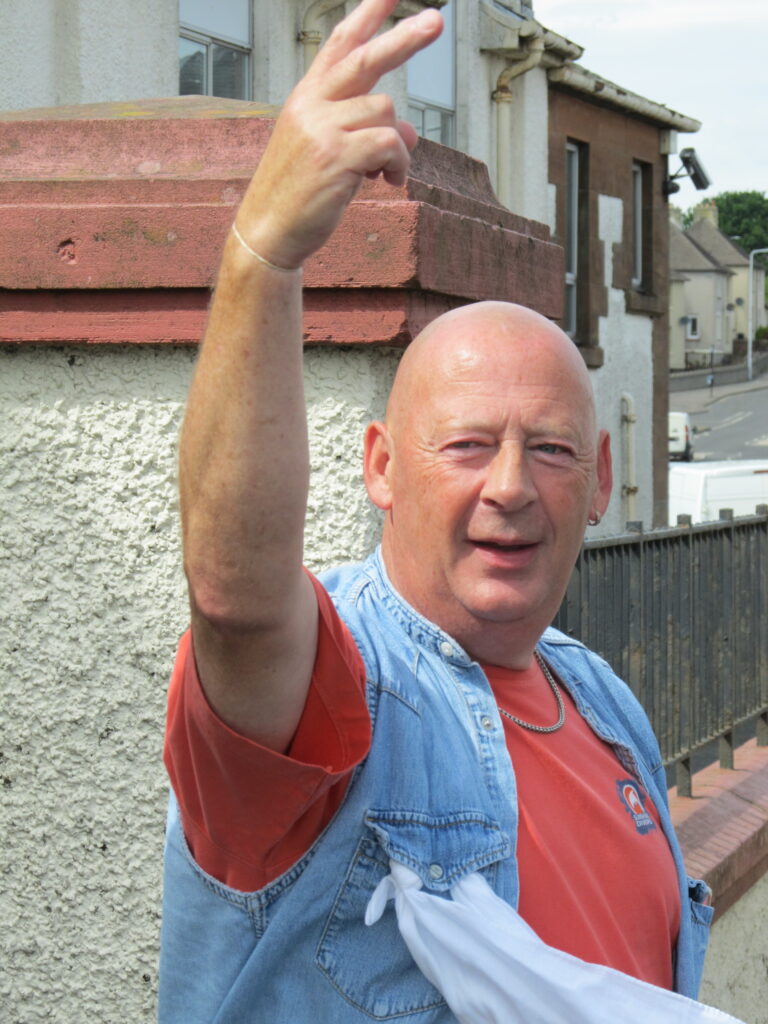
Featured image: ‘Red Ronnie’ Campbell holding a copy of Robert’s book, Backbone of the Nation. Photo: Anna Campbell and Margaret Todd.
Our shared research in the British coalfields has been immensely rewarding. ‘Staying with it’, appearing in Oral History, 52.2 (2024), is based on more than 150 interviews, conducted in phases since 2009 with veteran miners, family members and supporters. These have been life-course interviews, organised around individual, family and collective memory of the year-long 1984-85 miners’ strike in Britain. The interviews enabled us to see the strike as an immense collective injustice with varied national, regional and local contingencies. Staying with it is our shorthand for a patient method that has involved visiting and revisiting coalfield communities. We have developed high-trust personal relationships with our interviewees which in many cases have blossomed into lasting friendships.
We have cooperated as researchers since 2018, with overlapping projects on the strike. Robert’s book, Backbone of the Nation, an oral history of the strike viewed through communities in Fife, Durham, Yorkshire, Nottinghamshire, Leicestershire and South Wales, was published in 2023. Jim’s book, Coalfield Justice, examining the distinct injustices encountered by strikers in Scotland, and the remedy secured by veteran miners and their supporters with the Miners’ Strike (Scotland) (Pardons) Act of 2022, was published in September 2024. We have stayed with it since finishing these books and writing the article for Oral History, spending time with our friends from mining communities, and participating in their commemorations of the fortieth anniversary of the strike. Here we reflect on these recent activities, where oral history has retained a powerful presence.
The Family of Miners
Before and After Coal was an exhibition at the National Portrait Gallery of Scotland in Edinburgh, running from March to September 2024 to mark the strike’s anniversary. It integrated the photographic art of Milton Rogovin and Nicky Bird with testimonies collected in 2023 from three mining communities in Scotland: Cumnock in East Ayrshire, Dalkeith in Midlothian, and Cardenden plus Benarty in Fife. A selection of exhibits from Before and After Coal will be displayed at Kirkcaldy Art Gallery, Fife, from 7 December 2024 to 20 April 2025, and The Baird Institute, East Ayrshire, from 8 May to 23 August 2025.
Milton Rogovin (1909-2011), the celebrated US photographer artist, Milton Rogovin, visited Ayrshire, Midlothian and Fife in September 1982, guided by officials of the National Union of Mineworkers Scottish Area (NUMSA). Rogovin’s Scottish Miners sequence contributed to a major international series, The Family of Miners, compiled across the 1970s and 1980s. Nicky Bird (artist and academic) provided new photographs taken in the three communities in 2023, along with oral history testimonies, working with Robin Baillie, Outreach Coordinator at the National Galleries of Scotland.
Jim participated in the exhibition’s community engagement programme in the summer and autumn of 2023 and then delivered a public lecture at the National Galleries in June 2024, where he presented the Scottish Miners collection from 1982 as a means of reinterpreting the strike which followed two years later. Rogovin’s sensitive images of work, family, home and community demonstrated the economic security and social vibrancy which miners and their supporters defended against the Conservative government’s agenda of pit closures and diminished union rights in 1984-85.
Jim spoke about two images in particular, a pair offering a contrasting reading of a miner, apparently stiff and sombre at home with his wife and young daughter, while laughing and at ease at the pit head with work-mates about to commence a shift underground. Family of Miners, Scotland, 1982 by Milton Rogovin | National Galleries of Scotland The domestic pose was especially intriguing. Family of Miners, Scotland, 1982 by Milton Rogovin | National Galleries of Scotland The family trio posed in front of a fireside tribute to monarchism, militarism, the Orange Order and Rangers Football Club. Its centrepiece was a print of Prince William of Orange, or ‘King Billy’, at the Battle of Boyne in Ireland in 1690, where victory over the forces of James II secured the protestant ascendancy.
At first sight this appeared to be a major subversion of the politics of the NUMSA. Led by its Communist President, Michael McGahey, the union in Scotland was internationalist in its outlook, highly supportive of anti-colonialism. It argued for the establishment of a Scottish Parliament within the UK, to better safeguard the distinct interests of workers in Scotland, and emphasised the unity of all Scottish miners, irrespective of regional, cultural and religious identity.
But the oral histories patiently undertaken by Nicky since 2018 and with Robin in 2023 provided a more affirmative interpretation. From conversations with former neighbours in central Fife as well as work-mates it became clear that the ‘Orange’ miner was a staunch striker in 1984-85 and a union branch leader afterwards. He laboured alongside comrades with diverse cultural, political and sporting identities and interests. Oral history had established that this cross-cultural working-class unity was an important element of the mining world captured by Rogovin and defended by the union during the strike.
Commemorations in March 2024
Meanwhile Robert returned to mining communities where he had collected oral testimony in 2019-21 in order to commemorate the fortieth anniversary of the strike with many of those he had interviewed. He was struck by the different atmospheres at these events, which seemed to reflect both the violent or less violent experience of the strike and the greater or lesser deprivation suffered since by those communities.
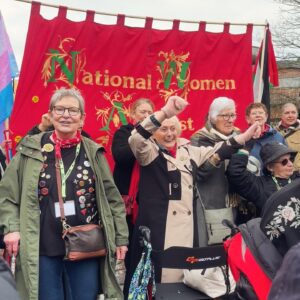
In Durham on 2 March 2024, as women came together from England, Wales and Scotland to mark the fortieth anniversary of Women against Pit Closures, the mood was warm and upbeat. The meeting was chaired by Heather Wood, leading light of Save Easington Area Mines (SEAM), founded in 1983. The message from the speakers was simple. ‘We know that the reason the Miners’ Strike went on for so long’, declared Sarah Woolley, the first female general secretary of Bakers, Food and Allied Workers’ Union, ‘was because of the support of women in their communities. We women weren’t defeated. We found our voices. We had a political education.’
Betty Cook of Barnsley Women against Pit Closures recalled the picket they had formed and the brazier which they lit outside the UK government’s Board of Trade offices in London to combat a second round of pit closures announced in 1992. ‘Our brazier is still burning’, she said. ‘They cannot put the light out. They’ll never put the light out.’
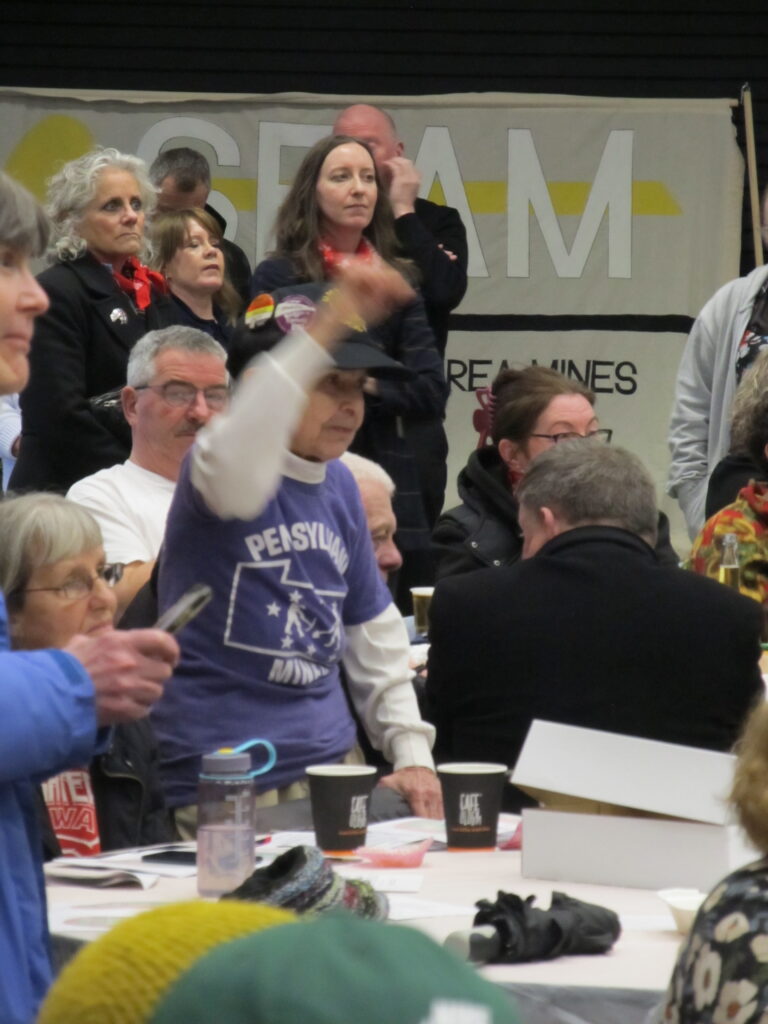
Robert was reunited with Carol Ross, co-founder of the women’s support group in Cowdenbeath in 1984, who read from her poetry, and delighted to meet in person Kipp Dawson, the former American woman miner whom he had interviewed online. Kipp had made fistfuls of contacts when she came over to support the strike in 1984, from South Wales to South Yorkshire and the Dirty Thirty in Leicestershire, and was delighted to embrace the sorority once again.
A week later, on 9 March, Robert joined a march of ex-Yorkshire miners and supporters from other coalfields from Dunscroft to the headgear of Hatfield Main colliery, which still stands. The atmosphere was lively but edgy, with undercurrents of pain and anger. Many of those cheering from their houses along the route had clearly felt the pinch of deprivation. Dave Douglass, the Hatfield miner and strike leader, who had led in the event’s organisation, was in hospital after a stroke. His message read at the former pithead called for a miners’ rally to be held every August. The idea was cheered, but might be more difficult to achieve in reality.
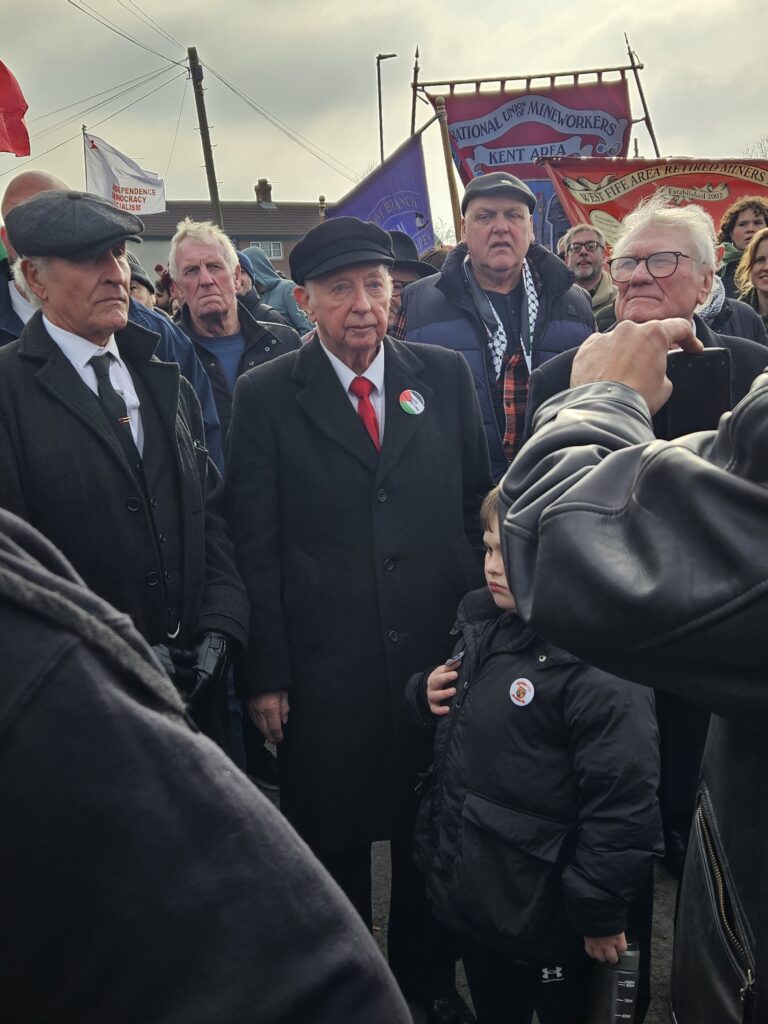
The procession moved on to the pit club in Stainforth, packed to the rafters by a restless crowd. Rose Hunter, of the North Staffordshire Miners’ Wives Action Group, recalled that ‘we watched in horror what the police did to villages in Yorkshire’, occupying them to intimidate the miners and force them back to work, criminalising and jailing those who resisted. Arthur Scargill, the star attraction, reran the history of the strike, arguing that it began not in March 1984 but in November 1983 with the overtime ban. It would have been won, he insisted, if the NUM areas had continued the mass picket after Orgreave in June 1984, or if the national executive of the pit deputies’ union, NACODS, had honoured a membership vote in favour of strike action too, in October 1984. Robert managed to give Arthur a signed copy of his book in the hope that an elusive interview might one day be possible.
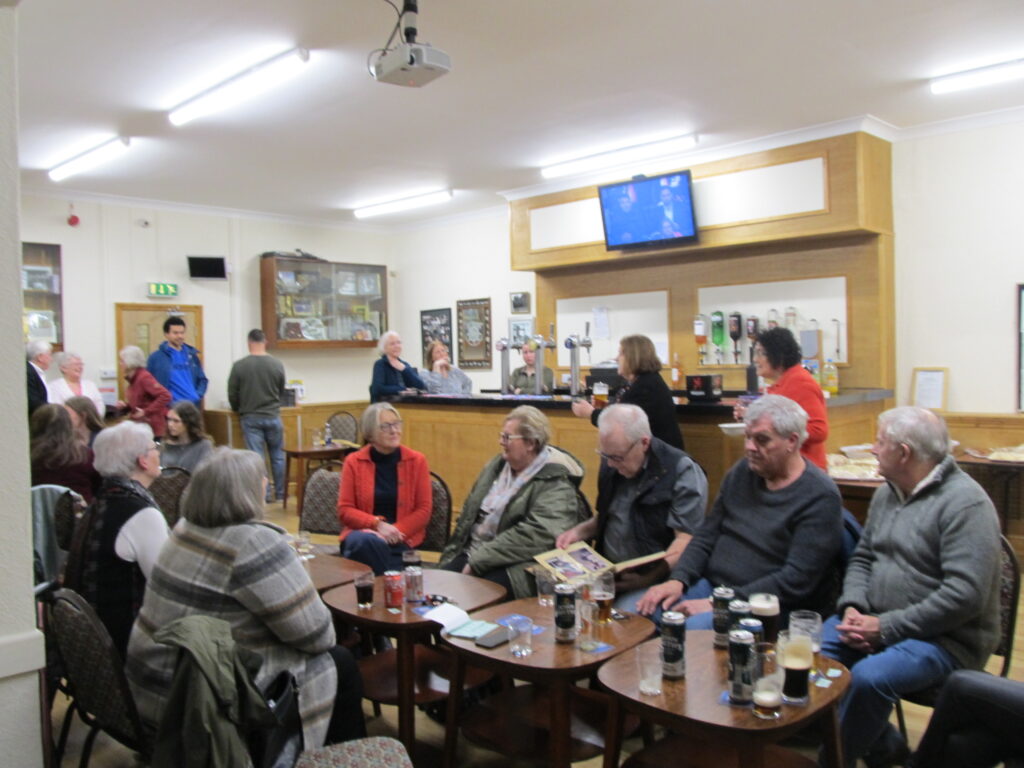
More intimate was the meeting of the Neath, Dulais and Swansea Valleys Support Group at Onllwyn on 16 March 2024. Held in the back parlour of the welfare club rather than in the large, now chilly hall where Lesbians and Gays Support the Miners had made their memorable entry on 27 October 1984, it was no more than a coming together of old friends and comrades who agreed that after this celebration they would disband. There were messages of goodwill from the likes of Terry King, a teacher who had raised money for the strike and brought a vanload of Camden sixth formers to Onllwyn, to ‘meet and be welcomed by people from a totally different background and to see the effects of ruthless political decisions on the life of such a vibrant community’. Robert caught up with many of those he had interviewed, not least with Dai Donovan, who had been the main ambassador between Onllwyn and supporters in London, but had not, for personal reasons, wished to be interviewed for the book.
March with the Miners!
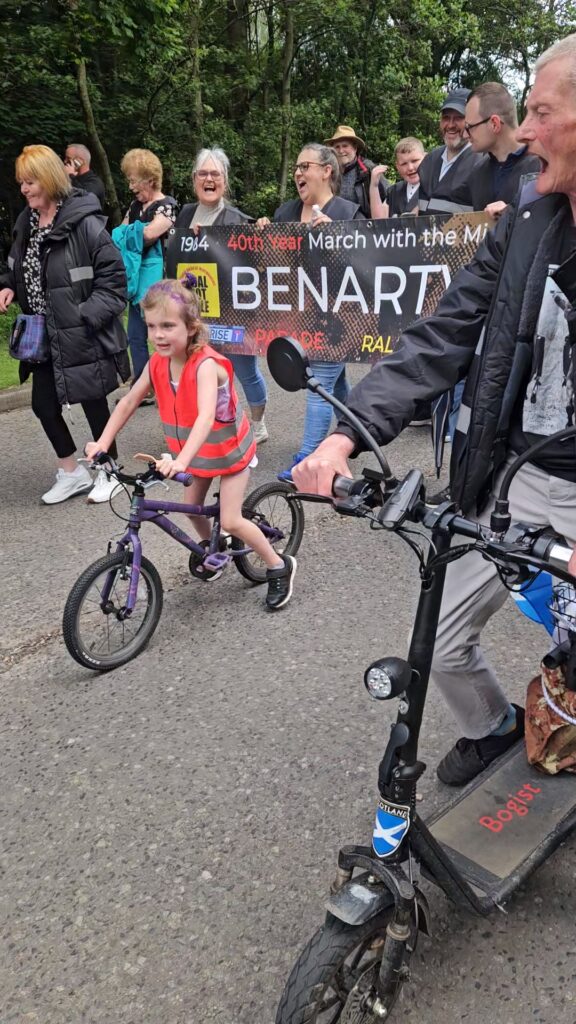
On 15 June 2024 Robert and Jim were in Benarty, the central Fife conurbation of Lochore, Ballingry, Crosshill and Glencraig. They joined the march of the miners from Ballingry to the Lochore Meadows Country Park, known locally as the Meedies, for a rally on the strike’s fortieth anniversary. The event, described in the published Oral History article, was co-organised by Save the Cage, a group campaigning for an outdoor mining museum in the Meedies.
The first banner, commemorating the Benarty Six who had been criminalised for actions during the strike, was carried by Anna, Margaret, Marissa and Mark, the daughters and grandchildren of ‘Red Ronnie’ Campbell, one of the six, who had died the previous November. Sean Lee, another of the Six, came to the front on his mobility scooter, using a loud hailer to orchestrate the singing: ‘Maggie, Maggie, Maggie, Out, Out, Out!’ Maeve, Sean’s wee granddaughter, rode alongside on her bike and eagerly took up the chant.
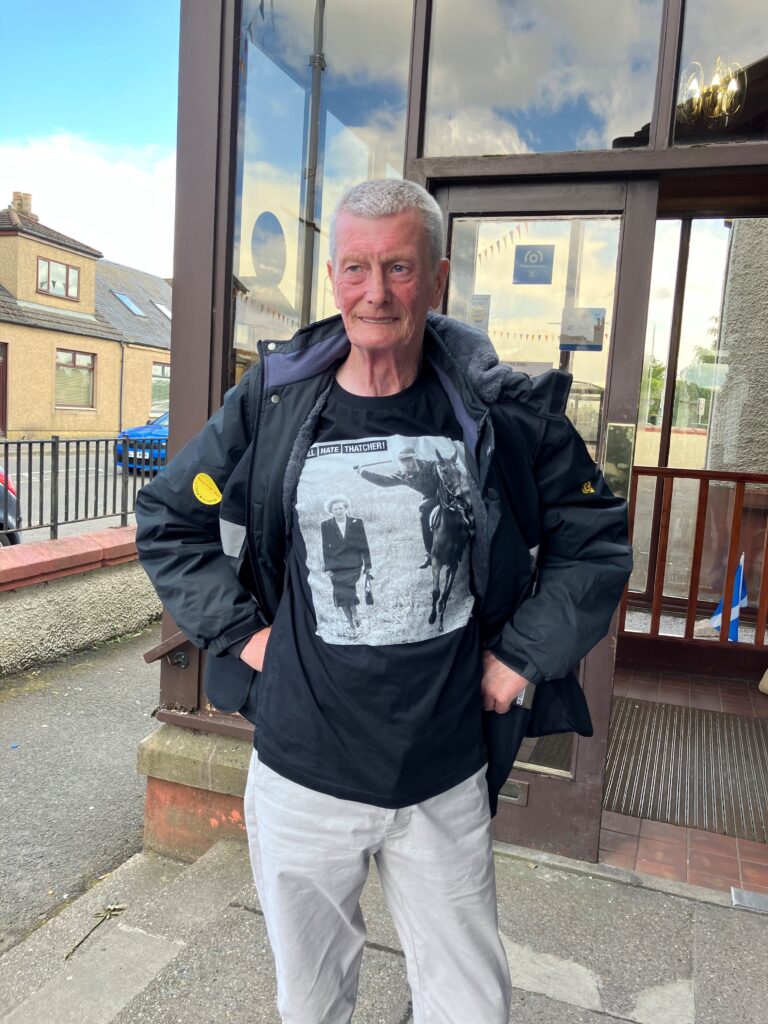
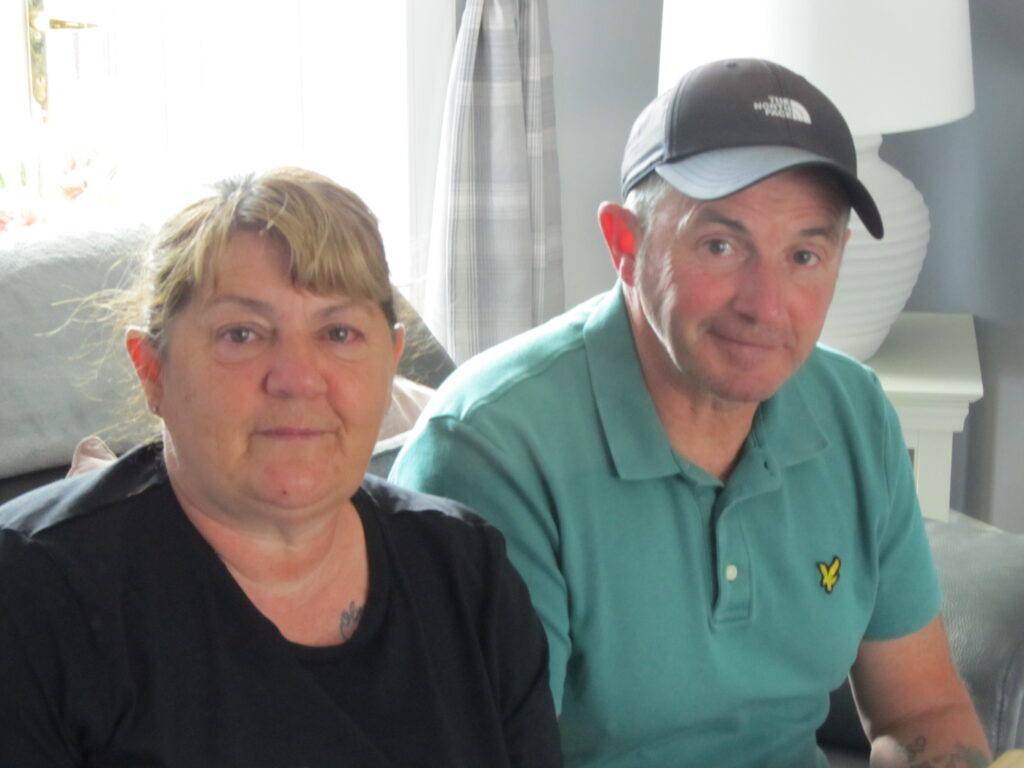
Three of Sean’s six sisters were there, including Carol Ross, with her husband, Rosco Ross, a veteran striker. Just behind Sean and the Campbells were Janet, James, Isobel, Declan, Logan and Fin, respectively the elder daughter, the son, the daughter-in-law, a grandson, and two great-grandsons of Doddy McShane, another of the Benarty Six.
Watty Watson, arrested and convicted on the same day as Doddy in November 1984, and the youngest of the Six, beamed at the success of an event it had taken him fourteen months to organise. Pictured with Robert a few hours later, he was visibly weary although inwardly thrilled. ‘I’m still buzzing’, he told Jim several days later.
Under threatening clouds at the Meedies, speeches were heard from Nicky Wilson and Ian Lavery, the president and former president of the NUM, Roz Foyer, the general secretary of the Scottish TUC, Richard Leonard, Scottish Labour MSP for Central Scotland, , plus Linda Erskine and Lea McLelland, respectively Scottish Labour and Scottish National Party elected councillors in central Fife. Recurrent themes were resilience, resistance, solidarity and a future of hope. Fittingly, the rain held off.
Heather Wood brought greetings from the reunion of Women against Pit Closures, while Kate Flannery, secretary of the Orgreave Truth and Justice Campaign, thanked the Scottish miners for their presence at Orgreave and looked forward to an enquiry by a future Labour government. Billy Fraser and Bob Young, their stories told in Coalfield Justice, who are bruised Orgreave veterans along with Rosco Ross, joined the applause.
Jim spoke about the value of oral history and thanked people from mining communities for entrusting their stories to educators, including Nicky Bird and Robin Baillie, who were at the rally too. He reminded everyone that the title of Robert’s book had been suggested by Watty’s late father, Tam, and paid tribute to each of the Benarty Six: Tam Brown and Ian Walker as well as Sean, Doddy, Ronnie and Watty. Each of these names was loudly cheered. The community remembered its heroes.
The veteran miners, families, friends and many supporters retired to the Miners’ Welfare Institute, known as the Tute, where a soup kitchen jointly organised by Watty’s wife Maureen provided lentil soup, leek and potato soup, meat pies, and stovies. Ex-miners and their families exhibited banners and other mining artifacts. Oral testimony as well as beer was on tap, with poetry and songs punctuating the conversation. Jim went home on the early side, nursing an onrushing summer cold, but Robert really stayed with it, his liver ‘taking one for the research team’ in the Tute and at the Red Goth pub across the road.
Staying with it
March with the Miners could be seen as apotheosis of a project co-created by a mining community and two historians. Jim had worked with veteran strikers like Watty in the coalfield justice campaign since 2018, and their contacts were interviewed by Robert in 2021 for his book. ‘Thank you for bringing together these bodies and putting them in the book’, Watty said to Robert in the Tute that afternoon. ‘You brought them together, I then I put them in the book’, Robert replied. Significantly, Watty suggested that ‘putting them in the book’ had enhanced the cohesion of the community, already strong, but then reinforced through memory-making arising from the fortieth anniversary.
We had written the miners and their families back into the history books, but our project does not really have a climax or an ending. We were in Benarty in June with the same motive as we had been in the making of Before and After Coal, and at Durham, Hatfield and Onllwyn: to honour and thank the veteran miners and their family members. They had generously and trustingly given us their stories of courage, pain and redemption. Here are people who we have developed a profound admiration for. We are lucky to count many of them as our friends, who we are in regular contact with, and whose company we look forward to and treasure.
In 1963 E.P. Thompson declared in The Making of the English Working Class that he had sought to rescue the stockinger, handloom weaver and artisan from ‘the enormous condescension of posterity’. We did not set out with quite the same agenda as Thompson. Our mining friends have their own agency and are certainly not seeking ‘rescue’ from impersonal social forces. We have nevertheless enabled their stories to reach audiences beyond the coalfields. As historians, moreover, we have changed as a result of these contacts. Listening to families with such powerful stories has obliged us to set aside academic distance, and to write histories that put their voices at the heart of the analysis. We encourage others engaged in oral history to shed their detachment too.