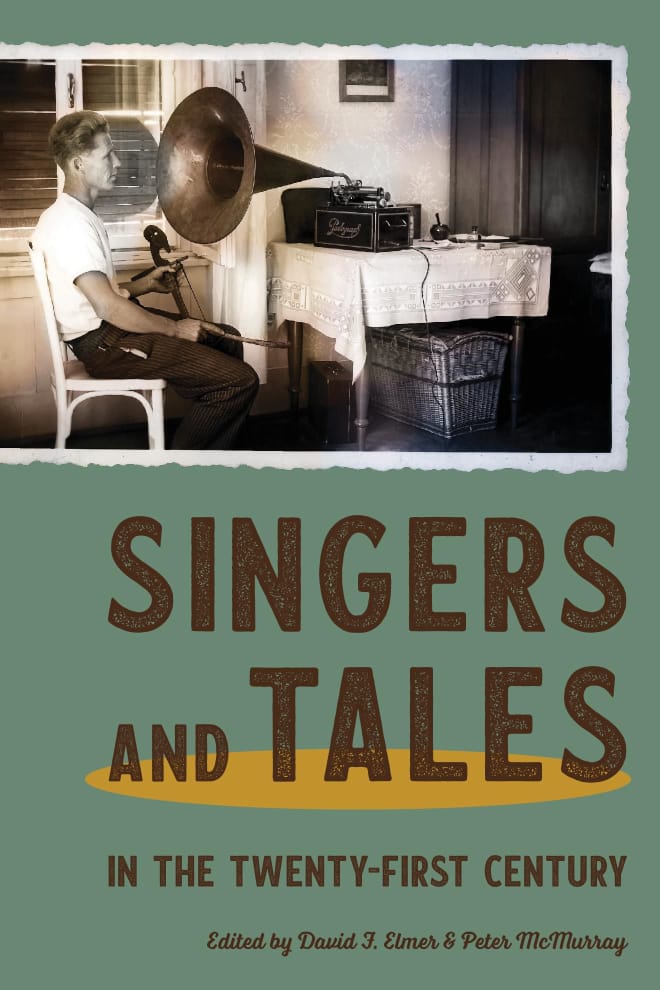
by David F Elmer and Peter McMurray (eds)
Harvard University Press, 2024, 524pp, £33.95, paperback
The essays collected in Singers and Tales in the Twenty-First Century originated in a 2010 conference markingthe fiftieth anniversary of Albert Lord’s hugely influential The Singer of Tales, and the seventy-fifth anniversary of the death of Milman Parry. Their focus was on south Slavic epic and how it related to epic at large, Homer in particular. As this volume shows, their path-breaking work has had a broad and lasting impact.
Geographically there is an inevitable emphasis on south-eastern Europe but the spread is wide. Chapters by Gejin Chao and Qubumo Bamo describe how Lord and Parry’s oral formulaic approach has, relatively recently, been ‘indigenized’ for the collection and study of the extremely rich current oral traditions of modern China: by the early 2010s the Institute of Ethnic Literature had 6,884 hours of audio and video and 19,735 photographs, and the China Ethnic Literature Network has over 14,000 entries for research materials. Other contributions range from the oral traditions of Finland (Sami joiks) to Northern Egypt (the epic of the Bani Hilal Bedouin tribe).
The essays are grouped around areas of exploration that Lord and Parry pioneered, and due attention is given to close analysis of the oral-formulaic approach to epic for which they are best known. However, the sections on ‘Orality and Textuality’ and ‘Performance and Context’ might be of particular interest to readers of Oral History. Describing how he attempted to continue Lord and Parry’s ‘experimentation in the field’, Dwight Reynolds engaged in an ‘apprenticeship’ with a singer, hoping to gain deeper understanding of their methods, but found that he could only learn a few verses at a time: ‘I was hopelessly literate and resorted to writing down passages on scraps of paper’ (p76). The contrast between orality and literacy is stark here, but as becomes clear throughout this collection, there are no hard boundaries.
Aida Vidan draws out political meanings in Croatian Renaissance literature through comparison with oral material, and in the chapter, ‘The Oral Background of the Eddas and Sagas’, Gísli Sigurðsson notes how ideas developed in The Singer of Tales ‘still act as a fresh wind in the textually-oriented field of Old Norse studies’ (p295). The relationships go beyond borrowing; as Olga Davidson shows in the case of medieval Persian texts, there is ‘a deep prehistory to be found in the linkage of book and performance’ (p290) with a cycling disintegration and reintegration of texts in and of print and orality. Zymer Neziri and Nicola Scaldaferri’s survey of new research on Albanian epic songs gives an idea of how this might happen in practice, with performers being well aware of a qualitative difference between a ‘sung performance of a text and a dictation for transcription’, the latter being inferior: as singer Suleyman Makić put it, ‘It can be written more correctly but it can be sung more exactly’ (p443).
All orality – conversation, interview, recitation – involves performing, and the last section of the book, ‘Audible Archives’, offers some stimulating takes on this. In ‘Tracking the South Slavic Epic Register’ Ronelle Alexander explores the complexities of pinning down the linguistic register of a spoken or sung performance as it relates to other registers. Lord and Parry recorded not only performances but conversations about them, allowing comparison, albeit qualified: ‘[A]lthough the speech he recorded was conversational, the social context was far from neutral’ (p.459). Neziri and Scaldaferri stress the importance of body movement for song performers to the extent that they can find it difficult without having an instrument to play. ‘I can tell it much better this way [with an instrument], sitting without a lahuta is difficult’, says Isa Eleza, frustrated at being asked to do so, ‘I can tell it standing, with footsteps’ (p448). Peter McMurray’s chapter, ‘There Are No Oral Media?’, re-iterates the importance of the physical, drawing on photographs taken by Parry to give a survey of the range of sensory, spatial and visual dimensions implicit in recordings.
A running theme in these essays is how performances relate to the world of the performers. The late John Foley’s chapter, ‘Oral Epic in Stolac: Collective Tradition and Individual Art’, suggests borrowing the term ‘distributed authorship’ from digital technology as a conceptual aid, a term used by software engineers to ‘designate a continuous process of rule-governed creation and innovation, a process that involves multiple “authors” who contribute to an application that, strictly speaking, belongs to no one person.’ (p272). This gets us away from thinking in terms of fixed ‘texts’ to something much more life-like. But there is still the question of the social context, outside their immediate, ‘professional’ body of knowledge or expertise, within which epic singers (and software engineers) operate. This wider context is alluded to throughout these essays, but not always followed up, deferring to comparison with other performances and texts. After all, as Carl Lindahl, who attended lectures by Lord, writes in his chapter on Appalachian ‘Mountain Märchens’, ‘More than five decades later, I still start at the calm audacity of the book’s [The Singer of Tales] opening line: “This book is about Homer”’(p347).
Though treated from the perspective of traditional performances, there is much here to engage historians working with less obviously folkloristic ‘interviews’; issues of orality and literacy, performance event and context, the role of the collector, as well as the shifting nature of the ‘archive’. Of course, epic traditions are, unlike interviews, ‘special’ – artistic or artisanal artefacts – and the tradition bearers who have maintained them are often keenly aware of this. I once offered an informant a tape of our conventional oral history conversation together. She looked puzzled and asked ‘Why?’ By contrast, Peter McMurray was struck by how singer Zaim Međedovič (son of singer Avdo, one of Lord and Parry’s informants), like others before him, made it a priority to get a recording of his performance (p499).