In this piece, Joanna Gilmore shares insights from her research into the lawyers who supported striking miners in the 1984-5 miners’ strike. You can read more about this in her article, ”They really did us proud’: legal solidarity and the 1984-1985 miners’ strike’, which will be published in the next issue of Oral History (Volume 52, Number 2).
The 1984-1985 miners’ strike was one of the most fiercely contested industrial conflicts in British history. Prime Minister Margaret Thatcher’s declaration in May 1984 that “the rule of law must prevail over the rule of the mob” set the tone for the legal battles to come. Home Office figures reveal that 11,312 striking miners and their supporters were arrested during the year-long strike. While most arrests were for minor public order offences, some went on to face more serious charges, including the ninety-five pickets charged with riot and unlawful assembly following the violent police operation at the Orgreave coking works in Rotherham on 18 June 1984.
The strike also generated an extraordinary amount of civil litigation, transforming the courts into intense legal and political battlegrounds. Particularly damaging were the claims for injunctions against the National Union of Mineworkers (NUM), its National Executive Committee (NEC) and Areas of the NUM by non-striking miners. Often sponsored by right-wing pressure groups with government and National Coal Board (NCB) support, one such action resulted in a £200,000 fine on the NUM, the sequestration of its assets, and the appointment of a receiver to manage its funds.
The legal onslaught against the NUM was relentless. Mass arrests, often based on obsolete and archaic offences, were part of a calculated strategy to criminalise pickets, impose strict bail conditions, and erode public support for the strike. The civil assault aimed, as Ian MacGregor, Chairman of the NCB, later admitted, “to progressively tie the NUM up in knots” and “cost Scargill so much money that it would reduce his ability to finance flying pickets.”
While the role of law and legal institutions in undermining the strike is well-documented, the contributions of lawyers in furthering the miners’ cause are largely unexamined. In partnership with National Life Stories at the British Library and supported by a British Academy/Leverhulme Small Research Grant, this project aimed to collect and preserve the memories of lawyers who represented striking miners, their supporters, and the NUM during this period. By doing so, it sought to capture a history from below of radical lawyering during the miners’ strike, and the impact of these explosive experiences on those who took part.
The project draws on the growing recognition of the value of oral history in socio-legal research, pioneered by Anna Bryson and others. It also builds on Luca Falciola’s recent powerful account of U.S. lawyers’ militant engagement in the radical movements of the 1960s and 1970s. Falciola makes a crucial distinction between cause lawyers – who work for both the left and right out of specific political or moral commitments – and radical lawyers, who “stood unmistakably on the Left, joined the most combative social movements, shared their clients’ substantive political claims, sought to transform legal questions into political issues, and criticised the law as an instrument perpetuating systemic injustice.”
The oral history interviews reveal the remarkable networks of legal solidarity that emerged during the miners’ strike. Tony Briscoe, a solicitor at the Newcastle office of the trade union law firm Thompsons, exemplified the dedication of many lawyers involved:
My mindset was these are not criminals, and therefore I had to pull out every stop I could to tip those scales back the other way in their favour.
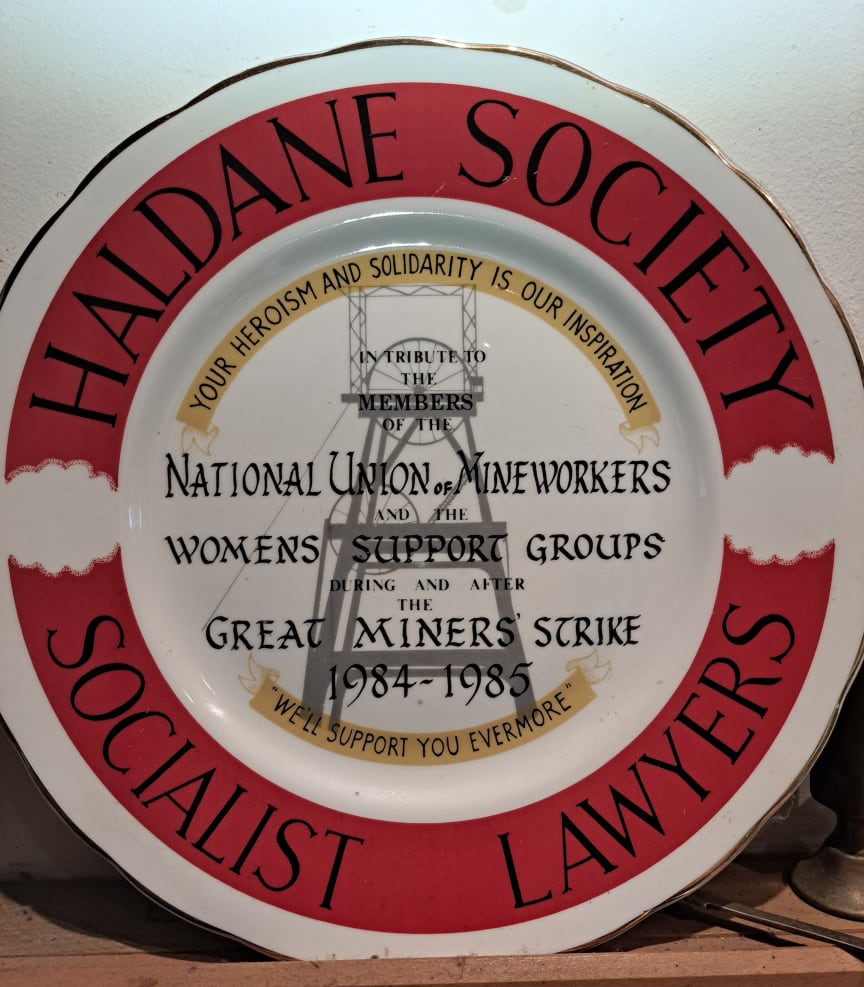
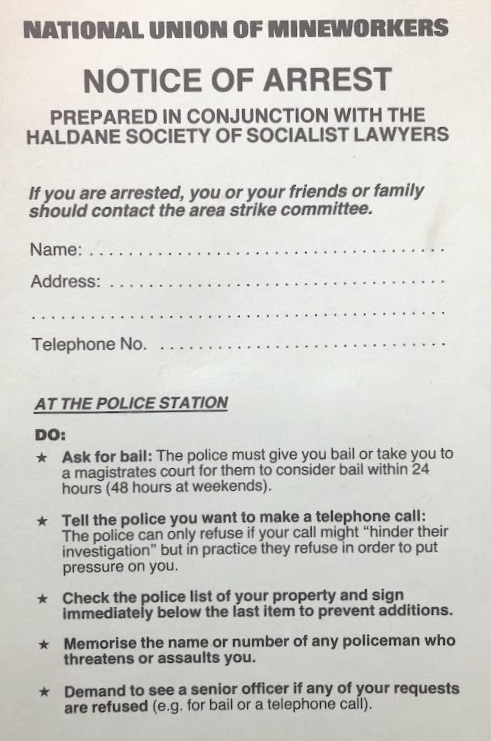
This support extended beyond courtroom representation. The Haldane Society of Socialist Lawyers, for example, organised a rota of lawyers to staff a free legal advice centre in the Ollerton miners’ welfare in Nottinghamshire, produced educational leaflets and ‘bust cards’ detailing rights upon arrest, and raised thousands of pounds from within the legal community to support striking miners and their families.
In addition to representing miners in court and providing housing and welfare advice to striking miners’ families, Manchester solicitor Robert Lizar was an active member of Chorlton Miners’ Support Group in South Manchester. He explained:
It just felt like it was impossible not to get involved. I suppose it was ‘which side are you on?’ […] it really seemed crucial to actually not just be on the sidelines but trying to do something to support these people. I can’t begin to imagine what some of the striking miners and their families went through, it must have been desperate for them.
This solidarity fostered a strong camaraderie between lawyers and mining communities. Barrister Michael Mansfield spoke to the profound “closeness” that developed:
We’d visit them in their homes. We’d see them burning their furniture because they had nothing else and living on rations sent up from the south by those who supported the miners, of which there were a large number […] I think the miners, in a way, and their wives, had a real sense of humour, a sense of history, and they were very bright. All of them were very bright. So you were embraced by their warmth.
The strike became a catalyst for mutual learning and broader understanding of shared struggles across working-class communities. Leeds solicitor Ruth Bundey observed a significant shift in political consciousness during this period:
I think what resonated with me over that period was the fact that, all of a sudden, there was a far greater understanding from the white community about what the black community had faced on the streets and in court, and how people could be verballed and misrepresented in court, because the miners found this was happening to them.
McEvoy et al. rightly caution against the uncritical “over-remembering” of the heroic efforts of cause lawyers. However, by centralising the contributions of legal practitioners and lay legal activists – including police monitoring groups and legal defence campaigns – the oral histories offer new insights into the transformative potential of radical legal advocacy. Forty years after the miners’ strike, amidst an authoritarian turn against protest, these experiences provide a vital case study in ‘lawyering from below’ during a period of intense social and political rupture.
The first output from the project, ‘“They really did us proud”: legal solidarity and the 1984-85 miners’ strike’, will be included in a special issue of Oral History on the miners’ strike, published in September 2024. The article explores the complex interplay between legal practice and political solidarity during the strike, illustrating how the spirit of radical Chartist lawyer W. P. Roberts – know as ‘the pitman’s attorney’ – was expressed during this period.
A monograph, Legal Solidarity and the Miners’ Strike: An Oral History, will be published by Hart / Bloomsbury in 2025-26. The book will draw on oral history interviews and extensive archival material gathered during the research. The oral history interviews will be archived by National Life Stories at the British Library and made publicly accessible in 2025.