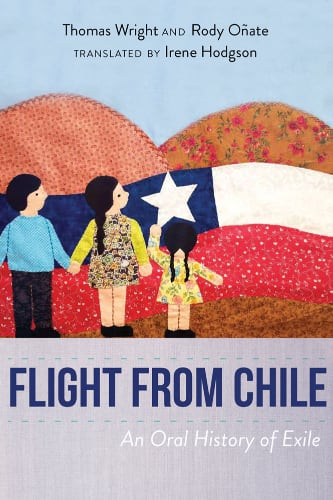
Edited by Thomas Wright and Rody Oñate, and translated by Irene Hodgson.
Albuquerque: University of New Mexico Press, 2023 (2nd edition), 278pp, £21, paperback
Alongside executions, disappearance and torture, exile was one of the tactics of decimation favoured by the dictatorships of the Southern Cone throughout the 1960s and 1970s. After the 11 September 1973 military coup that overthrew the socialist government of Salvador Allende and his Popular Unity coalition, such an “internal enemy” doctrine forced over 200,000 Chileans into exile in all corners of the world. The phenomenon of Chilean exile was “the largest, most dispersed, and longest lasting” (p ix) of all these cases, but its resonances and significance extended far beyond Latin America. The history of Chilean exile is crucial for the development of transnational networks of solidarity and for the emergence of discourses of memory and human rights on a global scale.
Flight from Chile offers a fabulous oral history of this widespread experience of forced displacement. The book expertly narrates this “moving human drama” (p xiii) by relying on the testimonies of thirty-three exiles gathered in interviews with the editors: historian Thomas Wright and journalist and political scientist Rody Oñate. Oñate was also a Chilean exile who, like most of the people they talked with, had recently returned to Chile. Wright and Oñate conducted their interviews primarily in the first half of the 1990s, soon after the largest waves of homecoming that followed the official “end of exile” in September 1988.
Like many narratives of exile in literature and film, the book is structured as a journey of exile and return—beginning with the different forms of departure into a life away from the homeland immediately after the coup and ending with the process of homecoming, usually perceived as a “return to a new exile” (p 233). In between, the different chapters explore the multiple pathways to exile, the work of political militancy in the movement of resistance against the dictatorship, the lives of exiles in multiple nations throughout the world, and the long process of establishing the plight for the return of the exiles as a human right. The first chapter offers the national and transnational context necessary for understanding this history, from the election of Salvador Allende in 1970 to the closing of the National Office of Return in 1994.
Except for the first one, all chapters begin with a brief historical overview followed by six to eight testimonies. The selection is representative of the diversity of the Chilean exile experience, with equal attention paid to men and women, “members of Marxist and non-Marxist parties as well as independents, practitioners of different occupations and professions, individuals from all parts of Chile, and people who sojourned in four continents” (p xii). While the contextual narratives inform readers of key bits of historical information—like the role of embassies in securing asylum, the work of the leadership of political parties in the diaspora, the community groups exiles formed, the organizations of solidarity and human rights they interacted with, the institutional barriers they faced when planning their return—the interviews highlight the affective and political force of testimony as well as its powers for historical writing.
For example, the chapter “Resistance and Exile” focuses on the stories of militants of the MIR party (Movimiento de Izquierda Revolucionaria or Revolutionary Left Movement). When narrating her story of survival from a detention centre, Gladys Díaz states: “I was detained February 20, 1975, with the compañero I lived with, Juan Carlos Perelman, who was killed—he is one of the disappeared. They tortured us together the first days—they made me witness his torture and he had to watch mine” (p 95). Her retelling is unsettling in its almost literary form of narrative economy. The book is filled with these memories—some painfully brutal like Díaz’s torture, some humorous like Silvia Quiroga discussing the troubles of adapting to Mozambican food (pp 113-119). With these interviews, Flight from Chile reminds us that the surplus of testimony is not merely emotional; the interviews, in and of themselves, offer a historical account of the radical transformations exile meant for the lives of thousands of Chileans.
Originally published in 1998 for the twenty-fifth anniversary of the 1973 military coup, this new edition of Flight from Chile reappears in 2023 to mark the fiftieth anniversary of an event whose political and cultural consequences continue to reverberate in the present. Much has changed in the landscape of Chilean memory struggles between 1998 and 2023. Dictator Pinochet’s detention in London in 1998 unleashed a series of efforts in bringing justice. Since then, numerous military officers have been convicted for their crimes, torture and detention centres have been converted into sites or houses of memory, and plenty of documentary films, usually in the form of a first-person investigation, have addressed histories of exile and return. The Museum of Memory and Human Rights, founded in 2010 in the context of the bicentennial of the republic, devoted its whole programming to the topic of “exile and asylum” in 2014, including a series of video-testimonies and the creation of the oral history digital project Memorias de exilio (Memories of Exile).
Accounting for this transformation, a true highlight of the new edition is its expanded bibliography, which should be an obligatory reference for new researchers initiating projects on exile and displacement. When Flight from Chile was first published, the critical literature on the topic—including collections of testimonies—was already vast. But most titles, published in Spanish and French, were difficult to find and access. Wright’s and Oñate’s book brought these histories of exile closer to broader audiences, and the same should happen with its second edition. Beyond the commemorative nature of the fiftieth anniversary of the coup, Flight from Chile is incredibly relevant for today’s historical understanding of solidarity and global migration.