Expect the Unexpected
You never know what’s going to happen when you visit someone’s house or another venue for an interview. I could bore you to death with memories of unusual television interviews I’ve done (for example, the MP Cyril Smith with his mother lying in bed in the same room). Always expect the unexpected.
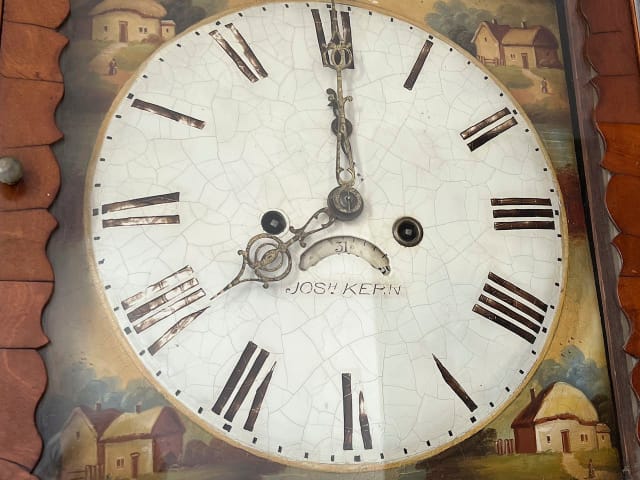
I was carrying out an interview for the Granada Television project a few years ago and had visited an interviewee in his very elegant house in Manchester, close to the university. He had a fine array of antique furniture and paintings and also a collection of clocks. I didn’t give the clocks a second thought. The interview began and was going well when suddenly the grandfather clock in the hall boomed out at 4.00pm, BONG, BONG, BONG, BONG! This was immediately followed by a Westminster chime from the clock in the lounge where we were sitting, then another chime from the dining room, a delightful ping from the kitchen and a cuckoo clock as well. I stopped the interview. ‘Oh, we’ll be okay now,’ he insisted, ‘Well at least until 5.00pm.’
If it’s not animals interrupting it’s usually clocks. Clare Jenkins remembers a similar situation: ‘There was the man I interviewed who had three grandfather clocks in the room. In the end I had to ask if we could move rooms – it was either that or he’d have had to stop all three of them from tick-tocking.’
Cynthia Brown recalls an unusual hazard encountered by a colleague: ‘An open fire spat sparks from a log onto the interviewee’s carpet and set part of it on fire. The shouts on the recording at that point were accompanied by both of them jumping on the burning bit to put it out (as was duly noted in the transcript)’.
Yes, unexpected things can happen when interviewing and I seem to have attracted more than my fair share. In the 1980s I went to interview an old man well into his nineties. He was the son of a famous Liverpool goalkeeper who had played for Liverpool in 1904. I was doing a book about the Liverpool Kop and people’s memories of it and this man had been at Anfield before the Kop had been built in 1906. ‘Come round on Saturday lunchtime,‘ his son told me. ‘Dad will be coming over for dinner and you can do the interview and then go off to Anfield for the game.‘
I arrived only to find that not only was he still at the dinner table, enjoying his roast beef and Yorkshire pudding, but had been joined by the entire extended family, about a dozen of them, all still eating. He was a lovely old man and I didn’t want to spoil everyone’s enjoyment of the occasion. I could hardly whisk him off to the quiet of another room. So we did the interview over pudding and rattling spoons, with everyone attentively listening in. It was not a good interview. He had interesting memories but was rather monosyllabic in his answers. However, it was amazing to talk to someone who had been at a football match in 1904. It’s almost certainly the earliest recollections recorded of a Liverpool fan.
Julia Letts had an incident that certainly takes some beating when she was conducting an interview:
I was interviewing a wonderful man who’d spent most of his life on the River Teme in Herefordshire, starting work aged 14 as part of a river gang clearing and dredging the river. He was a brilliant interviewee, his stories were vivid and at times I felt like I was standing next to him on the river bank, seeing and hearing what he was describing so graphically. So it came as an enormous shock when the imagined sounds of bird song and lapping water were interrupted by an enormous crash, sudden and intensely loud, and for a moment I had no idea what had happened. We both realised quite quickly that a vast Victorian gilded mirror hanging on the wall behind my interviewee had fallen from its fixing and crashed to the floor, splintering into a thousand pieces. In that moment neither of us moved. We literally froze. Then, instantly, we hurtled from the idyllic past he’d been describing back into the present. Coming to, I muttered something and fumblingly turned the recorder off. My interviewee took the interruption in his stride, called his wife who appeared with a dustpan and brush and the two of them busily moved furniture and cleared up the mirror shards. Then my interviewee settled back into his chair and continued where he had left off. I however felt the need to say on the recording, ‘For anyone listening to this, a large mirror has just fallen off the wall, but we are both fine and continuing with the interview’.