One of our more recently funded projects is proving more challenging than most. Green Corridors North East brings together the National Trust, local councils, wildlife trusts, three universities, and community organisations across Gateshead, Durham, and South Tees to explore how people relate to the green spaces and heritage on their doorsteps. It’s funded by the Arts and Humanities Research Council as one of three Mission Awards. This is a programme designed to put the team, rather than the individual researcher, at the centre of how research gets done.
One of the first conversations we had within the Collective was about who actually holds the agenda.
That question sits at the heart of a paper we’ve just published on History & Policy, written collectively by university researchers and community partners who have worked together in the Newcastle University Oral History Collective over the past decade. It’s called ‘Who Holds the Agenda? Participation, Partnership, Power, and the Funding of Collaborative Oral History Research’
The word “collaboration” now appears increasingly in funding applications. And while the clumsy term might make many oral historians queasy, it is an area that most of us in oral history already know from experience.
But collaboration with whom, on whose terms, and towards whose ends? Sherry Arnstein made the same point back in 1969, when she argued that most of what institutions call participation sits at the lower rungs of her ladder — informing and consulting rather than genuinely sharing power. Fifty years on, the language has got more sophisticated. The structures, not so much. Funding still flows via institutions. Communities still participate within frameworks they did not design, on timelines they did not set, towards outputs they do not control. The AHRC, UKRI, and the National Lottery Heritage Fund all use the language of co-production and partnership. The paper traces how that language developed and why, despite it, the structural problem has proved so persistent.
What we’ve tried to do is show what extending shared authority looks like in practice, drawing on five projects the Collective has run over the past decade. In Foodbank Histories, working with West End Foodbank and Northern Cultural Projects in Newcastle, the research questions were shaped by people who used and staffed the foodbank, not only by academics. In the Byker Community Archive, now opening on the estate itself, residents are being progressively upskilled to take full control. The long-term aim is for the archive to be entirely community-led and community-run. In Positively Spoken, young people living with HIV co-produced, collected, and creatively shared their own oral histories, challenging the archival conventions built around an older narrator. Each of these projects required working against the grain of how research funding is normally structured, not simply along it.
What comes through clearly across most of the work we do from Newcastle is that communities are most involved when the research questions belong to them from the beginning. And not when they’re brought in after the agenda has already been fixed. Remuneration matters too. The asymmetry between institutions that hold grants and partners who contribute knowledge and labour isn’t resolved by goodwill. And the reduced capacity of community organisations after years of austerity must be factored into how projects are designed and budgeted, not treated as someone else’s problem.
We’re aware of the irony of making this argument from inside a university led funding bid. Green Corridors is funded through institutions, on timelines institutions agreed, towards outputs institutions will be held accountable for. That’s the structure we’re working within. But it’s also why we think the argument in the paper matters, not as criticism from the outside, but as a set of questions, we’re asking ourselves as we go.
The full paper is free to read at History & Policy.
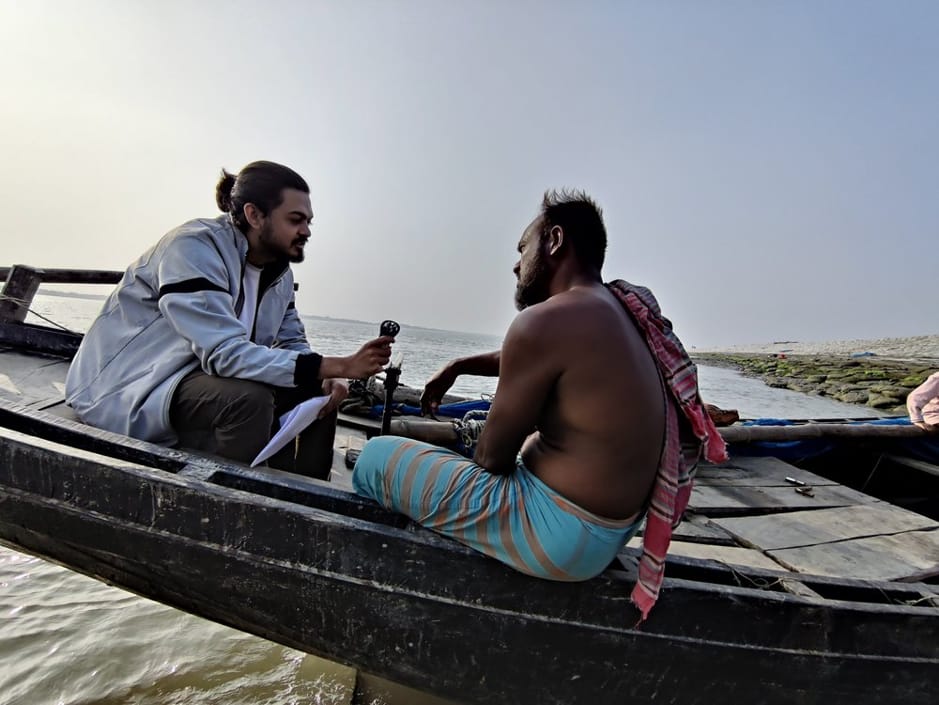
Featured image: Horinkhola, Bangladesh, Oral History, Living Deltas, (photo: Abdul Mobin, Ibna Hafiz, 2023)