Ngũgĩ wa Thiong’o’s seminal text Decolonising the Mind opens with an evening from his childhood in colonial Kenya. Gathered around a fire with other children, he listens as an older relative tells a story in Gikuyu, the language of the Agĩkũyũ people of Mount Kenya. The next day he would rise with anticipation, eager to recount these stories of deceptive hyenas and brave hares to others as they picked pyrethrum and coffee on plantations owned by European and African landlords. He describes those evenings as an education of repetition and imagination that colonial schooling was built to destroy.
In 1952, Britain declared a state of emergency over Kenya, and independent schools run by Kenyan nationalists were seized. Any child caught speaking Gikuyu on school grounds was caned and in extreme cases made to wear a metal plate around their neck, engraved with words like “I AM STUPID” or “I AM A DONKEY” (Ngũgĩ wa Thiong’o, Decolonising the Mind: The Politics of Language in African Literature, 1986). Almost overnight, English became the official language of instruction, and with it, the only language Kenya’s own history could exist in.
I often return to that scene because it so poignantly illustrates what has happened, and continues to happen, to African collective memory.
On one hand, African oral tradition runs centuries deep, surviving in proverb, praise song, and the way my grandfather will answer a question sideways instead of directly. Simultaneously, though, that tradition tends to stop short of the household. Parents, especially those who migrate, often do not recount their lived experiences to their children, sometimes out of protection and sometimes because of the great difficulty that comes with attaching words to grief. Whatever the reason, once the cord of memory is cut, it is left to be patched by whoever holds the needle. For most of African history, that has meant the colonizer’s record, or no record at all.
Narrating the Nation: A Polyphonic Archive is my attempt to weave something of ours back into the fold.
Everything is Gone, Everything Remains
Between July and September 2026, I independently conducted, edited, and built five portraits which now exist as volume 1 of Narrating the Nation. The five speakers cover a broad expanse of contemporary African history, carrying readers from civic resistance during Zimbabwe’s #ThisFlag movement to wartime hunger during the Nigeria-Biafra War, alongside the everyday life that surrounds them.
One such narrator, Meron Estefanos, grew up in Ethiopia-occupied Eritrea during the thirty-year struggle for independence. In reflecting on her early impression of Ethiopian culture, she recalled a refusal to speak Amharic as a schoolgirl despite national policies that enforced it.
“Now, when I think about it, it’s sad as a child to hate a language, to intentionally tell your brain, ‘I don’t want to learn this,’ even though you understand it, because understanding it would mean that you are part of the enemy.”
(Estefanos, “The Old Meron Is Dead,” interview by Florence Onyiuke, August 26, 2026)
Meron went on to become a journalist and human rights activist, documenting and negotiating the release of Eritreans kidnapped and ransomed by traffickers in the Sinai and Libya. For over fifteen years she has run a one-woman radio hotline out of her kitchen in Stockholm, taking calls at all hours from refugee boats in distress and people held in captivity, pleading with her for help.
Despite her remarkable resolve, Meron holds no reservations about what she has lost doing this work. In our conversation, she plainly recounted lost friends, family, lovers, and even a sense of laughter she can no longer access since becoming aware of the immense suffering of Eritreans simply trying to live normal lives.
Her portrait, like the others, explores themes of national duty, resilience, self-erasure, and regret through a soundtrack of her choosing. Some songs serve as historical interludes while others, like “Gual Hagerey,” have instilled in her the lasting confidence needed to overcome colorism as a child and to speak out against EU immigration policies as an adult. The result of these rhythms is an immersive polyphony where voice and music fold childhood, adolescence, and adulthood into a singular breathing present.
“Yemane Barya doing that song, the likable color [“Gual Hagerey”]—this song gave me hope and made me love my color. If it wasn’t for this song, I probably would have low self-esteem or something.”
(Estefanos, “The Old Meron Is Dead,” interview by Florence Onyiuke, August 26, 2026)
Still, the archive embodies a unique methodology that invites readers to experience the lives of each narrator while intentionally refusing to resolve moral complexity. A reader will not leave with a clear answer on whether Meron’s choice to fight for kidnapped refugees was in fact worth it, or whether her father was right for cautioning her against a life of activism. Her portrait, like the others, offers no neat timelines or interpretive overviews; you will need to do that analytic work yourself. This choice demands that African histories be engaged with the same rigor and literary intentionality as those of any major civilization.
What I find most rewarding about the final product is what it does to the concept of time. By letting each portrait jump freely across decades, the archive rejects the closed, sequential boundaries that public history so often assigns to African life. Achille Mbembe calls this entanglement, the idea that time does not pass in a linear sequence, but folds back on itself in layers (Mbembe, On the Postcolony, 2001). For Meron, Evan, Felix, A.K., Gloria, and all of us, the past has no clear end. My goal with these methods is to push oral history to trust a narrator’s own sense of temporality as much as it trusts their spoken words.
Volume 1 of Narrating the Nation represents the foundation of an expanding archival effort. I have written each portrait to be legible at once to general readers, to scholars of oral history and African studies, and to the narrators’ own families, for whom a portrait is an inheritance.
Much like the flame-lit storytellings of Ngũgĩ’s childhood, my work seeks to preserve a version of African history that can be found only in personal memory. It reclaims the work of historical accounting for Africans and Africanists alike, speaking in the familiar, unmediated language of our own people.
Narrating the Nation can be accessed here (narratingthenation.com).
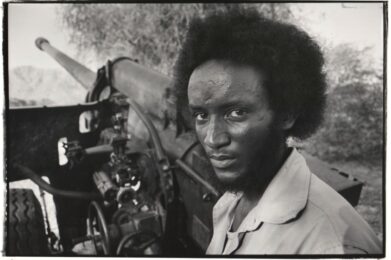
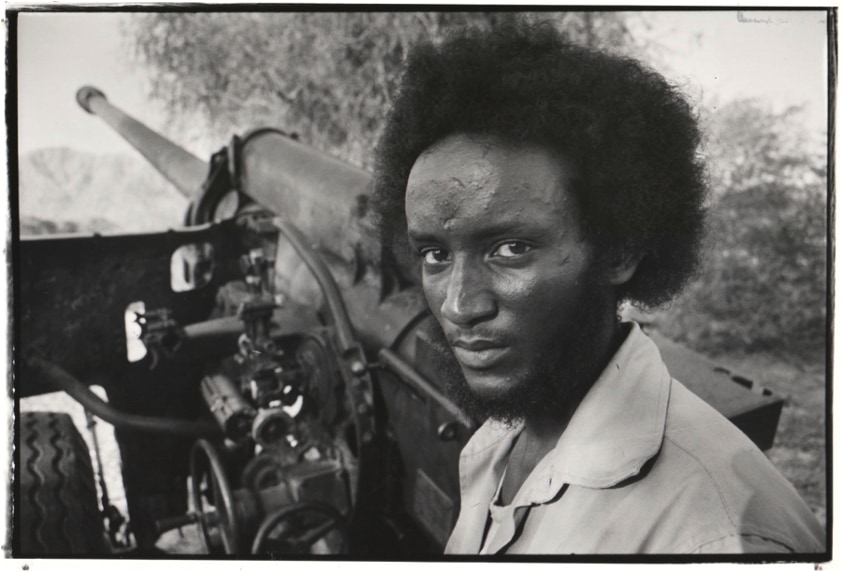
Featured image: An EPLF fighter stands in front of a captured Soviet-made cannon used in the taking of the port of Massawa, June 29, 1990. Source: Martin Plaut, martinplaut.com, from his personal collection of photographs from the Eritrean war for independence.