Notes from the OHS Regional Network event, 2 March 2024
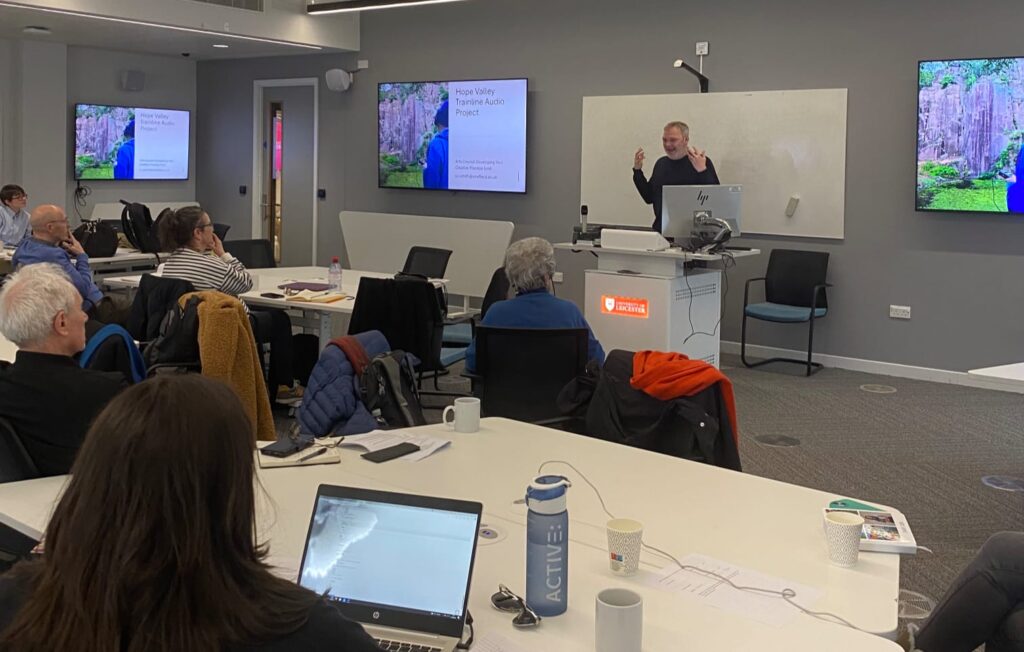
In March 2024 the Oral History Society Network of Regional Advisers held its annual event at the University of Leicester, hosted by Colin Hyde, manager of the East Midlands Oral History Archive (EMOHA), and Cynthia Brown, one of its previous managers. These events – a business meeting followed by a day of discussion around a particular theme – help us to keep up to date with recent developments or current issues relating to oral history. Many Regional Advisors are freelancers, or the only oral history practitioners in their workplaces, so it is also a welcome opportunity to meet and talk with each other in person.
The theme of this year’s event was ‘Future Oral History’, as outlined by Cynthia Brown in her introduction to the day:
We are not here – fortunately – to discuss if oral history has a future. We would not be here at all if we didn’t believe that is does; and there is abundant evidence that it is thriving and developing into areas that were barely thought of when I began my own oral history career around 30 years ago. Perhaps the most striking aspect is the growth of academic oral history, with much support from research councils such as the AHRC and ESRC; but you have only to look through the latest edition of ‘Current British Work’ in Oral History to get a sense of the number and variety of community-based projects. We are here because we do believe in the future of oral history, and want to play our part in making it as secure and as accessible as we can.
This is not to suggest that we don’t – and won’t – face difficulties and challenges along the way. Some of these challenges are constant and unlikely to go away – not least that of funding. How do we finance our own projects, or advise the people who contact us about sources of funding for theirs? The National Heritage Lottery Fund (NLHF) remains a major resource for community organisations, but are there other local or national sources of which we need to be aware? The OHS is currently investigating, and would welcome any information or suggestions you may have. However, as local authority budgets come under increasing pressure, along with those of academic institutions, oral history-based work can be seen as a ‘soft’ target for cuts or closures, as the recent ‘discontinuation’ of the Centre for Memory, Narrative and Histories at the University of Brighton has demonstrated. Nor can we be complacent about the future of the Oral History Society itself, which is very dependent on its funding from membership subscriptions – though we can do our bit to persuade those we advise of the benefits of membership.
The main focus today, though, is on how we can not only address some of the challenges of future oral history, but capitalise on the opportunities that are on offer.
How do we ensure that the oral histories recorded in the past and present – and those yet to come – will be safely preserved and made accessible in the future?
How do we continue to engage with wider – and younger – audiences, taking more creative approaches to collecting and using oral histories, or making the most of new or improved technology and social media?
And how do we address the specific issues that Artificial Intelligence raises for oral history practice and process, and capitalise on its potential, when there are still so many unknowns around it?
‘Let’s not panic’ was the advice I got after discussing some of the knowns and unknowns with someone who works in the field of Information Technology. Yes, there are serious issues around fake news and stolen identities, and we need to do whatever we can to persuade people to be more sceptical about what they see and hear. Nevertheless, a lot of AI as it relates to oral history is within our control. Take, for example, the question of whether AI can collect oral histories – one of those that we will be discussing later today. If the answer is yes (as it is) we still have a choice about whether we actually use it in that way.
So let’s not panic. Let’s have informed discussions about this and the other aspects of today’s programme. Let’s continue to keep up to date, and share what we know and think with each other and those who come to us for advice. Let’s enjoy this opportunity to spend some time together. And now, let’s get on with the business of today…
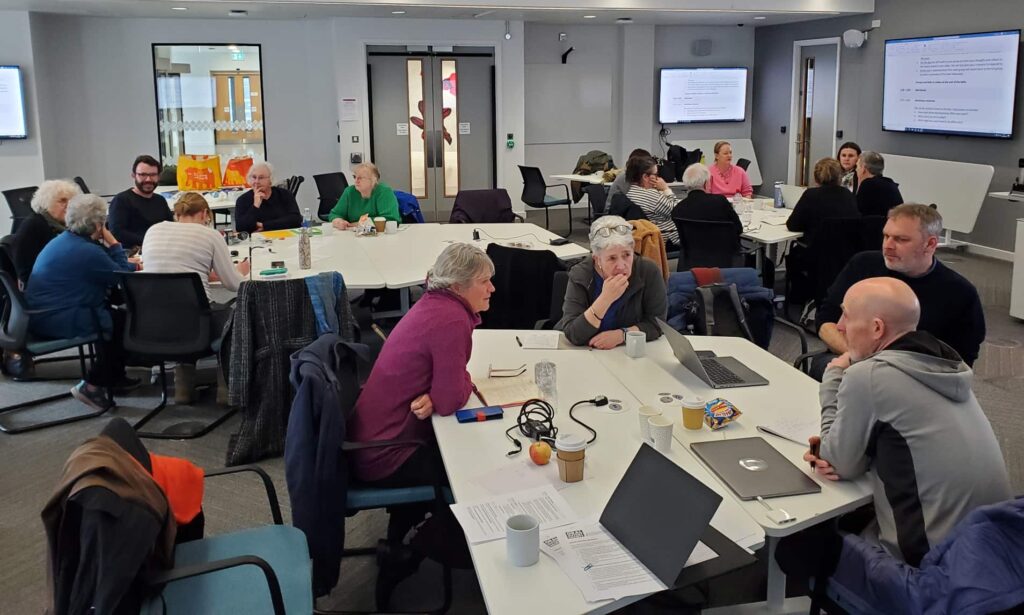
So what did we cover? Only a brief outline can be given here – but in the morning session we had presentations on different aspects of oral history, its preservation and accessibility, and how we might use it more creatively. Colin Hyde, a Regional Advisor (RA) for the East Midlands, spoke about the digitisation and cataloguing processes adopted by EMOHA during the Unlocking our Sound Heritage and subsequent Sounds for the Future projects. He also introduced the work of a colleague on ‘Unlocking the connective potential of oral history through Natural Language Processing’, which aims to connect oral history and other types of heritage collections across the UK using Artificial Intelligence, in particular the Congruence Engine project led by the British Museum.
Martin Bisiker, one of our London RA’s, gave a presentation on ‘Technology, Tik Tok and the future of oral history’, focusing on technological developments in the use of video as a capture tool for oral history and how these changes provided opportunities to do oral history ‘another way’. He also reflected on ways in which we might use technology and social media to raise the profile of our projects and attract new and younger audiences. Sam Smith, a Yorkshire RA, spoke about his current project ‘Hope Valley Trainline Soundscapes’, which is funded by an Arts Council’s Developing your Creative Practice grant. Sam has been conducting oral histories and making field recordings to compose music, based on the Hope Valley Trainline from Sheffield to the far border of the Peak District. This has enabled mentoring, equipment and the time to carry out the work. We were also very pleased to welcome Emily Godden an educator and creative technologist based in Suffolk, whose current work with StoryLab is investigating immersive storytelling and virtual heritage in the site-specific context of The Lost City of Dunwich. Emily presented examples of using various software to create immersive experiences, and of using social media to engage audiences through Snapchat and TikTok.
In the afternoon RAs split into groups to discuss one of three videos that they had viewed online in advance of the meeting. These were:
Using AI to Analyze and Organize Oral History
Can AI Collect Oral Histories?
Both positives and negatives emerged. The benefits of AI to increase accessibility to collections, to carry out mundane and repetitive tasks and quickly identify potentially sensitive content were acknowledged. AI generated transcriptions are now 80% accurate and likely to get better, and offer the ability to process vast amounts of data, search for specific terms, and analyse the differences between collections. It was emphasised, however, that AI will not dispense with the need to check transcripts against the original recording.
Concerns were expressed about the possibility of fake content being produced by synthesising voices from oral history recordings. Uploading full interviews may expose interviewees’ personal details to potential fraud, and the danger of companies using our content for data scraping was also identified. Overall it was agreed that we need to reassess our processes and how content is published online, considering if current agreements need changing, and explaining to interviewees the implications of using AI to process and make available their recordings. We also need to keep up with new developments, and continue the discussions that we began during this very constructive and enjoyable Annual Event.