Peak Tracks: The Hope Valley Train Line Soundscape
Sam Smith
The Hope Valley Train line has always been close to my heart. Linking Sheffield to Manchester via the Peak District, it’s a major transportation route and a beautiful journey – a shift from urban to rural and back to urban again. A major reason why people settle and stay in Sheffield is because of the beautiful countryside within walking distance, and the city has recently rebranded itself as the outdoors city, moving away from its post-industrial identity. With the 200th anniversary of the railway last year, it seemed the perfect time to celebrate the Hope Valley.
I was awarded a Developing Your Creative Practice grant from the Arts Council, to explore how the mediums of oral history, music and field recording could be combined.
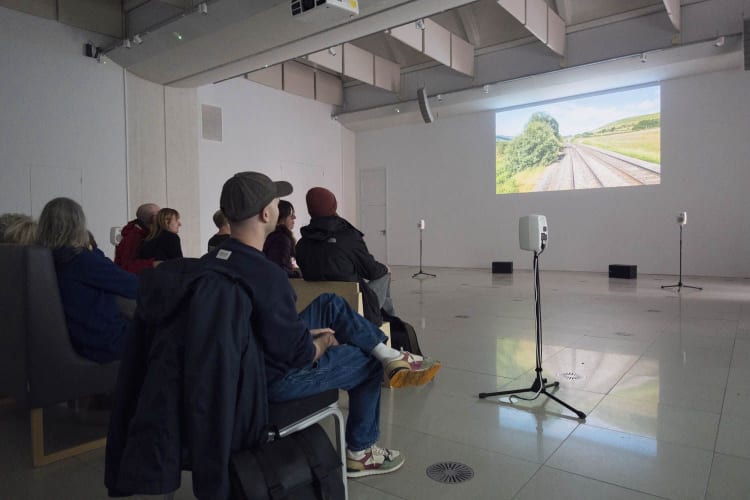
The Peak Tracks Hope Valley Train line soundscape follows the train journey from Sheffield, through the Peak District, to Chinley, with each stop represented by a combination of improvised music, locative field recordings and oral history clips. Self-produced, it also included improvised music from my group Polyhymns. The soundscape premiered at the Millenium Gallery as part of Sensoria Festival in October 2025.
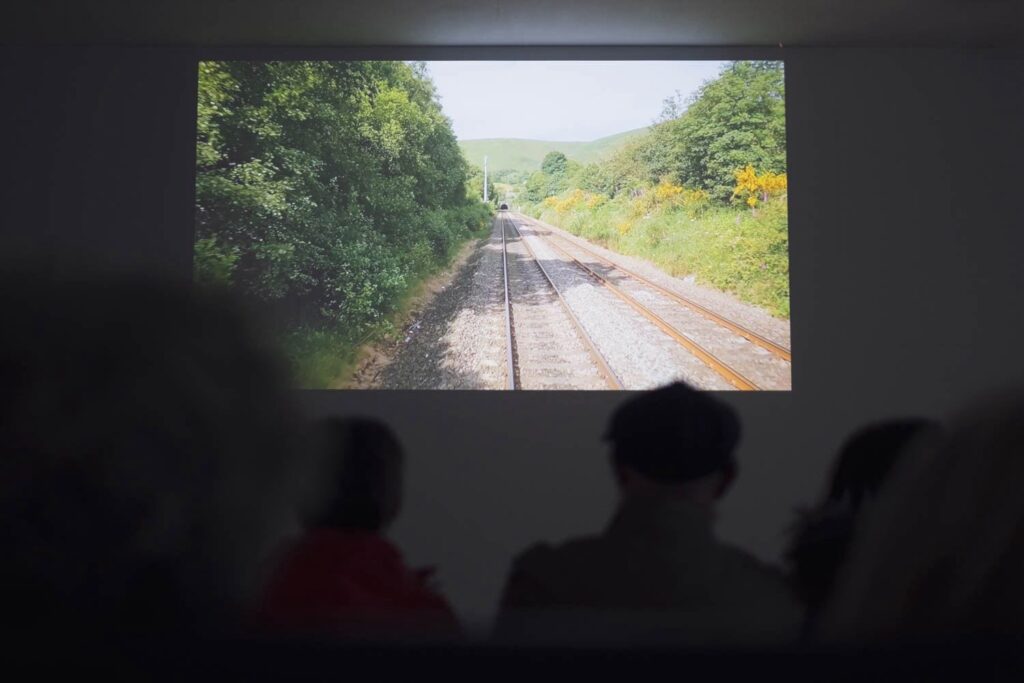
The soundscape is quadraphonic (using four speakers) and set in real time to video footage from the train drivers POV of the journey. The rear speakers featured the sounds of the train, with the voices, field recordings and music in the front stereo speakers. I worked closely with the friends of train station groups along the journey to find people to interview, and to better understand the history of the journey and surrounding places. I interviewed a variety of people for the project, all of whom worked or lived along the route: a train driver, signal person, track workers, farmers, a local historian and a folk singer. The full oral histories have also been archived at Derbyshire Records Office for posterity.
I was delighted by how well the soundscape was received, with nearly 800 people attending the Sensoria Festival installation over four days. It then ran again in Edale Hall, Derbyshire– a key stop along the route – in November ‘25. Extracts from the piece also featured on The Verb on Radio 4, as part of the 200-year anniversary of the modern railway.
At the start of the Arts Council funding period, I carried out research to find similar projects which have incorporated music and oral history, but there were surprisingly few. However, there does seem to have been a recent shift of interest around mixing music and oral history, with places including The Centre for Sound and Image at the University of Greenwich and The University of Birmingham Music Department both increasingly using oral history as a tool for electro-acoustic music making. Past projects such as the Radio Ballads on Radio 2 involved song writing based on oral history interviews and recent community projects such the Northlight Sound Walk in Nelson, Lancashire, working with sound artist Jo Kennedy, have merged oral history and field recordings in creative ways, Nina Perry also wrote her PhD: Music, Narrative, Voice and Presence on the topic of using music alongside voices. Her composition Supermarket Symphony being an excellent example of her work.
The digital world has led to a merging of creative disciplines and, although collecting the source material remains both time and resource intensive, it is now more viable to creatively merge oral histories with field recordings and music. Advances in computer processing speeds and capacity and spatial audio studios and software now enable these fields to be more widely explored. It’s exciting to see how much easier it is becoming to represent and interpret whole acoustic environments – and the identities within them.
All photos taken by Will Roberts
This project was supported using public funding by Arts Council England.
Share this post
Sam Smith
Sam Smith is an Oral History Society accredited trainer on the Introduction to Oral History, Life Story Interviewing Near the End of Life and Audio Editing courses. He is also the OHS Regional Network Coordinator and an Adviser for South Yorkshire.
We use cookies on our website to give you the most relevant experience by remembering your preferences and repeat visits. By clicking “Accept”, you consent to the use of ALL the cookies that feature on this website. For more information on how cookies are used on this website, please refere to the OHS Privacy Policy
The OHS uses cookies to improve your experience while you navigate through our website. Out of these, the cookies that are categorised as necessary are stored on your browser as they are essential for the working of basic functionalities of the website. We also use third-party cookies that help us analyse and understand how you use this website. These cookies will be stored in your browser only with your consent. You also have the option to opt-out of these cookies. But opting out of some of these cookies may affect your browsing experience.
Necessary cookies are absolutely essential for the website to function properly. These cookies ensure basic functionalities and security features of the website, anonymously.
Cookie
Duration
Description
cookielawinfo-checbox-others
11 months
This cookie is set by GDPR Cookie Consent plugin. The cookie is used to store the user consent for the cookies in the category "Other.
cookielawinfo-checkbox-analytics
1 year
This cookies is set by GDPR Cookie Consent WordPress Plugin. The cookie is used to remember the user consent for the cookies under the category "Analytics".
cookielawinfo-checkbox-necessary
1 year
This cookie is set by GDPR Cookie Consent plugin. The cookies is used to store the user consent for the cookies in the category "Necessary".
cookielawinfo-checkbox-performance
1 year
This cookie is set by GDPR Cookie Consent plugin. The cookie is used to store the user consent for the cookies in the category "Performance".
viewed_cookie_policy
11 months
The cookie is set by the GDPR Cookie Consent plugin and is used to store whether or not user has consented to the use of cookies. It does not store any personal data.
Functional cookies help to perform certain functionalities like sharing the content of the website on social media platforms, collect feedbacks, and other third-party features.
Cookie
Duration
Description
cookielawinfo-checkbox-functional
1 year
The cookie is set by GDPR cookie consent to record the user consent for the cookies in the category "Functional".
YouTube cookies
5 months 27 days
A cookie that YouTube sets that measures your bandwidth to determine whether you get the new player interface or the old.
Performance cookies are used to understand and analyze the key performance indexes of the website which helps in delivering a better user experience for the visitors.
Cookie
Duration
Description
swpm_session
session
This cookie is set by the Simple WordPress Membership Plugin. This cookie is used for membership login session and to provide access to the protected content on the website.This cookie keeps the login records so user don't want to authorise each time while moving to next page.
Analytical cookies are used to understand how visitors interact with the website. These cookies help provide information on metrics the number of visitors, bounce rate, traffic source, etc.
Cookie
Duration
Description
Universal Analytics (Google)
2 years
These cookies are used to collect information about how visitors use our website. We use the information to compile reports and to help us improve the website. The cookies collect information in a way that does not directly identify anyone, including the number of visitors to the website and blog, where visitors have come to the website from and the pages they visited.
YSC
session
This cookies is set by Youtube and is used to track the views of embedded videos.
Advertisement cookies are used to provide visitors with relevant ads and marketing campaigns. These cookies track visitors across websites and collect information to provide customized ads.
Cookie
Duration
Description
DoubleClick (part of Google Inc)
1 year 24 days
DoubleClick Campaign Manager sets cookies that are used for serving targeted advertisements relevant to you across the web. Targeted advertisements may be displayed to you based on your previous visits to this website. For example, advertisements about a topic you have expressed an interest in while browsing our site may be displayed to you across the web. In addition, these cookies measure the conversion rate of ads presented to the user.
doubleclick.net
15 minutes
This cookie is set by DoubleClick to determine if the website visitor's browser supports cookies.