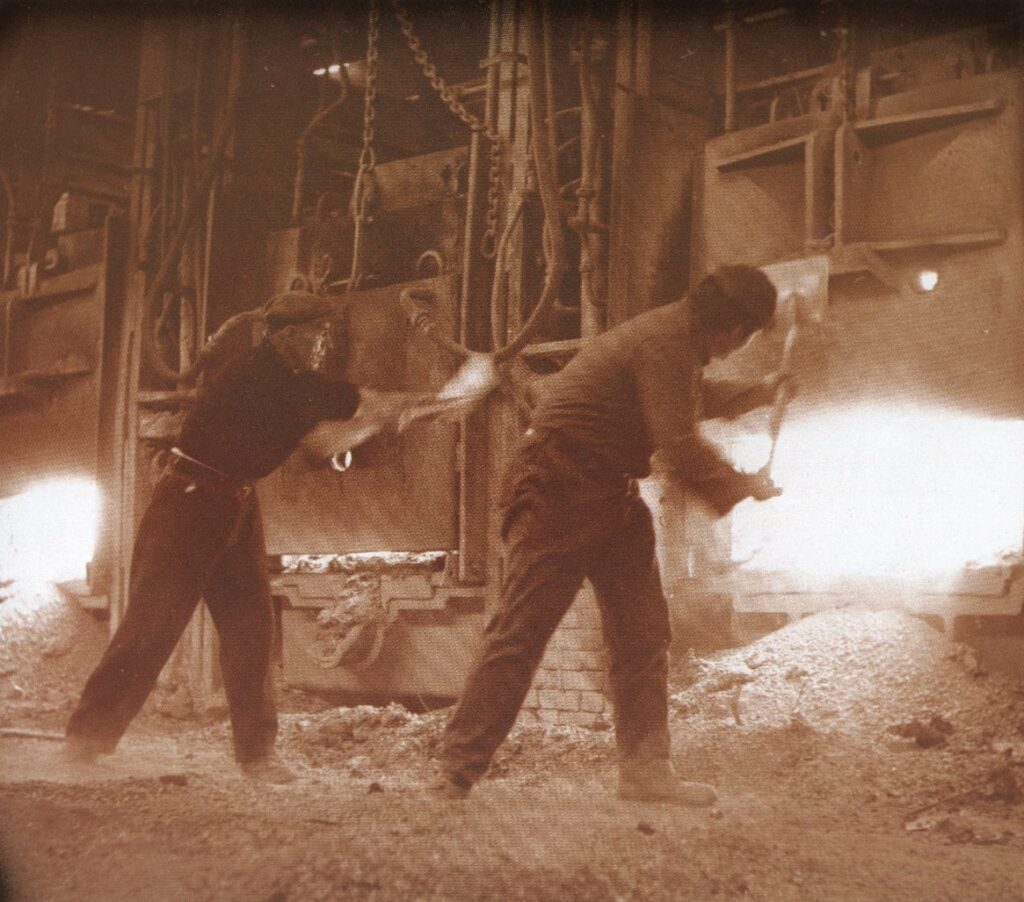
In the Spring of 1991, I got a call from Rob Perks, curator of the Oral History department at the British Library National Sound Archive. They were at advanced stages of getting funding from British Steel to collect the first ever national oral history of the UK’s steel industry. Would I be interested in the post of ‘Project Officer’, whose remit would be to research and interview around 100 people for a new project for the National Life Story Collection that they’d already titled as ‘Lives in Steel’?
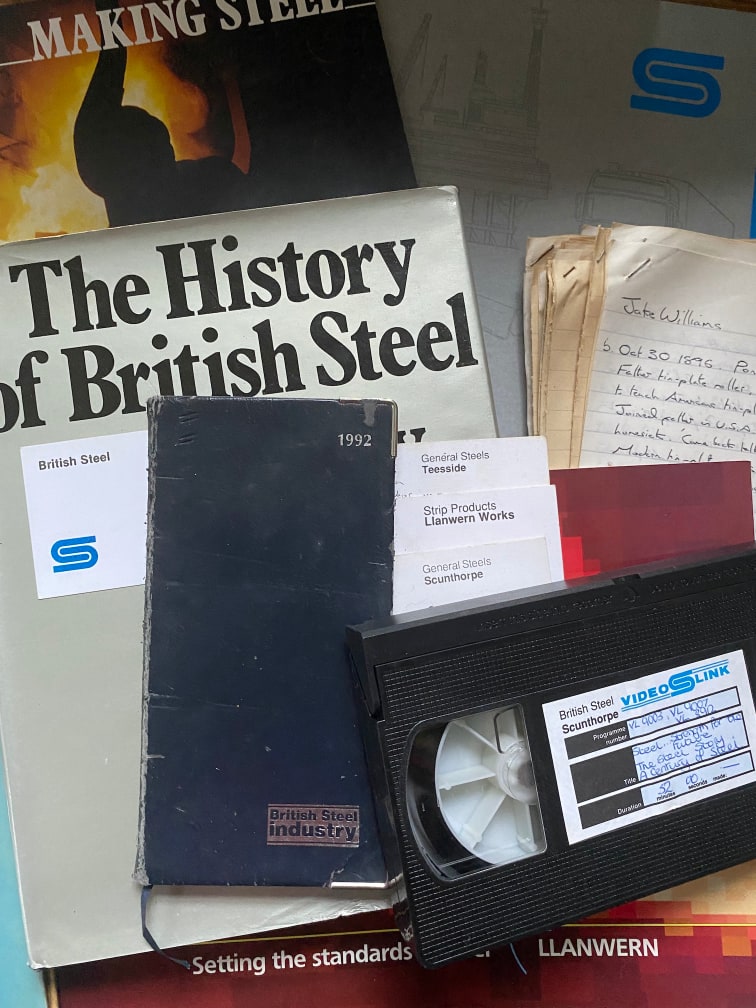
I was a London-based oral historian working for local and national museums, and had never lived or worked outside the capital. I’d have to learn about the subject from scratch, and the terrain was completely unfamiliar. Apart from Sheffield, where I’d once been for a football match, the other key locations – Corby, Scunthorpe, Workington and Redcar in England, Newport, Port Talbot, Ebbw Vale in Wales, and Motherwell in Scotland – were faintly-remembered names from my primary school’s geography curriculum on Britain’s heavy industries, but hadn’t made it onto my bucket-list of locations for upcoming holiday breaks. I accepted the invitation on the spot, and my induction week included a training session on a state-of-the-art Marantz CP430 cassette tape recorder and meetings with various officials from British Steel. It was immediately transparent to me that there was a collective passion for steel-making and more significantly, a fondness for ‘steel people’. I was wished “good luck” and presented with a deep pile of steel-related literature, VHS tapes of in-house training videos – plus a British Steel pocket diary.
No number of preliminary conversations and pictures and textbook descriptions of the steel making process could compare with my first visit to a steel works. I was given a hard hat by my guide at ‘Steel House’, British Steel’s HQ in Redcar, Teesside and was told that the tour would take all day as this was a fully-integrated steel works set across miles of rambling coastline up to the mouth of the River Tees and the North Sea. With my glossary of iron and steel-making terms in hand, I was guided into massive buildings housing blast furnaces, the melting shops that produced liquid steel, and the rolling mills. Back in those days, we were already in the technological era where machines and computers had replaced sheer manpower, and bullet-proof glass screens separated you from naked flames and white-hot molten metal. But I was in the heart of a world I’d never known existed. No-one can, unless they’ve experienced it firsthand. The utter power and fantastic size of the machinery, furious flaming sparks like bonfire indoors on repeat play, and the deep-bass rumbles, the banging and clanging of metal-on-metal.
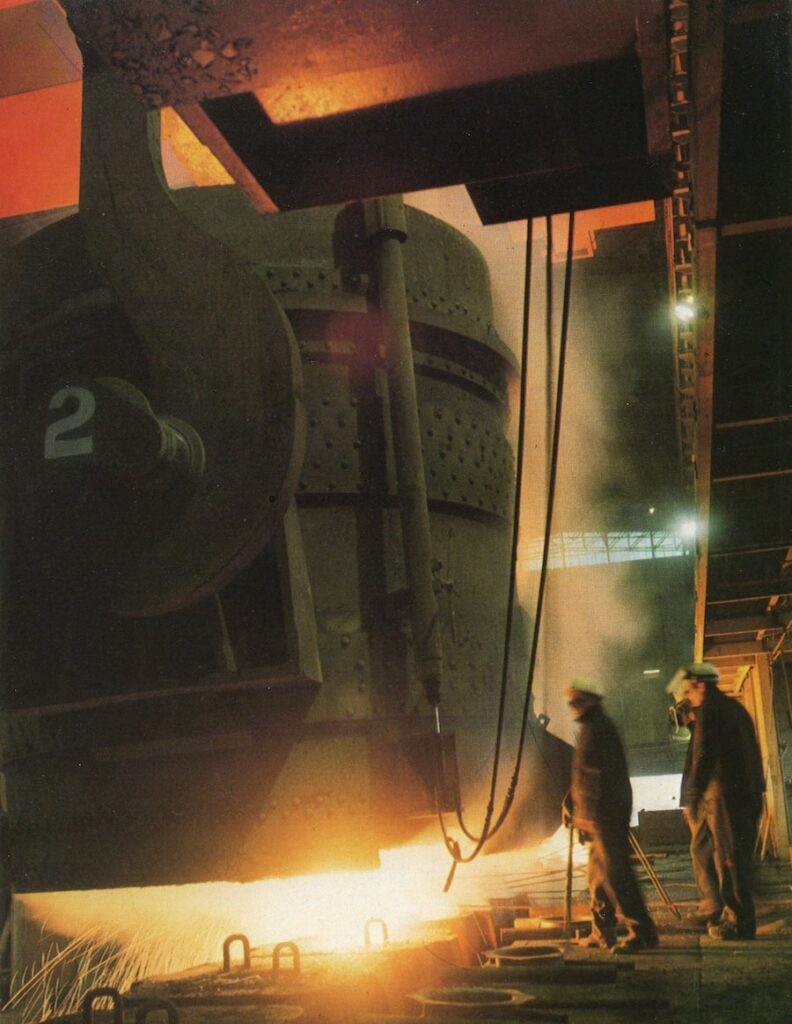
My job remit was to tap the memory banks of a generation of steelworkers who had often started their working lives in the inter-war years. These were far more hazardous times, where danger and extreme physical labour went hand-in-hand. I felt like a fish out of water, ‘an outsider’ employed to collect the living memory of steel-making in places perhaps out of sight and mind from my metropolitan background. But my concerns were eased by Wes, a softly spoken British Steel Welfare Officer in Redcar. He shared with me that the one thing I’ll learn very quickly on this journey is that men of steel love to talk about the work, the communities and the culture that shaped them, and what their steel was used for (from local landmarks like the Tyne Bridge, to the construction of power stations, transmission towers and office blocks). And they will talk and they will talk if you are listening. And, worry-not, a word-of-mouth introduction from a trusted person like Wes, or from one of your interviewees will ease any reticence, and get the recording button rolling.
So, my Lives in Steel interviews began in the north east, then to Scunthorpe, Workington and Corby. My car made it straightforward to get to people’s homes, and in those days before mobile phone, I’d pull over at a public telephone box to set up interviews. Often for the day or the week ahead.
In total I recorded 102 interviews in England, Scotland and Wales for the project. The eldest was Jake Williams a pitman and trade unionist from Morriston, South Wales who was born in 1896. I got to interview women who’d been called-up to the work in the rolling mills during World War 2, trade unionists, management, chemists, skilled furnacemen, rollermen and labourers.
In all, a representative snapshot of the steel industry from its heyday of production, manpower and deep bonds with the economic and social life of its communities. And inevitably, its massive decline with the abundance of cheaper steel from abroad. There were over a third of a million people working in the steel industry in the early 1970s. Today, in 2026, just some 25,000 are employed in steel, and with the possibility that the nation’s last two blast furnaces are set to close this year, the very concept of ‘Lives in Steel’ may be all but consigned to history. A perfect time then to re-visit this 30 plus year old oral history project for ‘Forged in Steel’, a BBC Radio ‘Archive on 4’ feature?
My producer, Martin Williams from BBC Wales, had grown up a stone’s throw from Newport’s Llanwern steelworks so he too had a personal connection to making the programme. The commission itself was based on our plan to speak with descendants of some of my original interviewees – after we’d collectively listen back to the interviews recorded for ‘Lives in Steel’. Fortunately, in recent years I had already been in touch with the Pugh’s in Port Talbot and the Pendlington’s in Teesside. Both had contacted me having discovered the interviews were in the British Library’s archive. We also wanted a representative from my Scottish set of interviews, and through some detective work on social media, I managed to track down Billy Hayhoe, whose father Frank had worked at Clyde Alloy in Motherwell. I’d interviewed Frank in 1992, the very year of the closure of the town’s massive post-war Ravenscraig steelworks.
For the radio programme, my conversations with the families all began after playing back some extracts from their late father’s Lives in Steel interviews. I never underestimate the power of listening back to a voice from past and it was very moving for me to be told that they all found it comforting knowing that it was me who was the interviewer both back then, and now. What followed was a remarkable and very emotional series of reflections and reminiscence – but also significantly an insight into their own life stories as well. All I’d argue, as a result of reflecting back on ‘life story’ interviews – a methodology that helps to shape the experience of the world of work with a wider chronology of the interviewees life.
Inevitably steel making is an emotionally charged subject given the social and economic impact of steel closures in the places where the Pendlington’s, the Pugh’s and the Hayhoe’s all live. It was also really helpful to speak with Louise Miskell, Professor of History at Swansea University. Like my producer Martin Williams, Port Talbot-born Louise grew up in a world of steel. She was also very familiar with the ‘Lives in Steel’ interviews which she’d used in her own research, and she could contextualise how these recordings helped her to investigate the impact of the steel industry on people and communities in Wales. Martin beautifully entwined my new and original interviews within an audio selection of vintage news reports, documentaries and promotional films – and a drive with Stephen Pendlington around the almost deserted landscape where both he and his father had worked in steel.
We were also privileged to have the voices of youth. Rob Pendlington, the grandson of my original interviewee Ben, is a secondary school history teacher. He’d deliberately chosen a different career path to his father and grandfather – and he agreed that it would be really valuable for today’s project to get to hear what his students think about their heritage, their communities, and their future.
A future that will very unlikely be ‘lives in steel’…
The Lives on Steel collection is available at the British Library. Search the Sound and Moving Image catalogue for reference C532. The compilation of edited clips ‘Lives in Steel’ (1993, originally released on cassette and CD) is on SoundCloud .
Visit the BBC website to listen to the BBC R4 ‘Archive on 4’ episode ‘Forged in Steel’ .