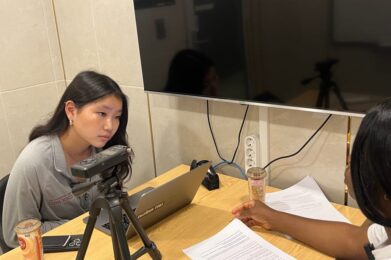
This blog is a reflective piece based on the workshop ‘Crafting Listening: Listening to Craft’ at the Oral History Festival on 4th July 2026.
The workshop explored how different listening conditions shape the way we engage with oral history recordings. Given the importance of listening to our work within oral history, we were curious about our own practices and wanted to open this exploration to others.
What we did
We played a series of four short clips, selected from the British Library’s Craft Lives and Artists’ Lives collections for their rich visual quality, with four different ways of listening. Working in two groups meant that people could choose not to participate in anything they were uncomfortable with, though most chose to experience all four.
The first clip was artist Rory Young’s observations of the London Docks, followed by designer Caroline Broadhead on dressmaking and the body. Silversmith Michael Lloyd recalled making a mace for the Scottish Parliament, and artist Jacqueline Poncelet reflected on haircuts and femininity.
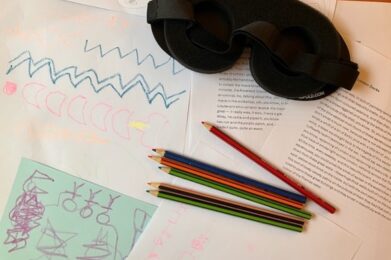
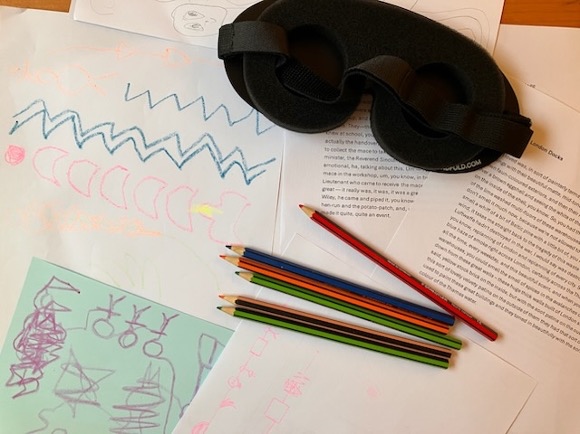
Participants listened wearing a blackout eye mask, following a printed transcript, mark-making (free drawing/doodling), and while looking at related images. We set aside some time in-between playing the clips to discuss the participants’ experiences of listening – how, for example, it felt to listen without seeing; or to listen to the audio and read the transcript simultaneously.
Experiences of listening
We didn’t know how participants would respond to wearing a blindfold, but it was enthusiastically received. The act of putting on and wearing the blackout mask – rather than just closing eyes – seemed to heighten the pure listening experience, and listeners were deeply engaged with it, although conscious of it being an unusual experience. Some participants found themselves wanting further stimulation, suggesting that even when we think we are fully focused on listening, we may also be using other cues to support or filter our concentration.
The immediate reaction to listening with the transcript was, surprisingly, widely negative. Participants found it distracting and began to evaluate the transcription choices rather than engaging with the audio itself. While transcripts are important for accessibility, this reaction highlighted that they are not neutral. It also raises the question of whether a transcript on a slide in a presentation – rather than as an optional handout – is as valuable as we assume. If it distracts from listening, then what role does the transcript play?
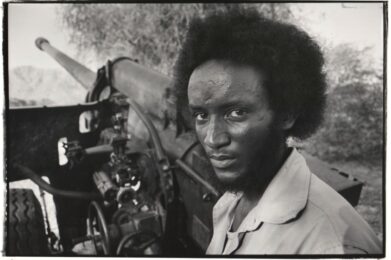
Listening with related images was also controversial. Some liked seeing the speaker’s face, but where an image didn’t relate directly to the audio or hadn’t been fully explained, it caused considerable irritation. This frustration when simultaneously engaging with both visual and audio information at once which some participants felt very strongly was revealing. Perhaps this came from the extra processing energy that the participant needed to use to respond to both sources of information at the same time.
Free drawing, or mark-making provoked the most unexpected response from the participants. Some participants focused strongly on particularly visual passages, while others used their drawing to reflect the speaker’s tone or pace. There was some self-judgement about listeners’ ability to express themselves ‘artistically’ so in future we would downplay the idea of ‘drawing’ in favour of lower-pressure words such as ‘doodling’.
Group reflections
As a group, we were struck by how strongly each way of listening influenced how participants experienced each clip. As oral historians, it’s tempting to add additional information when sharing audio with others, but our exploration suggests that these additions can have a far more profound, and mixed, impact than we expect. Sometimes less is more.
Details matter. One of our participants objected to a transcribed filler that had been written as ‘um’, when she heard it as ‘erm’. Pictures that didn’t have a clear purpose were actively annoying. Conversely, we saw that finding the right supports can enhance listening and take people out of their ‘normal’ ways of engaging. Mark-making opened new perspectives for some, while the blindfolds intensified the experience of being present with the voice.
We discussed potential practical implications when sharing audio clips. We felt it had relevance for experimenting in school workshops, presenting audio in exhibitions or including audio in presentations. Other participants found implications for their personal practice, with the filters offering new ways of processing and analysing audio material between multi-session recordings, or for research. As one participant summarised, the main takeaway is that we must always come back to the audio recording.
Further explorations in listening
It would be fascinating to explore other ways of listening. How would it be to listen while moving expressively, drawing or writing with a non-dominant hand, sitting on floor-cushions or at a desk? What changes when listeners use headphones, for example, make a transcript themselves or watch video clips simultaneously?
Another approach could explore how to match particular clips to specific ways of listening or to consider individual and collective listening: what difference does it make to listen together, and does the collective experience change how we experience listening?
We were conscious of running a workshop within a festival setting and with participants already involved in oral history. It would be interesting to repeat this, or something similar, with less specialist groups. We set out to be playful and experimental, and the feedback from participants suggested that we achieved it, alongside responses that we hadn’t expected.
We’d be delighted to share our experiences and other learnings with anyone considering a workshop like this.
Further reading / references
In this workshop we drew on the British Library collections Crafts Lives and Artist’s Lives but the techniques could be applicable to any oral history collection
Link to Craft Lives Soundcloud – https://soundcloud.com/the-british-library/sets/crafts-lives
Link to Artists’ Lives “Connecting Lines: Artists Talk About Drawing” extracts on Soundcloud https://soundcloud.com/the-british-library/sets/connecting-lines-artists-talk