In 2012, when I was going through the process of adopting my second child, after having my first by a more conventional route, I was consumed by the need to read true life stories of women who had walked the path before me. Auto/biographical accounts of motherhood have primarily focused on the biological mother raising the child she gave birth to. There is a dearth of life writing by and about other types of mother: women who have become mothers through the alternative routes of adoption, surrogacy and egg donation, and their silent partners – the birth mothers, surrogate mothers and egg donors – who have made motherhood possible for them, sometimes at a personal cost. In 2014, two years after becoming an adoptive mother, I embarked on a journey as a PhD student with The Open University, to uncover and narrate their stories.
As a fiction writer and poet, I pitched the PhD as creative writing, and undertook practice-based research, culminating in a collection of women’s stories and a critical meta-narrative analysing the process of writing them. After obtaining ethics approval, I recruited six women to interview for the project: Alison, who conceived her first child via an egg donor in Cyprus before going on to adopt a second child in the UK; Charlotte, an egg donor whose eggs conceived two babies for other families before she had any children of her own; Rubi, a mother who used surrogcy services in India; Robin, a surrogate mother; Lorraine, an adoptive mother who also happened to be adopted as a baby herself; and Margaret, a birth mother now in her seventies, whose baby was adopted through the Church many years ago.
Initially, I envisaged writing up the stories as prose life writing, a subset of creative non-fiction. However, after transcribing the first interviewee’s recorded interviews, I found her voice so riveting that I wanted to preserve it rather than transform it. I turned to the work of oral historians Tony Parker (In No Man’s Land: Some Unmarried Mothers) and Svetlana Alexievich (Voices from Chernobyl), as examples of finely edited interviews. I found the unique, idiosyncratic voices in these published verbatim accounts utterly compelling and used them as inspiration in editing Alison’s transcripts. I grappled with whether such work could be classified as creative writing, sensing that I would somehow be ‘cheating’ in submitting edited interviews for a PhD in Creative Writing. In Alexievich’s interview on receiving the Nobel Prize for Literature in 2015, she referred to Voices from Chernobyl as a ‘novel of voices’ (Chayka, 2015), highlighting its artistic value. Parker’s writing has been similarly discussed:
John Banville, the novelist, makes the point in his review of Parker’s (1991) Life After Life: ‘Tony Parker’s material is tape-recorded speech but he is a very cunning writer. By means of arrangement and pattern, rhythm and tone… he makes out of these tape-recorded testimonies a kind of art that is all the more affecting because it springs from fact.’ (Barton, 2018, p. 251)
For Alison’s story, I began with an edited interview, interspersed with descriptions of childhood photographs (both from Alison’s childhood and of her children). The decision to use descriptions of photographs was influenced by Janice Galloway’s approach in her memoir, This Is Not About Me (2010), which makes the reader feel as though they are flicking through family albums with her. In addition to preserving Alison’s voice using edited interview format, I wanted to allow some freedom and elasticity for the material to find its own form.
During our meetings, Alison showed me an embroidered quilt that her mother-in-law created to tell their family story. This notion of the quilt, a tapestry, a rich woven artistic product encompassing different images, threads and stories became an interesting metaphor for the way the project unfolded, combining different voices, registers, stories and forms. The material eventually found its own hybrid form, combining edited verbatim voices with a range of creative forms inspired by the interviews – re-imagined prose scenes, poetry, collages of quotations from other published non-fiction, and personal essays about my own journey as a biological and adoptive mother.
Five years into my research, a book was published by Jo Parnell called New and Experimental Approaches to Writing Lives (2019). In the introduction, Hugh Craig explains how Parnell’s concept of the ‘literary docu-memoir’ has its roots in Tony Parker’s work, and further explains Parnell’s invented form:
Colour and texture is given by the documentary effect of incidental factual materials and photographs. Literary docu-memoir also creates a three-dimensional experience for the reader, by rendering in detail the context of the interviews and the experience of the interviewer. Literary docu-memoir also creates a three-dimensional experience for the reader, by rendering in detail the context of the interviews and the experience of the interviewer. The interviewer puts on a ‘fictional cloak’ as a writer, striving, paradoxically, to create truth by acknowledging the context of imagination and feeling for both subject and interviewer. (Craig in Parnell, 2019, p. 3)
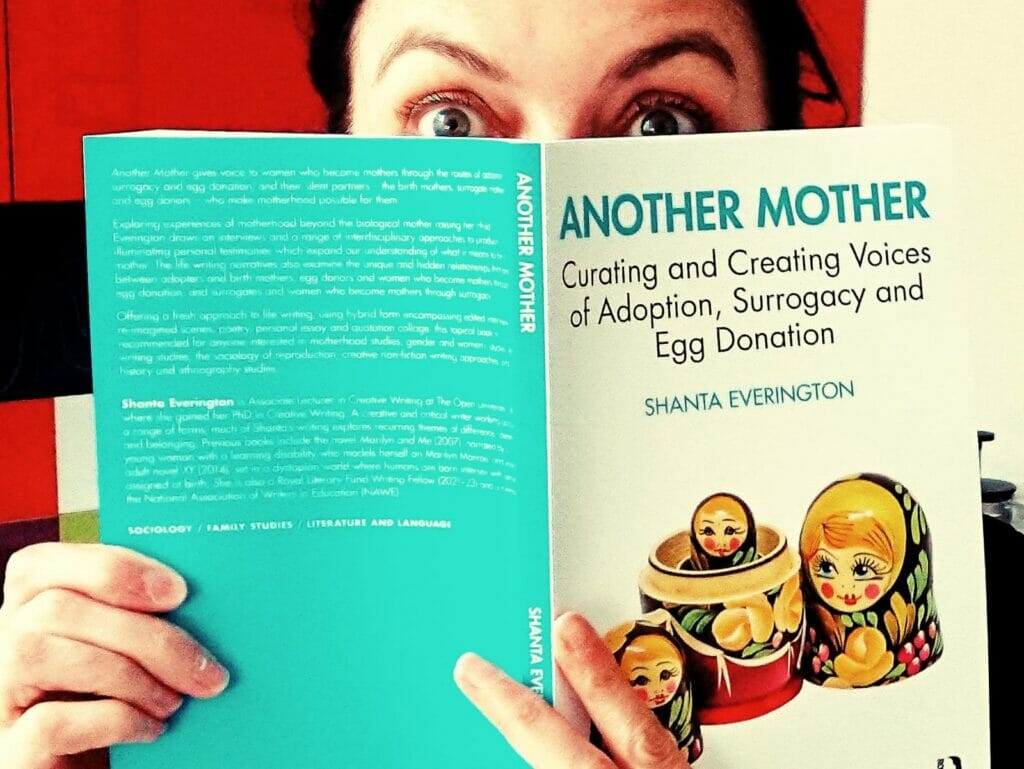
My work builds on these ideas, in providing colour and texture to the interviews through a tapestry of creative and factual components. Nine years after embarking on my PhD journey, the thesis was published in book form as Another Mother: Curating and Creating Voices of Adoption, Surrogacy and Egg Donation by Routledge in June 2023.
References:
Alexievich, S. (1997) Voices from Chernobyl, New York, Picador.
Barton, L. (2018) Disability and Society: Emerging Issues and Insights, Abingdon, Routledge.
Chayka, J. (2015) ‘Svetlana Alexievich – Interview’, Nobelprize.org [Online]. Available at http://www.nobelprize.org/nobel_prizes/literature/laureates/2015/alexievich-interview.html (Accessed 13 November 2015).
Galloway, J. (2010) This Is Not About Me, London, Granta Books.
Parker, T. (1972) In No Man’s Land: Some Unmarried Mothers, London, Faber and Faber.
Parnell, J. (Ed.) (2019) New and Experimental Approaches to Writing Lives, London, Red Globe Press.