“One of St Helens’ most iconic bakeries is to close after its doors for the final time to bring to an end an era lasting nearly seven decades.” St Helens Star, 10th September, 2022.
When I read that Colin Greenall was retiring from running his family bakery business after 60 years I wanted to tell his story.
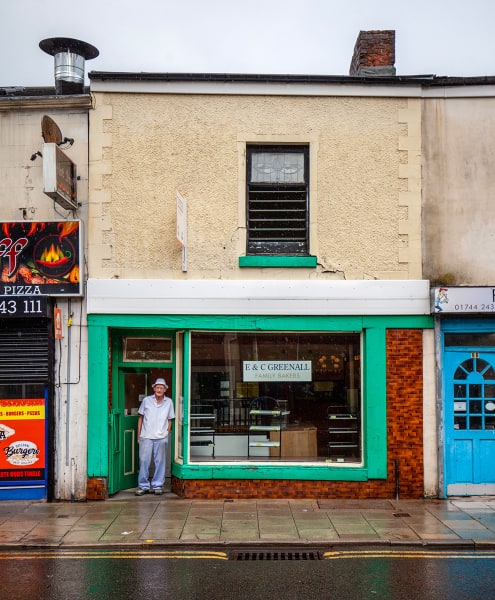
I’ve lived in St Helens, an industrial town in the north-west of England most famous for glassmaking, for most of my life. I’ve driven past Colin’s bakery and shop so many times over the years I’d almost forgotten it was there. Its longevity meant it became a part of the fabric of Duke Street, a main thoroughfare into the town centre. It felt like something that had always been there and would always be there. But as the street changed the mint green window frame with the cakes on display became more distinctive. So too the simple printed sign in the top centre of the window. It symbolised a no-frills modesty. Ask anyone of a certain age in St Helens what Duke Street was like growing up and they will reel off the names of independent sweet shops, butchers, and clothes shops. They are now all gone with barely anything to remember them by. They were the backbone of a town that was hard-working, thrifty and inventive, day after day.
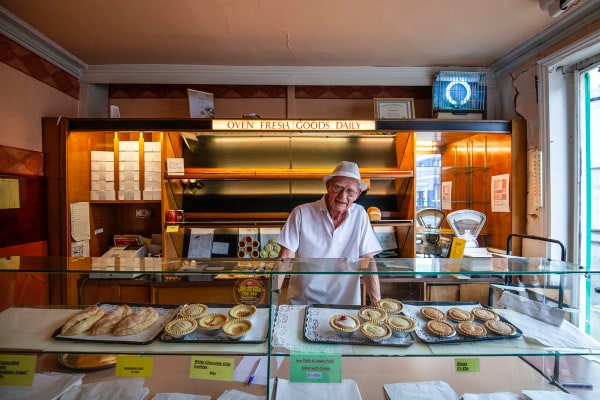
As supermarkets arrived and shopping habits changed, many of the good-based independent retailers were replaced on the street by a night-time economy of bars, fast-food outlets and restaurants. While it’s tempting to romanticise the past, shops like Colin’s perform a social function. They were places to meet, chat, make friends, easing the drudgery and loneliness of everyday life. They helped people to feel connected to their local community. The had their own individual character. As retail moves online and “service” is increasingly prefaced by “self” this daily connection with others is being lost.
Before he closed for the last time, Colin kindly agreed my request to photograph the shop and record an oral history interview with him in November 2022. As chairman of the Sankey Canal Restoration Society – the oldest working canal in the country – he appreciated the local history interest. The shop, established by his mother in 1954, was taken over by Colin in 1970.
I was amazed at how the shop at barely changed in years. My Mum said how much it reminded her of another local bakery she’d worked in the 1970s. ‘Cash only’, a simple laminated product list, cakes filled with “imitation cream”. No LED signs here. In fact, apart from the till and the lights, there was nothing electronic. The pies, pasties and cakes, clearly handmade, smelled delicious.
I was even more surprised entering the bakery. It was a small backroom, with a kitchen smaller than those found in many of the terraced houses that surround the shop. It featured sturdy instruments that were already second-hand when purchased by Colin over 50 years ago. I couldn’t photograph the place fast enough as Colin demonstrated the Pie-Blocker, a heavy iron contraption used to mould the pies into shape, which Colin sold by the load everyday to his loyal customers.
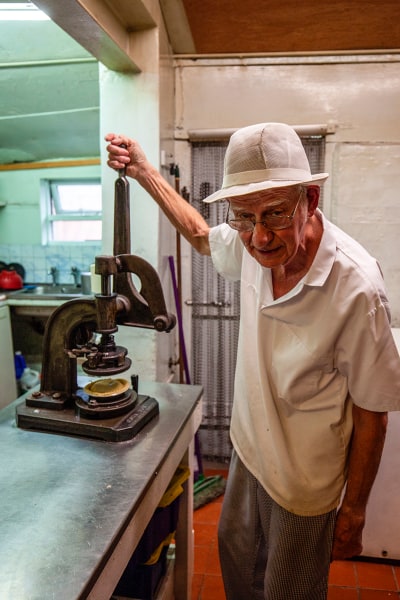
Colin’s mantra was very much “if ain’t broke don’t fix it.” He told me in the subsequent oral history interview – my first ever – that his mother began baking at home after the Second World War for family and friends, and had bought 100 Duke Street for £300 in 1954. He recounted the days when rationing was still on, when they sold a small selection of other groceries, and would kept a tin of salmon under the counter for their favourite customers.
“It’s was a bit like Dad’s Army really!” he said.
Aged 78 he didn’t want to retire but his body – and rising inflation – was taking over.
As I looked round the back room of this place that he’d put his life into, doing 5am starts 6 days a week, only finishing at 6pm, my final question came to me:
“Would you say it’s been a labour of love?”
He smiled and said “it has been a labour of love, yes. I’ve enjoyed every minute of it.”
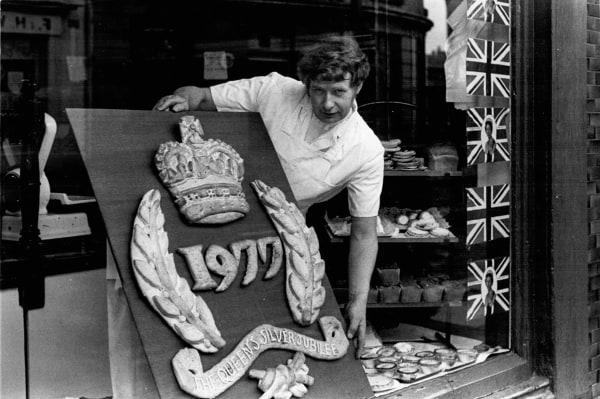
We established a good relationship and Colin kindly provided further artefacts from the shop. Photos of bread wheatsheafs he’d made to commemorate the successes of the town’s rugby league team; one for the 1977 Silver Jubilee, a photo of which showed the Queen and Prince Philip in the royal car riding past the shop; and another for the wedding of Charles and Diana in 1981. There were other items, such as the sales ledger from the very first week of trading, September 6th 1954. Every expense – Lyons Tea, Hovis, 2Ibs of Cooking Apples – was dutifully noted.
The photographs, oral history recordings and a photobook were subsequently exhibited as part of the St Helens Borough of Culture, where Colin’s customers could pay him one last visit. The title? A Labour of Love.
This was my first oral history project after attending training facilitated by OHS. After my fascinating experience telling the story of Colin’s bakery it certainly won’t be the last.
‘A Labour of Love’ is available to buy at https://www.blurb.co.uk/b/11907338
The oral history recordings with Colin Greenall are available at Soundcloud https://rb.gy/ztc72c