About half a year into my interviews with Aluízio Palmar, a former political prisoner and torture victim, I asked whether he wanted to co-author the book that I was writing about his life. Prior to this moment, it is not that I had purposefully avoided the question of authorship—set against the unfolding crisis of the COVID-19 pandemic, my work with Palmar was driven by an initial drive to record as many interviews as possible. Palmar was nearly eighty years old, a diabetic, and living through the uncertain early phases of a global health crisis. The stakes of our interviews felt even higher because Palmar was Brazilian, at a time when his country’s far-right president was actively downplaying the severity of the pandemic.
Outwardly, at least, Palmar seemed less stressed than I did. The pandemic was terrifying, yes, but his life as a political militant had contained a long line of risky moments. From his origins as a student activist in the early 1960s, Palmar became one of the several thousand Brazilians who, in the aftermath of a military coup that ushered in a violent dictatorship, joined the armed revolutionary underground. The regime eventually captured and brutally tortured Palmar, keeping him in a series of detention centres for nearly two years. After his release into exile, Palmar stayed active in political circles in Chile and Argentina, all while trying to dodge the security forces that continued to pursue exiles abroad. Once, while living clandestinely in Argentina in 1974, he very nearly fell victim to a trap that led to the deaths of six other comrades. In the decades that followed, his survivor’s guilt, paired with an earnest commitment to uncovering the crimes of Brazil’s dictatorship, led to his late-in-life transition from political militant to human rights activist. At a time when many people would start contemplating retirement, Palmar began a one-man investigation into the 1974 disappearances of his six comrades. His search for the disappeared bodies led to a wider portfolio of human rights campaigns, and Palmar gradually became an important figure in Brazil’s movement for truth, justice, and accountability about the years of military rule.
In many ways, Palmar’s life story reflected the winding path of Brazilian politics over the past fifty years: the battles between democratic and dictatorial forces, the personal and collective traumas that lingered long afterwards, and the wider efforts to achieve peace and reconciliation. And set against the backdrop of an escalating pandemic, in which I feared that Palmar might not survive, I had pitched him on the idea of writing a biography. He agreed, and with no clear blueprint to follow, we embarked on what became a five-year collaboration.
Methodology
I first met Aluízio Palmar in 2013, while researching my dissertation on the Itaipu dam and the displacement of local farmers, peasants, and Indigenous communities near Foz do Iguaçu. At the time, I had only a general understanding of his larger human rights work. In the years after my fieldwork, we sporadically stayed in touch, mostly on Facebook: he would forward me campaigns he was involved with, and I shared with him the progress of my book.
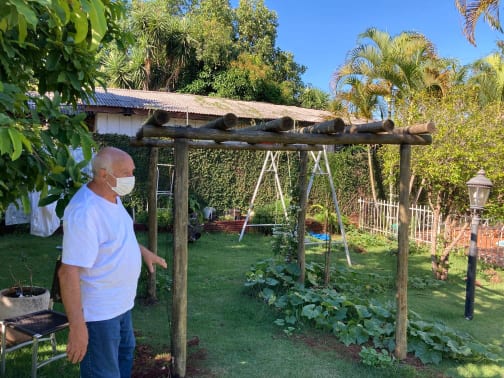
When the pandemic hit and as we found ourselves sitting anxiously at home, I was scared for him. Especially in the early phases of the pandemic, whenever I logged onto Facebook, I worried that I would see his obituary. With both of us stuck at home, I saw an opportunity to conduct a series of virtual interviews. In May 2020, Palmar and I began recording interviews. For the first several months, the conversations took place weekly, and they became more spaced out with time. Over the course of several years, we did twenty-five interviews, totalling nearly forty hours. I also interviewed three dozen people from across Palmar’s life, including other militants, family members, friends, and human rights activists with whom he has worked. All of the interviews, with Palmar and the others, took place digitally, most often using the WhatsApp audio function, but also with video calls on various platforms. This methodology was not without drawbacks, including my own desire to connect more strongly with my interviewees. With a decade of research experience in Brazil, I knew these spaces well: the gardens in Foz do Iguaçu where we would sit on plastic chairs under the shade of guava trees, and the small, yellow-tiled kitchens in Rio de Janeiro, where former militants would serve coffee and share stories of their younger days. But for this project, at this time, researching at a distance would suffice. In parallel with the interviews, I started this project by reading Palmar’s memoir and his testimony to Brazil’s truth commission. I also pored through his online presence, which included an outdated WordPress blog and his still-active Facebook page.
Over the course of our interviews, as I read deeper into the archive of Palmar’s blog and social media posts, I also compiled his digitally available memories, which included a dozen YouTube videos of his old presentations and interviews. This iterative process was useful because, in our conversations, his initial reaction to many questions was to tell me the same stories, with the same details, that he has told elsewhere. Knowing the general patterns of Palmar’s narrative allowed me to anticipate emblematic anecdotes and ask for more information than he had provided elsewhere. And in the instances when he gave dates or names that did not seem to align, I could ask for clarification in real time.
The Dynamics of a Collaborative Biography
In this article, I draw from my recently published biography of Aluízio Palmar to offer reflections on the project’s methodological contributions. In line with the narrative tone of the book itself, this article aims to provide an informal story-driven analysis of how I ended up writing the book. Namely, I focus on what I came to call a “collaborative biography”—a biography in a traditional sense of a professional writer crafting a life story about somebody else, but a bit odd in that the subject of the biography maintained an active role in key parts of the research and production of the book. As we will see, I did not initially seek to write a collaborative biography—it was only as I confronted a string of ethical, authorial, and methodological questions that I realized the need to chart a new approach.
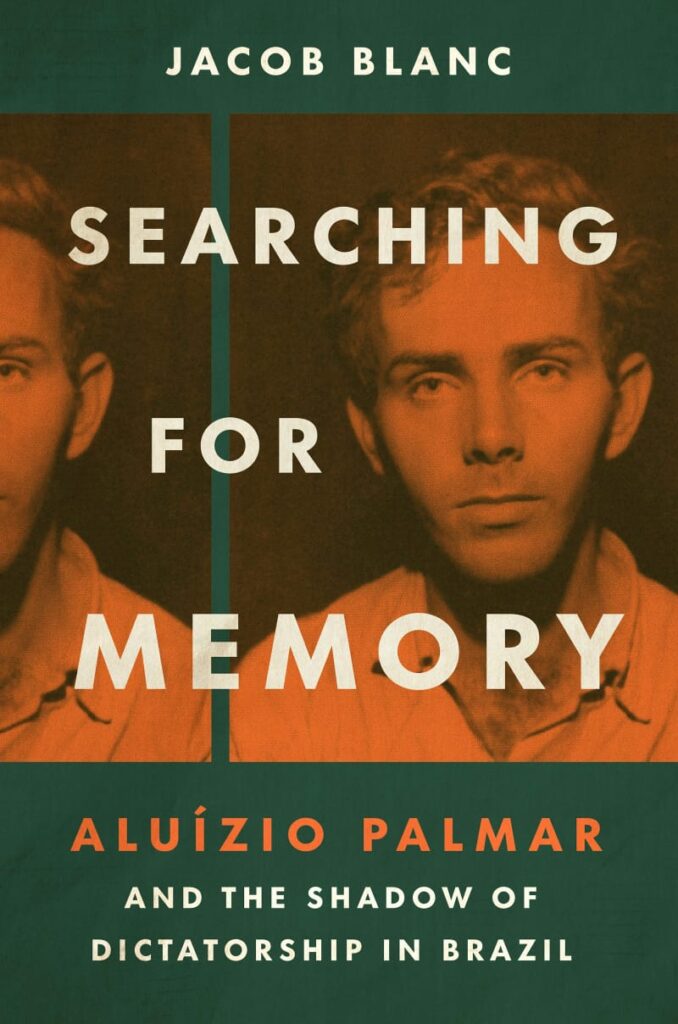
I first broached the subject of authorship in September of 2020, once we had already recorded a dozen lengthy interviews. As a historian of dictatorship and social movements in Latin America, I was familiar with the genre of testimonio, in which an activist, militant, or persecuted figure of some sort would give a lengthy series of interviews that would then be compiled into a life history narrated in the first-person. In testimonio, the interviewer recedes into the background. Because Palmar had already written his own biography some two decades earlier, I knew that he now wanted a professional historian to write about him—he wanted to be biographized. Yet I still wanted to confront the potential ethical problems of me, as a non-Brazilian, writing a life story that would deal with torture, trauma, and the legacies of a tense political life. So I asked him if he wanted to co-author the book with me. He declined, telling me that he already had too much work on his plate. Keen to be the subject of a professional biography, Palmar seemed content to cede the authorial voice to me.
Palmar’s disinterest in co-authoring did not fully resolve potential ethical and methodological concerns. So, I proposed, and Palmar agreed to, the following process for what became a collaborative biography: when I finished a chapter, I would translate it into Portuguese and share it with him, and he offered comments or corrections. He read every section of the book—from which this article derives—and we discussed it afterward. Palmar sometimes insisted on the inclusion of a particular anecdote—when reading my draft chapters, he called attention to stories that he had told me but which I had left out. Often, I stuck to my original choice and did not include the detail, though in key moments, when his insistence felt reflective of a larger theme in his memory script, I added it to the text. And in one case, after a lengthy dialogue with Palmar, I removed certain details. In this article, as in the book, I always tell the reader when these changes happened, how Palmar reacted to my initial draft, and why I ultimately included or removed something. Once the full text was professionally translated, Palmar reread the whole book, offering only a few minor factual and grammatical corrections.
What makes collaborative biography different from other forms of co-creation based on oral history? Michael Frisch’s important term shared authority posits that, because nobody is the single interpreter of an individual or public story, the ability to interpret the past belongs not only to professional historians, but to everyone. This horizontal approach to articulating and sharing stories spans various forms in published work, including in my field of Latin American history. Daniel James’s Doña María’s Story is the leading example, in which James narrates both the life story of, and his exchanges with a working-class Argentinian woman. What differentiates my approach from those of scholars like Frisch or James is that the collaborative aspect of my collaborative biography is not just at the level of oral history (the recording of interviews) or ethics (bringing in the subject as much as possible into my decisions as author), but by folding my subject into my research process itself. In addition to reading and commenting on drafts of the book, Palmar also enabled some of the research that complemented his interviews: he gave me the contact information for most of the three dozen other people that I interviewed, a helpful if not uncomplicated collaboration, as those he wanted me to speak with were more likely to say positive things about him. (I also made my own contacts and interviewed many people that he did not know about beforehand, some of whom had far less nice things to say). Palmar also gave me the phone numbers for all his children. And I drew on Palmar’s own website, Documentos Revelados (Revealed documents), which in addition to housing vast materials related to the era of dictatorship more broadly includes a section dedicated to his own life and the digitization of documents that he personally consulted in police and military archives. In many ways, Palmar was a walking archive—constantly telling his own life history, and having made the narration of that story a key part of his human rights activism over the previous four decades. He was an eager, if not always uncomplicated, collaborator.
What can make a collaborative biography so revealing—the proximity between writer and subject—also makes it very difficult to navigate. My analysis of Palmar’s memories required entering an uncomfortable space of studying, and at times complicating, the statements of a torture victim who dedicated the second half of his life to human rights activism. Writing a biography of someone who is still alive is tricky enough, and it can be even more complicated when you already know that person and respect them. When triangulating the various platforms of Palmar’s memory, I also discovered some discrepancies, in which he seemed to stylize his memories in ways that did not always align. As part of our collaborative biography, when I came across these moments of misaligned memories, I shared them with Palmar. And in turn, I would have to describe for readers his reactions to these discrepancies.
Examples of a Collaborative Biography
To illustrate the methods of a collaborative biography—the mechanisms through which I researched and wrote the biography and also the positionality through which I had to embed myself into the text of the biography itself—this article will chronicle three emblematic examples. Proceeding in a roughly chronological order, the three examples help chart Palmar’s life while also showcasing three different types of archival sources that I used as a complement to the primary corpus of oral history interviews. All three cases help illustrate the dynamics of a memory-based biography, their collaborative methods, and the potential benefits—and drawbacks—for embracing the first-person narrative and sharing with readers one’s own positionality and vulnerability as author.
Example One: Gender, Sex, and Nostalgia for the Freedom of the 1960s
Aluízio Palmar was born in 1943 in São Fidélis, a town in the northern interior of Rio de Janeiro state, where his parents ran a small dry goods store. When Palmar was sixteen, his family moved to the coast and lived in a suburb of Niterói, the bustling port city across the Guanabara Bay from Rio de Janeiro. Palmar’s adolescence in the early 1960s took place against the backdrop of a changing Brazil. Under the presidency of the leftist reformer João Goulart, Palmar—like many of his generation—was active in student politics, through which he was recruited to join one of the many Marxist groups of the time. As was the case with most of his friends, Palmar would eventually join the Brazilian Communist Party (PCB), though he would later leave, thinking that they were not radical enough.
In the aftermath of the military’s 1964 coup, Palmar was prepared to go underground and begin guerrilla training to, it was hoped, follow the example of the Cuban revolution and overthrow the dictatorship. As he recounted in a post on his Facebook page, Palmar held a strong memory of his final night before leaving. This anecdote is one that he insisted that I include a story that was not in an early draft of the book. Tinged with masculine nostalgia and a sexualized sense of the dangers that awaited him, Palmar wrote on Facebook about a student dance at the local university, where he met a young woman:
Her body moving and sweating, it was like a rite of departure at a student party in Niterói. Around midnight, as the party was ending, she asks me,
“Are you driving?”
“No, I live close to here.”
“Can I go back with you?”
She looked at me as if it were the last time, she laid her head on my shoulder and suddenly I saw her eyes fill with tears.
And, without really knowing why, I said,
“Don’t be sad, we can see each other again tomorrow.”
“Tomorrow?”
It was almost like she knew that I was going to Paraná, as if the secret of [our] MR-8 [revolutionary group] had leaked out.
Palmar’s anecdote about the woman—and his insistence that I include it in the biography—is emblematic of the types of masculinity that shaped revolutionary politics in Brazil and globally, when the rugged persona of Che Guevara mixed with the veneer of 1960s sexual revolution. And because Palmar’s Facebook page is a central part of his public engagement, its stylized sexuality also reflects the performative gender role that features strongly in the broader genre of militant memoirs. In Palmar’s narrative, Jane serves a narrative device representing the freedom (whether sexual or political) that Palmar was sacrificing by going underground. And anchored by the image of her sweating, dancing body, Palmar’s depiction of Jane, and her alleged eagerness to go home with him, serves as a romanticized sendoff for a young militant at the start of a dangerous unknown. That Palmar did not bring Jane back to his apartment is also meant as a signal to his audience that even in such moments, he remained committed to the political task at hand.
Example Two: a Phantom March
While Palmar was conducting guerilla training in the dense Atlantic rainforest along the Brazil–Argentina border, the opposition movement back in Rio de Janeiro staged its most important action to date. Throughout the early months of 1968, the military regime had increased the scale of arbitrary arrests, most often against students. The targeting of youth movements, in turn, spurred more students to take action, not only against military rule generally, but also against the various policies that impacted daily life. On 28 March, at a demonstration to demand that university restaurants offer more affordable meals, police shot and killed Edson Luís de Lima Souto, an eighteen-year-old student who had recently moved to Rio from the northern state of Pará. Edson was one of the first students killed by the dictatorship, and his death sparked a new wave of protests. This culminated three months later, on 26 June, with the March of the 100,000– one of the largest demonstrations in Brazilian history, and part of a wave of global protests in 1968 that included Paris in May, the Prague Spring, and US demonstrations against the Vietnam War. In subsequent years, the march’s symbolism drew not only from its size but also for its position as a hinge moment in the history of Brazil’s dictatorship. For protestors, the outpouring of dissent represented a final attempt at peaceful protest before some groups would opt to take up arms. And for the dictatorship, the march served as a form of self-justification for becoming even more repressive, paving the way for a new set of laws at the end of the year that would usher in its most violent phase. For all involved, the protest served as a rationale for whatever came next.
Palmar was not among the 100,000 protesters in Rio de Janeiro that day in June. In our interviews, he emphasized that, except for a quick return to Niterói in early 1969 to visit his father, once he arrived in western Paraná in March 1968, he did not leave the region until being captured by the military the following year. Yet decades afterward, when speaking about the history of 1968, he placed himself not in Iguaçu National Park—part of a small band of ultimately unsuccessful rebels—but rather in the middle of the demonstration, taking part in arguably the most emblematic day in Brazil’s fight for democracy.
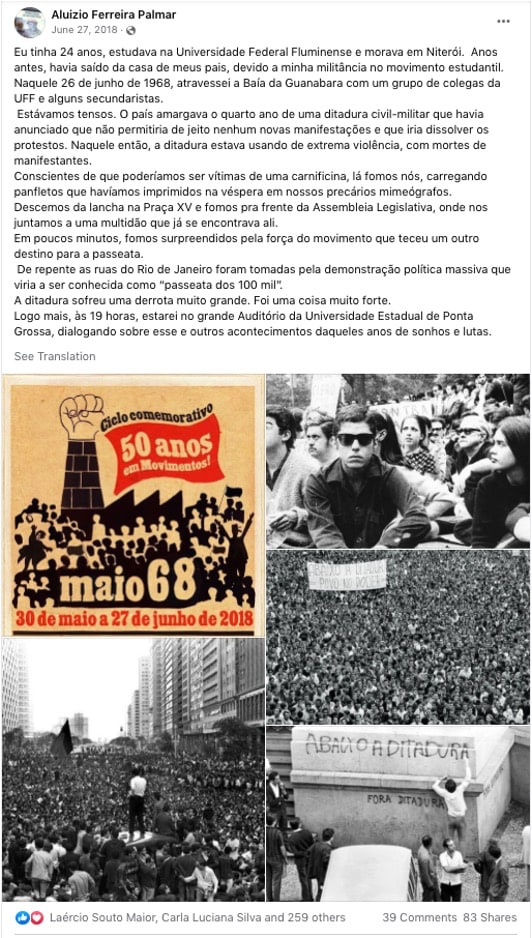
In 2018, as part of the fiftieth anniversary of 1968, Palmar was invited to speak at the State University of Ponta Grossa, a regional university in Paraná, 100 kilometres outside Curitiba. Across Brazil on that day, commemorations of 1968 took place with the 2018 presidential elections on the near horizon—the firebrand Jair Bolsonaro was already starting to top polls, and it was unclear if former president Lula would be allowed to run. In this context, the legacy of 1968, and the blending of past and present, was almost palpable. Perhaps Palmar wished that he had been invited to deliver his remarks at the larger events in Rio de Janeiro or São Paulo. Or maybe he was happy to address a Paraná audience that would likely be more familiar with his stories. The day before his speech, he promoted the event on Facebook, writing a short post about his participation in the famous protest:
On that June 26, 1968, I crossed the Guanabara Bay with a group of classmates from the UFF and some high school students. We were nervous. . . . At that time the dictatorship was using extreme violence, even killing protestors. Knowing that we could be victims of a massacre, we went [to Rio], carrying pamphlets we had printed the day before on our homemade mimeographs. We got off the ferry at the Praça XV and went to the front of the Legislative Assembly, where we joined the crowd. . . . In a few minutes, we were surprised by the strength of the momentum that swelled the march in another direction. Suddenly, the streets of Rio de Janeiro were overtaken by the massive political demonstration that would come to be known as the “march of the 100,000.” The dictatorship suffered a great defeat. It was really something amazing.
Soon, at 7 p.m., I will be in the main Auditorium of the State University of Ponta Grossa, talking about this and other events from those years of dreams and struggles.
I initially approached this discrepancy with trepidation. This was the first, and arguably the most glaring, of the discrepancies in Palmar’s memory script. Rather than call it out directly, I opted to pose a series of follow-up questions about his time in western Paraná. After our interviews about this period in his life, I asked him several permutations of the same question: Once you arrived in Foz do Iguaçu in March 1968, did you ever leave the region? No matter how I phrased it, Palmar was unwavering in telling me that aside from once visiting his father, he never left the frontier.
I sat with this information for over a year, putting off what I knew I needed to do, which was letting Palmar know about the discrepancy. This case helped push me to fully embrace a methodology that, until that point, I had tiptoed around. It was easy to have a close relationship with my research subject when the exchanges focused primarily on the memories that he provided me, but here I needed to show him where different versions of his own memories did not align.
When I told Palmar about my findings, I was relieved that he was not upset. Admittedly, I chose to convey this information in a carefully worded email rather than our usual WhatsApp or Zoom conversations, so it is possible that his initial reaction was different to the measured reply he sent later that night. In my email, I used the words “discrepância” (discrepancy) and “discordância” (something at odds with), which I hoped would provide a softer landing. Palmar, in his reply on WhatsApp, used the word “contradições,” (contradictions) which he explained were part of a “mental confusion” that he sometimes exhibited. In this case, he claimed to have mixed up the dates of two events. Rather than describe the 1968 protest, he told me that he had mistakenly drawn from his memory of a pro-government rally in 1964, two weeks prior to the coup. It seems likely that Palmar had indeed taken part in the 1964 assembly. Yet it appears that despite what he claimed on social media, he had not participated in the 1968 event.
This memory is the overlapping result of several potential themes, including the passage of time and the fact that all memories are liable to slippage. Fifty years after the event in question, the stories and images of that day in Rio de Janeiro have become so ubiquitous that Palmar could conjure the sights and feel of the protest. But there are other considerations as well. Namely, a desire to place oneself at an important historical moment.
Given the purpose of his Facebook post—to promote his appearance at a commemorative event, which itself took place far from Rio de Janeiro—we can also understand Palmar’s memory as a legacy of his political trajectory. Palmar’s campaign of armed struggle, like that of the various revolutionary groups in Brazil, did not achieve its goal of overthrowing the dictatorship. In the end, it could even be argued that the insurgent campaigns did more harm than good, given that the regime used the existence of a small number of armed groups as justification to unleash a disproportionate amount of violence. As such, putting himself among the protestors in 1968 can also be read as an attempt to re-narrate his chronology. Participating in the March of the 100,000 would have meant that he took up arms only after the waves of repression that followed the demonstration, repositioning himself at the centre of a large, collective final effort at peacefully confronting the military regime. At stake here are the contested memories and timelines of armed revolution. With a retrospective awareness of the violence to come, stories about 1968 were highly symbolic.
Example Three: Perpetrator Memory
Palmar was arrested in early 1969, and after two years spent in various detention centres, he gained his freedom in 1971 as part of a prisoner exchange, after which he lived in exile first in Chile and then Argentina. He did not return to Brazil until 1979, after nearly a decade on foreign soil. In the early 1980s, as the military regime oversaw a negotiated transition of power back to civilian rule, Palmar started to take part in local politics, including as a journalist and later in the mayor’s communications office.
Palmar’s new job in city government placed him within political and information networks that spurred his search for the six disappeared militants. For Palmar, this interest was deeply personal, as he had almost been part of the disappeared group: while passing through Buenos Aires in 1974, he was invited to join the group sneaking back into Brazil, but in a twist that saved his life, he declined the offer. Motivated by a mix of survivor’s guilt and militant curiosity, he always kept an ear out for rumours about what had happened in 1974. After several false turns and wild goose chases, Palmar’s search for answers about the six disappeared militant finally seemed to have a breakthrough.
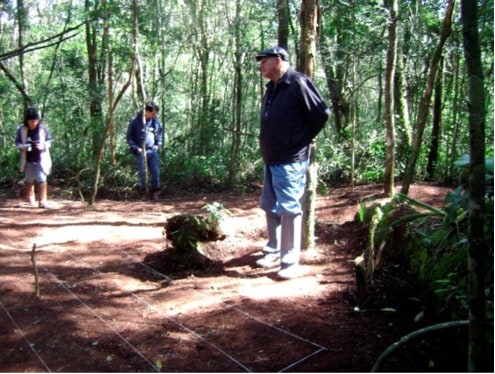
In July 2004, a former Army officer named Otávio Rainolfo admitted to having been the driver in the operation that killed the six militants. Rainolfo’s testimony, however, did not yield any new results in the search: a series of excavations, following Rainolfo’s memories of where the bodies were buried in 1974, failed to uncover any evidence. The mystery remained unsolved, and all the while Rainolfo then became publicly linked to the murders. Over the subsequent years, a great deal of animosity grew between Rainolfo—who was now known for having been an alleged accomplice to murder—and Palmar, who continued to lobby the government for further investigations. To make matters worse, the two men lived in the same city, and had several acquaintances in common.
Rainolfo died in 2018, at the age of sixty-nine, meaning that I could not interview him. But as part of Brazil’s National Truth Commission from 2012 to 2014—the country’s first organized attempt to account for the violent history of its military period—Rainolfo was called to testify.
This story about Rainolfo is not a part of Palmar’s standard narrative. If I had not brought it up, Palmar likely never would have mentioned it to me. And as far as I could tell, it received zero news coverage. Outside of those immediately involved with the truth commission, this particular testimony seems to have barely registered. Rainolfo was called to testify in June 2013, and most of what he discussed covered the details he had shared in previous years about how the six militants were lured back to Brazil and then killed. But three-quarters of the way into his two-hour testimony, Rainolfo made what seemed to be an absurd and vindictive statement. While discussing the double agent who had orchestrated the ambush, Rainolfo obliquely suggested that perhaps Palmar was also a double agent who had collaborated with the dictatorship. “I’m not saying this because I’m mad at him,” Rainolfo stated. “It’s just that you shouldn’t trust him, he’s not what he says he is.” When given an audience with Brazil’s truth commission, Rainolfo tried to turn the tables by accusing Palmar. And later in his testimony, having already made the provocative insinuation against Palmar, Rainolfo also made an overt threat: “If he doesn’t like me, well then I won’t like him. And I’ll find a way to tell him . . . you’ve made an enemy.”
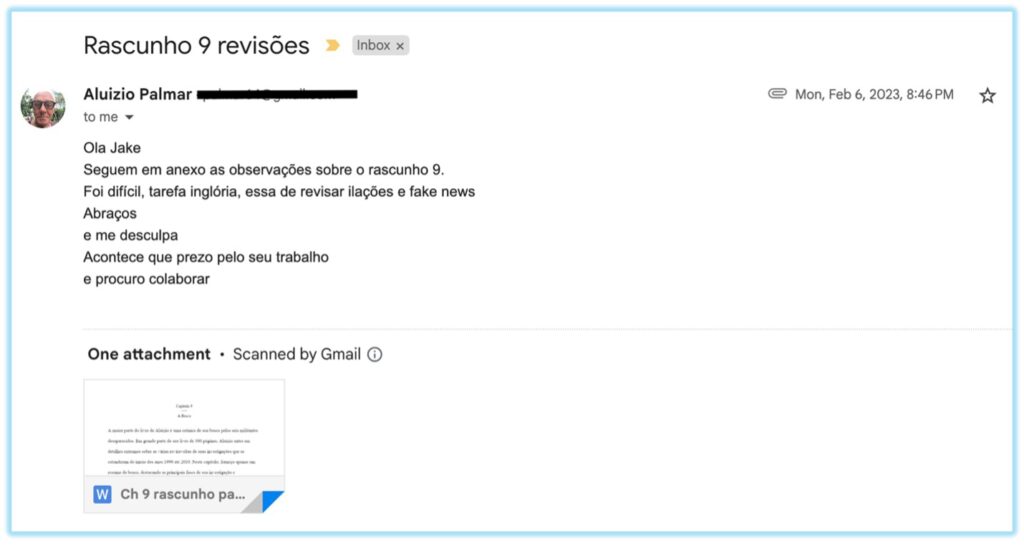
My analysis of Rainolfo’s testimony is a final example of revisions that I made after Palmar commented on a chapter draft. Here, rather than adding material in light of Palmar’s comments, I opted to remove some of my previous writing. Palmar took great exception to parts of this chapter. It was the only time during our collaboration that he seemed genuinely upset. Several weeks after I had emailed him the chapter, he replied tersely: “Hi Jake. Attached are my comments on the draft. This was hard, an inglorious task, looking over these fake news statements. Hugs, and I’m sorry. I do support your work and I try to collaborate.” In light of Palmar’s comments, and as part of my constant effort to balance my duties as a biographer with my relationship to the subject of the biography, I made a few key revisions. I removed a few additional quotations from Rainolfo’s testimony, and I framed the accusations in a more obviously negative way—the words “absurd” and “vindictive” had not appeared in the original version.
I felt only the smallest ethical qualms changing this material. Palmar had not directly asked me to do so, yet I knew that these edits would make him happy and thus maintain our working relationship. And in my collaborative biography approach, through which I also maintained a transparency with my reader, I also knew that I would inform the reader that I had removed selections from Rainolfo’s testimony. There are so many times while writing a book that we as authors make edits: we are constantly removing or adding material that will never register for a reader. Most often, a reader only knows about the final product in front of them, oblivious to the (often) painstaking edits and incisions of the drafting process. So here, in choosing to roll back some of my deeper evidence about Rainolfo, I did so toward my goal of keeping a balance of a collaborative (and consenting) subject of my biography and an informed reader.
In our conversation a few weeks later, once Palmar had read the new chapter, he was happier with the text, though he still worried that readers might take Rainolfo’s accusations seriously. Especially because the anecdote comes in the last chapter of the book, he wanted to leave a good final impression, telling me, with a slight chuckle, “You always remember your last kiss.”
Conclusion: Out of the Shadows
We can end this reflection on collaborative biography where it actually began. In December 2019, somebody knocked on the door of Aluízio Palmar’s home. He answered, and a person identifying themself as a court employee handed him an envelope. Palmar read the enclosed documents to discover that he was being sued in the Second Civil Court of Foz do Iguaçu by Mário Espedito Ostrovski—his former torturer. At the time of the lawsuit, both men were well over seventy years old. They had not crossed paths since 1969, when Ostrovski subjected Palmar to intense physical and psychological abuse. Yet fifty years later, Ostrovski resurfaced to threaten his victim once more.
Ostrovski’s human rights abuses had already been well documented, including in the 1985 report on torture, Brasil: nunca mais, (Brazil: never again) and also in the 2013 proceedings of the National Truth Commission. Ostrovski had been invited to speak to the truth commission, but he declined. On the afternoon of Ostrovski’s scheduled testimony, protestors engaged in a political action common in Latin America known as an escrache (escracho in Portuguese). To expose Ostrovski, who had been living a quiet life as a lawyer, the crowd marched to his law office and held a noisy rally to “out” him as a torturer. Palmar did not take part in the protest, but he did publicize the event on Facebook. And it was precisely Palmar’s act of sharing the protest on Facebook that Ostrovski cited in his claim for nearly US$10 million in moral damages.
But if the event in question took place in 2013, why did Ostrovski wait six years to pursue a lawsuit? The previous year, Brazil elected a far-right president, Jair Bolsonaro, whose open nostalgia for dictatorship had made the country’s long-standing culture of impunity even more brazen. Bolsonaro’s presidency emboldened former officers like Ostrovski to push back against Brazil’s gradually expanding culture of human rights. A torture victim being sued by his torturer was almost unimaginably perverse. But the lawsuit reflected Brazil’s contentious history of dictatorship, and the shadows that continued to haunt Palmar and countless others.
This is also where I came into the story. When I saw his 2019 Facebook posts about the Ostrovski lawsuit, and as I witnessed an outpouring of solidarity notes from other activists in Brazil, I asked Palmar for an interview. He agreed, and in January 2020 I wrote an online essay about the lawsuit and the legacy of military rule in Brazil. My piece was one of several dozen published in Brazil and internationally, and the public campaign seemed to work. By June of the following year, Ostrovski dropped the suit, a rare victory under Bolsonaro.
And it was in the interim, as the world was being rocked by Covid, that I approached Palmar with the idea for a biography. Having recently re-established contact with the short interview that I conducted about the lawsuit, we were well-positioned to continue the momentum toward a much larger project. The collaborative biography thus emerged from a context not only of an octogenarian former political prisoner taking stock of his life, but also of a human rights activist being actively persecuted and facing serious legal and financial jeopardy. Agreeing to my proposed biography project was another way for Palmar to bring attention to the lawsuit.
If not for the circumstances of how I came to know Palmar, the book would not exist. I did not set out to write a collaborative biography, nor did I initially seek to understand the off-the-beaten-path experiences of repression and resistance during Brazil’s dictatorship. Originally, I did not even have a clear idea of how I would engage the theoretical and methodological questions about memory. My goal was to write about Palmar’s life. It was only over the course of my two years of interviews and research, and through the subsequent years of writing, that the scope and importance of the project came into focus.
As anyone who has conducted oral histories can tell you, there is no single way to collect somebody else’s stories, no best method for conducting interviews or asking probing, personal questions. When these oral histories are intended for use in a biography, meant to follow one person’s life story in great detail, the challenges only increase. Writing an oral history-based biography of somebody who is still alive requires navigating a potential minefield of methodological and ethical dilemmas: does the subject of the biography have input into the final product? What are the expectations in terms of time given for interviews, for follow-up questions, for the length of time from start to finish of the entire project? And when the biography will include themes of violence and trauma, what latitude, if any, does a scholar have to encourage the subject toward painful recollections? My hope is that the type of collaborative biography that I pursued becomes a useful reference for future research. Those stories are out there, fascinating in their unique detail and universal in the lessons they can offer. It is on us to find those stories, to listen well, and to work collaboratively with the individuals who consent to opening their lives and allowing us to turn their private memories into a public narrative.