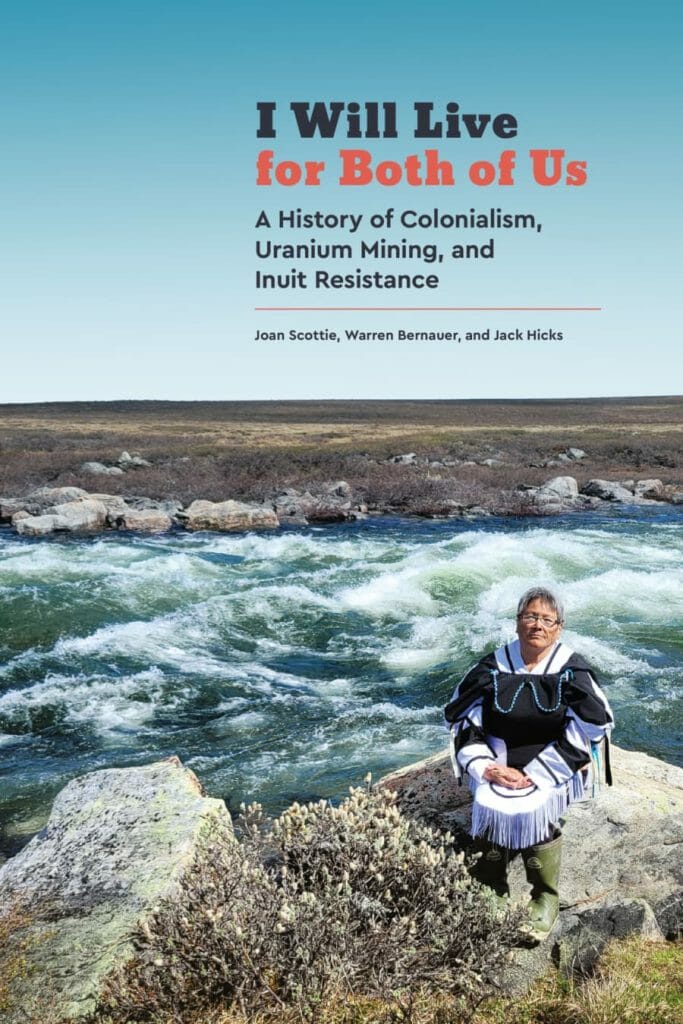
Joan Scottie, Warren Bernauer, and Jack Hicks
Winnipeg: University of Manitoba Press, 2022, 264 pp, $24.95 (£20.40), paperback
I Will Live for Both of Us recounts the history of Inuit grassroots activism from the firsthand account of Joan Scottie (born Paningaya’naaq), an Inuk elder and anti-uranium mining activist living in Baker Lake within the Kivalliq region of Nunavut. The case of uranium mining in Nunavut is a classic historical tale of mining benefitting the company, its shareholders, and the government without benefiting local Inuit communities. Instead, local communities are left with the burden of environmental harm once mining operations cease. Other scholars, myself included, who have studied mining in the Canadian North, have found this pattern of inequality, disregard, and environmental injustice repeated time and time again. John Sandlos and Arn Keeling’s collection Mining and Communities in Northern Canada: History, Politics and Memory, is one example of a work that draws on oral history with Northern Indigenous community members and partners to address this historical pattern.
Yet this new book makes a unique contribution to the existing literature – we primarily hear these Arctic histories from the interpretations of settler scholars. I Will Live for Both of Us provides readers the opportunity to learn about Inuit perspectives and experiences of colonialism from someone with personal experience. In this sense, it builds on the important work of Indigenous scholars writing about mining in the subarctic north, like Lianne Leddy’s new work Serpent River Resurgence: Confronting Uranium Mining at Elliot Lake,
While the book is a collaboration between Joan Scottie and two settler researchers, Warren Bernauer and Jack Hicks, her life story forms the backbone of the work. Her rich storytelling and oral memory are supplemented by historical documentation, scholarly literature, and academic research, but her personal journey of activism is what most engages the reader.
The book begins with an outline of her family lineage before Scottie’s birth in 1948 and moves forward into 2021, tracing the timeline of significant events in her battle against harmful uranium exploration and development. Resistance and participation in this struggle is at the core of this work. Scottie highlights her people’s opposition to uranium mining, their resistance to Northern postwar colonialism, and their insistence to claim a seat at the table. One of the many strengths of the book is that is does not rush its reader but spends time laying the groundwork for understanding the central mining conflict from an Inuit perspective. Its first two chapters provides historical context about Inuit life on the land, family structures, cultural beliefs, and experience with colonization following the Second World War. In these chapters, Scottie provides numerous Inuktitut words and explains culturally significant concepts like angatquit (shamans), aglirniq(spiritual prohibitions Inuit followed), and female infanticide to orient readers to the cultural and historical background to the history of mining opposition. This approach provides an accessible introduction to complex concepts and a general overview of post-war Inuit encounters with colonialism.
The next section of the book, chapters three through six, analyzes the uranium mining boom and the Baker Lake anti-uranium movement’s challenges and successes. Mining cannot be separated from the study of colonialism, especially in the North, and this section provides a detailed account of proposed uranium mining projects and its opposition from the 1970s into the early 2000s. Scottie explains that the fear of radioactive contamination and the disastrous affects of mining on caribou populations were at the heart of community action. By the late 1960s, exploration and drilling had shifted the migration routes of caribou and hunters noticed declining populations. In response, the Inuit of Baker Lake circulated petitions, conducted letter writing campaigns, and used the court to stop uranium exploration. While these early attempts failed to stop exploration, they did result in strict regulations for mineral exploration on caribou grounds (p 58).
These chapters catalogue Scottie’s prolific carer as a leading activist. Her determination and commitment is impressive. Over four decades, Scottie founded the Baker Lake Concerned Citizens Committee to inform local residents about the risks of uranium mining and serve as a voice for community opposition to the first Kiggavik project (a German owned uranium mine proposal). She vice-chaired the Mikata group, an organisation campaigning against the Kiggavik project’s revival in the 1990s. She also served on various research projects and anti-mining committees while remaining an avid hunter. Throughout the 1970s and 1990s, with strong organisation and international support, the anti-uranium movement succeeded in halting the Kiggavik uranium mine project twice. However, not all their efforts met success. Scottie commiserates that the Nunavut Land Claims Agreement let down the Inuit because after the creation of Nunavut, the Government of Nunavut and leading Inuit organisation supported uranium mining, creating fractures among the Inuit across Nunavut (pp 108-111).
The final chapter and conclusion remind readers that there are continued challenges to mining projects in the Arctic and across the global North. The mining industry and contemporary debates that surround it continues to perpetuate structures of colonialism. In the conclusion, Scottie discusses the lessons she has learned through her decades of activism, but she is open about the challenges she faced as an activist in a small community. Her activism brought on both social and economic challenges for her. At times she was ostracized and had difficulty finding employment in Baker Lake (p 194). Yet Scottie concludes her message with hope assuring readers that, ‘if you always keep the long-term best interests of the ordinary people of your community and your natural environment in your heart and mind and you don’t lose hope… YOU CAN WIN! Like we did’ (p 198).
I Will Live for Both of Us is a tremendous work of oral history that intersects with critical studies in environmental history. This book will appeal to researchers, instructors and students interested in history of the North, Indigenous histories, and resource extraction internationally. This story of mining, colonialism and resistance will resonate with other Indigenous nations around the world. I would not hesitate to include this work on future syllabi or encourage graduate students and fellow colleagues to read it. With its ability to seamlessly integrate personal reflections with scholarly research, the book further serves as an excellent model for collaborative work between settlers and Indigenous knowledge keepers.