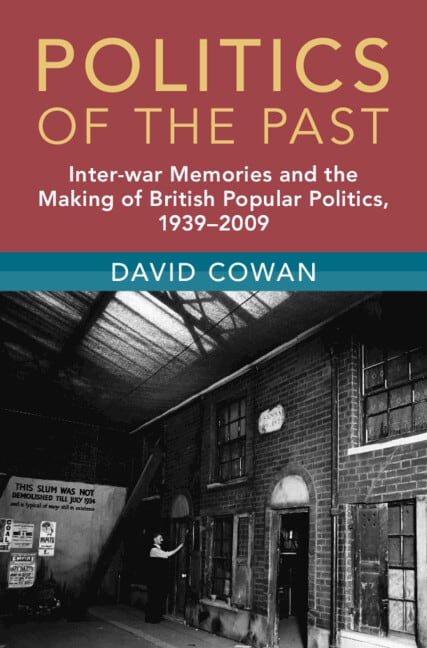
by David Cowan
Cambridge: Cambridge University Press, 2024, 300pp, £85.00, hardback
In his deeply researched and richly analytical book, David Cowan explores the ways in which memories of the 1930s have been variably composed, narrated and received across post-war British history. In particular, his concern is with memories of pre-welfare state hardships which came to define that decade, and which post-war planners and politicians used to buttress their reforms. Politics of the Past will be of significant interest to oral historians because of the central place of memory within its purview. Oral histories do form part of its source base, but Cowan’s study is informed primarily by archived social science research data. Following the example of scholars such as Pat Thane, Tanya Evans and Jon Lawrence, Cowan has made productive use of the research interviews conducted by sociologists, Mass Observers and health researchers from the late-1930s until the early twenty-first century. Cowan looks to these sources in order to access, reconstruct and make sense of the ways in which people told stories about the 1930s and, crucially, what these processes of storytelling reveal about shifting political, social, cultural and economic realities.
Cowan is interested in the ways in which political metanarratives were understood, articulated and exchanged on intimately local scales. As such, Politics of the Past is structured by thematic (and broadly chronological) visits to six British cities. Beginning in wartime Glasgow, Cowan uses Mass Observation (MO) interviews to gauge the ways in which interviewees drew upon memories of the inter-war years when articulating their hopes for post-war reconstruction. Unemployment and poor housing in the aftermath of the First World War caused many in Glasgow to remain pessimistic that things would be different after the second, and the interviews in this chapter certainly point to a cohort which used historic experiences to inform their expectations of the future. Cowan characterises this as ‘a future-looking democracy, concerned with the fate of the next generation, informed by recollections of the aftermath of the Great War’ (68).
From there, Cowan moves to London, a necessary and vital site of analysis, but one which is refreshingly peripheral in this book. A centrally recurring theme of Politics of the Past is the extent to and the ways in which intimate domestic and familial contexts shaped the ways memories of the 1930s were formed. Chapter 2 in particular shows how memories of inter-war Britain were constructed, imparted and mediated ‘at home’. ‘Family’, Cowan argues, ‘was central to everyday democracy in the 1940s’ (75). By unpacking MO interviews conducted in London in the mid to late-1940s, Cowan shows that patterns of deference to familial voting patterns both endured and were challenged. One political slogan during the 1948 Edmonton by-election encouraged young voters to ‘Ask your Dad’, an invitation which was taken up by much of the electorate but which was also strongly contested. ‘You should ask yourself & question your own experience’, one young woman told MO (99). Most, however, drew on their families’ experiences when thinking about politics, measuring their current situation against their memories or understandings of life in the 1930s as a barometer for change.
The remaining chapters of the book each have their own thematic interests including educational aspiration and class change in Huddersfield, and the ways in which memories of interwar healthcare forged diverse political opinions about the NHS in Aberdeen. Perhaps of particular interest to oral historians, though, is Cowan’s focus on the changing ways in which ‘the 1930s’ were being constructed and drawn upon as both individual and collective memories. Cowan shows how, as a period of post-war prosperity shifted class and political identities (in uneven and particular ways), memories of the 1930s ‘gradually flattened out into something simpler’ (109).
At times, Cowan draws on archived oral history interviews in order to supplement those conducted by social scientists. This is especially the case when particular voices were both marginal within, and marginalized by the original research projects. In his chapter on international migration to Birmingham, for example, Cowan draws on community oral history projects which set out to capture the experiences of Black and Asian migrants to the city. These oral histories, Cowan writes, ‘disseminated in print more racially inclusive stories about wartime that questioned whether only Britons had contributed to victory and whether only white British-born people deserved its fruits’ (230). Politically, this was a significant rejection of a growing racist sentiment that the post-war welfare state was benefiting people from overseas at the expense of white British people. Black and Asian oral history projects offered a corrective to the idea that Britain’s war effort was only a white project, and drew on a history of Commonwealth military service to make claims to both citizenship and a place within a shared history of wartime sacrifice. These were just some of the moments at which memories of the Second World War began to supplant those of interwar privations as consequential in the formation of political ideas and identities. Beyond looking to oral history archives for supplementary sources, Cowan’s book is informed by oral history scholarship. In particular, he is attentive to the ways in which interviewees composed narratives of interwar life, pointing to changes in composure over time. In his chapter on intra-British migration, which draws heavily on the well-known ‘Affluent Worker’ study of Luton, Cowan uses oral history theory of discomposure to highlight the extent to which memories of mass unemployment in the 1930s were becoming more homogenous and less nuanced. Some interviewees in Luton, for example, began to draw on a metanarrative of unemployment and poverty, but found it difficult to anchor their personal experiences of relative stability and affluence to these themes. As Cowan argues, such ‘challenges in “narrative” construction suggest that a more generic, nationwide memory of unemployment across Britain was ironing out older impressions of anomalous regional differences in pre-war unemployment’ (146). Not only does this offer a nuanced account of the changing makeup (and articulation) of memory during this period, it also demonstrates the utility of oral history theory, even in studies where oral history interviews are not the dominant source base.