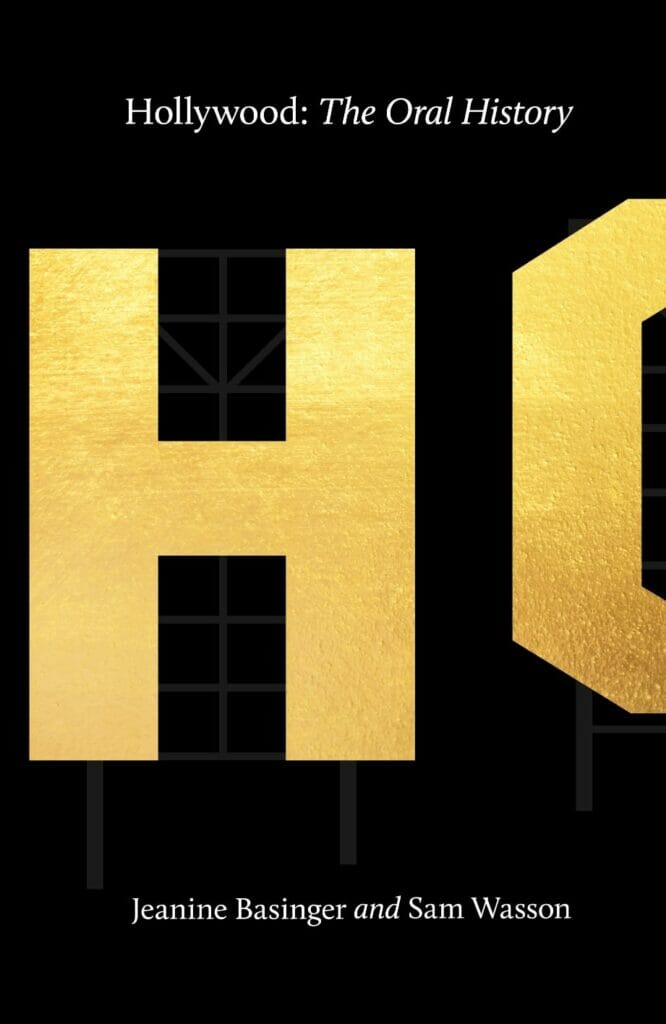
by Jeanine Basinger and Sam Wasson
Faber & Faber, 2022, 739pp, £21, hardback
A fascinating and relaxed read for those curious about the American film industry, from the early, ad-hoc roots of silent cinema to the present transmedia era, Hollywood: An Oral History offers up a staggering array of diverse industry voices from the beginning of the twentieth century.
As a scholar of Golden Age Hollywood and a fan of the previous, meticulously researched and extremely entertaining work of both Basinger (A Woman’s View: How Hollywood Spoke to Women, 1930-1960 [1995] and The Star Machine[2008]) and Wasson (The Big Goodbye: Chinatown and the Last Years of Hollywood [2020]), I was very much looking forward to reading this book. In terms of content, tone and subjects featured, I certainly was not disappointed. Delving into this book is like attending the most fantastic Beverley Hills cocktail party, and it was for this reason that alongside reading my print copy, I also purchased a copy as an audio book, luxuriating in sections again, while relaxing in the garden or as a glorious bedtime treat. However, while glamorous and exciting, the sheer volume of what is offered here also presents problems. This could have been a much more useful historical resource but for a couple of key shortcomings.
The authors’ organisational approach of placing interventions in dialogue with one another is key to giving this work its engaging and energetic conversational feel. As readers we hear, first-hand so to speak, from Lillian Gish about her infamous first meeting with D.W Griffiths, where he chased her and her sister, Dorothy, around his New York rehearsal studio, firing a gun at the ceiling to provoke a reaction (p55). Equally, George Lucas recalls how, prior to the convenience of pay-to-view, DVD and even VHS, he would check the Los Angeles newspapers daily to see what ‘classics’ the city’s repertory cinemas were showing. I would argue though, that none of this compares to the gloriously gossipy remembrances of Minta Durfee, actress at Keystone Studios and wife of infamous comic, ‘Fatty’ Roscoe Arbuckle. These include a lengthy tale of intrigue and infidelity between the studio founder, Mack Sennett and believed interloper Mae Busch, behind the back of studio darling, Mabel Normand, which appears to have resulted in Normand being violently assaulted by Busch and irreparable damage done to the Keystone studio social circle. While fascinating, I found it helpful to read the book incrementally to prevent a befuddling blur of anecdotes.
Additionally, while the historical examples used often highlight or hint at long-ingrained issues within the industry, such as Hollywood’s shocking lack of racial diversity across the decades and its long shadow of sexual abuse, these topics are rarely addressed head-on. Within the chapter ‘Everybody’s Business’, about industry progressiveness and making space for a broader spectrum of players in the film game, issues of racism and sexism are unsatisfyingly simplified, and are often recounted with vague or cliched statements, such as that of actress, editor and filmmaker Dyann Cannon: ‘I really don’t look at it as a male female thing. I look at it as talent. If you’re talented, I want you around’ (p696). We also hear from a string of successful and well-meaning white women whose statements on their experiences as, or working with, women filmmakers do not address intersectional factors such as race, class, disability and cultural and social capital that work against a number of women trying to break into, or productively remain in the industry (pp696-7).
A combination of the book’s length and number of interventions, its carefully interwoven structure and, at times, its obscure chapter titles also made revisiting particular quotes difficult. For example, director King Vidor’s testimony about working on set and the use of pantomime in the silent era could feasibly have featured in the chapters ‘Comedy’, ‘Silent Actors’, or ‘Silent Directors’ (heads up: it is in ‘Silent Actors’ [p99].) Equally exasperating, these fascinating quotes are unreferenced. This means there is no indication of the date of the interviews quoted, or where the unedited script may be found within the AFI archives or catalogue, for verification or elaboration. It is also unclear whether a respondent’s testimony is sourced from a single interview or multiple interviews recorded over time.
In the afterword, the authors touch upon the difficulties encountered whilst editing down the sheer volume of interventions made, as well as the detail and timescales covered. There is no doubt this must have been a herculean task, yet the one-page introduction says frustratingly little about the methodology of this crucial and fascinating project. As a classical-era fangirl and researcher, I was keen to know more about the selection criteria and processes, and about the archives used. The introduction infers that the material is drawn from the post-1969 Harold Lloyd Master Seminar series — a long-running series of dedicated interviews with prominent and US film industry professionals, the transcripts and/or recordings of which are held in the AFI’s Louis B. Mayer Library. However, the afterword describes other AFI histories and the interview collections of the authors themselves, but gives no idea of the weight of these collections within the whole. I wanted at least a little more information on the Harold Lloyd Master Seminars and other AFI archive sources drawn upon here — were they recorded in shorthand, or on audio or video tape, in private or before an audience, in the form of a monologue or structured questioning? All of these factors may have altered the nature of what was said, and how we now read it.
Equally, the introduction alludes to the first-hand account the authors seek to create — a diachronic narrative, that convincingly describes and demonstrates the industry’s broader processes of continuity and gradual change over time, through the recounted workaday experiences of those involved; an account free from the words of historians and academics, and told through the words of the participants themselves. But here, however, Basinger and Wasson do not acknowledge the most basic premise of oral history — that the retelling of a history ten, fifty or even 100 years later, is a rewriting of that history, a curation of a story in new context. And like the stories told at the best cocktail parties (which this book beautifully evokes) the stories included here may have been retold, rewritten, honed, filtered and even expanded, through decades of cocktail party retellings, in order to make them the best story that they can be. As such, they might tell us far more about the party than they do about the facts of historical Hollywood.