
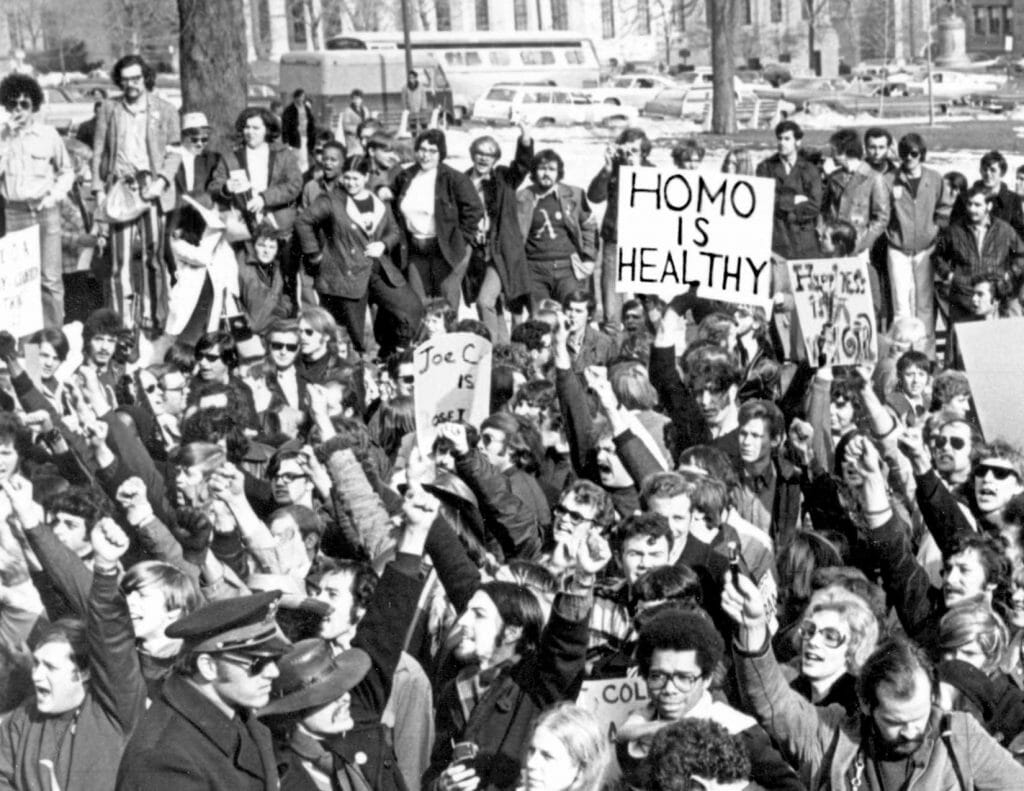
A conversation with Patrick Sammon, Co-Director of the documentary CURED
Featured image: Richard C. Wandel Photographs, The LGBT Community Center National History Archive
In 1972, at the annual meeting of the American Psychiatric Association (APA) in Dallas, a man with a distorted Richard Nixon Halloween mask and an oversize tuxedo addressed his colleagues and outed himself as a gay psychiatrist. He continued encouraging the minority of queer colleagues to avoid the risk of “not living fully our humanity” and to properly help their patients to accept their diversity. The speech of “DrAnonymous” at the APA Annual Meeting represented a crucial step in the advances not only of LGBTQ rights, but also of psychiatry itself (see also: https://www.bps.org.uk/psychologist/lasting-legacy-dr-anonymous). Thus in 1973, 50 years ago, the APA’s Board of Trustees removed the diagnosis of homosexuality from the Diagnostic and Statistical Manual of Mental Disorders, the “bible” of psychiatry that, since 1952, lists all mental diseases and is regularly updated. Yet Dr. John Fryer, the real name of “Dr Anonymous”, belonged to a hitherto scarcely known group of gay and lesbian people who challenged and changed the widespread conviction, supported by the coeval science, that homosexuality was an illness. The documentary Cured, co-directed by Bennett Singer and Patrick Sammon (2020) narrates this pioneering history thanks to their amazing archival research and a formidable set of interviews with the activists who pushed for the change. In so doing, it brilliantly addresses uneasy, critical relations between society, politics and science.
Indeed, the story of the pathologization of homosexuality is as disturbing as it is instructive. In 1899, the same year Freud published his Interpretation of Dreams, a German psychiatrist claimed that he turned a gay man straight through hypnosis. Krafft-Ebings’ idea that homosexuality was a “degenerative disorder” (1886) was widespread at the time. Conversion and never satisfactorily documented aversion therapies, even electroconvulsive therapies followed. In opposition to the majority of the medical establishment, Freud was convinced of the innate bisexuality of individuals (while Jung developed a somewhat similar view with his theory of the anima and animus, or the innate contrasexual binary within each individual), and did not consider homosexual behavior as an illness, a vice or an expression of degradation. He wrote “In general, to undertake to convert a fully developed homosexual into a heterosexual does not offer much more prospect of success than the reverse, except that for good practical reasons the latter is never attempted”. Yet some of his followers displayed less open and more bigoted positions, and many psychiatrists shared Charles Socarides’ (1922-2005) conviction that “homosexuality calls for treatments similar to those for mental retardation, epilepsy and alcoholism”. And it is sadly well known that pioneering English mathematician, computer scientist, and philosopher Alan Turing committed suicide in 1954 after suffering severe depression, likely due to the chemical castration he underwent to “treat” his homosexuality. Turing’s tragic story is narrated in the documentary Codebreaker by Patrick Sammon.
We met Patrick Sammon during a screening of Cured at the Pink Apple film festival in Zurich, which last year celebrated its 25th anniversary.
Giovanni: I’m very impressed by the quality of the film and by the synthesis you, along with the co- director Bennett Singer, were able to create from a research project that lasted 5 years. How difficult (or easy) was it to convince the producers about the subject and the treatment? And to find witnesses from the time when things started to change? Also, why was the story of these few combative activists relatively unknown till now?
Patrick: I’ll start a bit about the process. Bennett and I embarked on this in early 2015 and our first order of business was figuring out who was still around, from this fight. We weren’t certain, given that almost fifty years had passed, that there would be very many people still alive. We were very encouraged and heartened to find so many people who had been part of this struggle. Then very quickly we started interviewing as many of those folks as we could, really before we’d even raised much money or done much research into it. The first person we interviewed was Ron Gold, and when we tracked him down in the spring of 2015 he told us: “Listen, I’m 86 and I don’t feel too well. So if you want to interview me, you’d better do it fast”, and he unfortunately passed away about six months after we recorded his recollection. And so very early on we were mindful that we needed to move quickly because time would silence the voices of these folks who were involved in the fight. In fact during the production five of the people we interviewed passed on. So we felt a great sense of responsibility to tell this story in a way that does justice to what they achieved. At the heart of our initial production process, we also were wanting to find visual elements that matched their fight, such as photos from the era and where there was possible footage of them at work. So our archival producers, Mridu Chandra and Lewanne Jones led that effort and uncovered some incredible items. We managed to obtain present-day recollections of all our main characters, along with either footage or photos of them at work back in that period. We have Dr. Charles Silverstein on “60 Minutes”, we have Reverend Magora Kennedy on “the David Susskind Show”, sparring with him about these issues.
There is also this wonderful passage where Ron Gold is re-reading his 1973 speech “Don’t make me sick” with the footage from the original.
Yes, we discovered that recording during the archival research process at UCLA. And in Philadelphia we were able to find the recording of Dr John Fryer’s 1972 speech at the Annual Meeting of American Psychiatric Association; that was the event where John Fryer had to dress in disguise in order to testify what it was like to be a gay psychiatrist. We were the first to discover that. I don’t think the museum even knew what they had, since it was a small, unlabeled shoe box among 217 boxes. We are really proud of the story we were able to tell with the archival material.
In terms of why this story was unknown, I don’t really have a good answer for that. You know, a friend of mine put this idea on my radar and I had been familiar with it, but as I did some more digging I realized how important this moment was, in the history of the fight for LGBTQ equality, because as long as we were classified as mentally ill, then business and government were going to use that as an excuse to discriminate. So, I thought it was a really important story to tell, and Bennett obviously felt the same way…
Did you work with Bennett Singer before?
Bennett and I met about 10 years ago during my distribution for Codebreaker, my first film. We became friends – and he actually served as a consulting producer on it. When I came across this idea I convinced him to join with me on this journey. It has been quite a process to get the film made and a great collaboration with him. I think that LGBTQ history is often deleted and that could be part of the equation about why these events weren’t more well known. I also think that the visual elements were so hard to find which made the film’s creation quite difficult. It was touched upon in some other documentaries about LGBTQ history, but it was a two- or three- minute scene, and so it never got the depth that it deserved in the telling of its story. We hope it lasts as a testament to the amazing achievement that these activists accomplished.
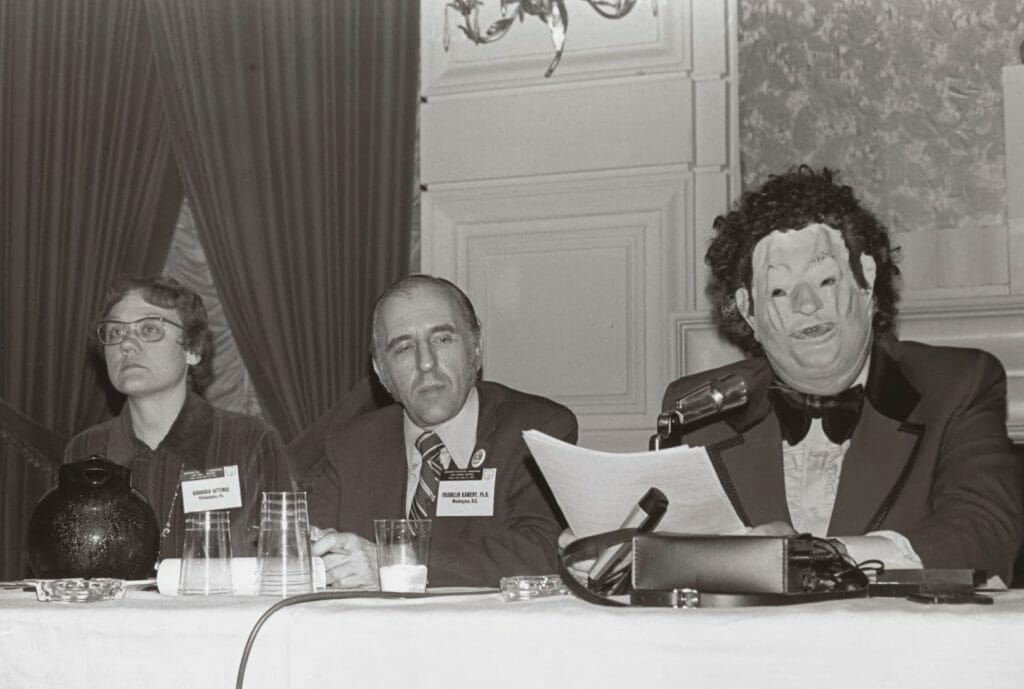
Disguised as “Dr. H. Anonymous” in an oversized tuxedo and distorted Nixon mask, Dr. John Fryer sent shock waves through the American Psychiatric Association’s 1972 convention by describing his life as a closeted gay psychiatrist. Activists Barbara Gittings and Frank Kameny joined Dr. Anonymous on this electrifying panel. Photo by Kay Tobin @Manuscripts and Archives Division, The New York Public Library
The 1972 APA Annual Meeting in Dallas marked a crucial moment in the history both of psychiatry and the LGBTQ movement. The image of “Dr Anonymous” at the podium together with the astronomer Frank Kameny and the activist Barbara Gittings was taken by the latter’s partner Kay Lahusen, who died last year at the age of 91. She’s a lovely figure in the film, interviewed while in the nursing home. She even founded an LGBTQ group there!
You know, I met so many great people during the production of this film, and certainly Kay was one of my favorites. I’m so grateful for the opportunity to have gotten to know her before she passed on, and I was so saddened Iast year [2021]; she had a short illness and died peacefully. She was really such an amazing trailblazer and had a resilient spirit that was infectious. She also understood, at this period starting in the 1960s and then into the ‘70s, the importance of recording what was happening. It’s almost as if they understood that we were living true history. Our community owes Kay such a debt of gratitude, not just for these photos, but she took hundreds of others at activist events, protest, and whatnot, throughout this period early in the Gay Liberation movement. You know, the moment with John Fryer is such a critical turning point in this story. It’s too simple to say, “this change happened because John Fryer testified in front of his colleagues”; because that would take away the role that so many others played in this fight, like Ron Gold, like Dr. Richard Pillard and Dr. Lawrence Hartmann. But it was a moment of bravery and courage for Dr Anonymous, i.e. John Fryer, to step forward and put his professional life on the line, by testifying in front of his colleagues about what it was like to be a closeted gay psychiatrist. It really had an impact on this debate and helped move things forward. However, I don’t think we would be talking about it in nearly the same way, without the photos that Kay took at that moment, portraying this man in a mask and an oversized tuxedo. It’s really a quite a dramatic moment, a bit of political theater. And first off, it was a distorted Richard Nixon mask that one of John Fryer’s friends, who was a drama student, had doctored up to make it look quite ghoulish, if you will ….
Do you think that the choice of a Richard Nixon mask was not by accident?
Well, I’m certain that it wasn’t by accident, because this would have been the heart of Richard Nixon’s re-election campaign in 1972. And during the production process we learned that after John Fryer died, his friend Harry Adamson, who we interview in the film, and who was responsible for preserving the 217 boxes, while digging through John’s rather cluttered home he came across a box of discarded items, what he thought were sort of Halloween masks, costumes and things, and in that box was the mask. And Harry threw out the mask, so we lost that piece to history after Fryer‘s death, which was unfortunate, but at least we have the photos to share.
It is also very interesting to learn about John Fryer’s first impressions after that meeting from his diary.
Yes, it’s such a poignant moment as Fryer reflects on what he’s just done. And consider the way the entry ends, he writes: “I hope this effort does not die”. Too often times when we’re thinking about history, we think that an outcome was inevitable. But that’s not true. Actions happen because individuals step forward and try to bring them about, and that’s what happened here. At this moment in 1972, it was far from clear that this victory would be achieved. In fact, at the start of this process, the overwhelming majority of psychiatrists in the late ‘60s and early ‘70s, probably 95% of APA members, according to the historians we spoke with, would have thought that homosexuality was a mental disorder. The activists were up against such long odds, the outcome wasn’t inevitable, and you got that sense reading in Fryer’s diary entry.
I think the documentary is not only about the history of the LGBTQ rights movement, but also an insightful demonstration, even without bringing up Foucault’ theory, that science is never neutral – or at least it is not always at the service of purely neutral objectives. There is a high risk of falling victim (or selling itself) to ideologies, politics, pharmaceutical companies etc. It would be foolish to deny the enormous progress that has been made, but science does not have to be a faith (as Ron Gold says). Yet the post-Enlightenment myth of an endless progress does not help in this sense – and science – combined with technical growth – belongs to this big game.
It’s definitely a relevant topic, especially now, given what we’ve been through with COVID… So much of the film is centered around this question: was this debate about science or politics, and we, throughout the production, were asking everyone we interviewed, because the opponents of the change to the mental health label were adamant that they felt that this was pure politics, and it’s really not accurate to put it in that way, but certainly it’s interesting to reflect on the fact that both sides in this fight thought science was on their side. For instance, Dr. Charles Socarides and Dr. Irving Bieber wrote books based on their so-called “research”. Well, when Frank Kameny and the other activists started digging into this research that they were using to justify the mental illness label, it was clear that it was shabby science. Socarides’ and Bieber’s books were based on studies of their patients: not an average sample of gay and lesbian people, but people who were coming to them because they were distressed about being gay or lesbian. Of course this was going to create a distorted view of the community.
They were already “medicalized” a priori, so to say.
Exactly. They weren’t doing a sample of the average gay or lesbian person, who was perfectly comfortable with who they were, and uninterested in going to get «cured». That was an important revelation that Frank Kameny and the other activists made. On the flipside, by the early ‘70s there was a growing body of research that showed there was nothing different in the mental makeup of someone who is gay or someone who is straight. That was important research done, among others, by California psychologist Dr Evelyn Hooker. It was a scientific case that the activists made to the APA, even if there were political tactics involved, in terms of putting outside pressure on the organization. Therefore I think this fight was really a mix of science and politics, and certainly we see that nowadays in a range of issues where this interplay between science and politics is still very common.
Charles Socarides was one of the most prominent psychiatrists convinced of the necessity to “cure” homosexuality. It is an emblematic case (and there is a certain irony in that, as Ron Gold said) that his son Richard became the LGBTQ senior advisor in the Clinton administration. He stated (about his father): “His position on the issue became so interconnected with his professional standing that he could not re-examine his initial view … He was just stuck with this, he could not let it go”. I guess that the idea of “helping” homosexuals through “conversion” into an allegedly “normal sex life” was not bad per se, if it was aimed at avoiding suffering and pain. Yet instead of changing the society, they wanted to change the individual and to adapt him or her to a society that did not want change. So probably the intent was not that bad in this sense, but it was hampered by a non-willingness to change society.
It’s an interesting point, and a complicated story. Bennett and I wanted to make Charles Socarides a three-dimensional person. There is no doubt that he did real harm to many, many hundreds, even thousands of people during his long career, not only through the actual therapy he conducted with these people, but also with his publications, and his public advocacy for this mental illness label. But at the same time, it is interesting that early on, his motives seemed to be that he was trying to help these people, and I agree with you that Socarides was responding to a society that was hostile to gay and lesbian people. But quickly it became clear that his work was helping to make society more hostile to queer people. This is the interesting thing that, I think, his son reflects on: that Charles Socarides simply couldn’t change his mind because hehad invested so much of his professional standing and his life’s work into this, that he simply wasn’t able to re- examine what he had built his career on. And of course one of the other ironic things in this story is that Charles Socarides had a view of homosexuality that largely blamed the father for the existence of a gay child, in terms of how they raised their child. So, when his son came out, it turns out that Charles would have felt a responsibility or burden, according to his own theory. Yet we know that what Charles Socarides believed, the so-called science he wrote about, was junk science and, unfortunately, what he did really harmed many LGBTQ people, and that was a real tragedy.
The film shows different positions among psychiatrists on the pathologization of homosexuality. For instance, Dr Richard Green, who, as I understood, at least at the beginning of his career, encouraged gender conformity, but at the same time he argued in favor of the declassification of homosexuality from the DSM.
Well, he has a complicated history. Dr. Richard Green was actually a trailblazer in gender transition surgery and advocating for it. He did write a book called The “Sissy Boy Syndrome” and the Development of Homosexuality (1987) looking at, I guess, masculinity and femininity in kids, and how that eventually impacts sexual orientation and gender identity. As I understand it, the book does not stand up well to history. It’s very controversial. Green’s life and professional career appear to me quite complicated: he certainly was a strong advocate for transgender people and the surgery that’s required for some people to pursue, to live as they are. In the fight over homosexuality in the DSM, Richard Green is an interesting person, because he was the first straight psychiatrist of note to write an academic article making the case as to why homosexuality shouldn’t be a mental illness, and he actually showed this article to his mentor before submitting it, and the mentor said: “Put it in a desk drawer. There’s no point in risking your own professional standing”. But Green believed so strongly in this that he published it anyway. Often times, if someone started engaging in this area, he or she would be accused of being closeted, but Green was known to be straight. The bottom line is that his voice shows, I think, the role that allies played in this fight. It wasn’t just gay and lesbian people who were at work on this effort; it was a group of different people, some gay, some straight, and they worked together to achieve this important victory.
I think this high-level documentary is also very important for young people today in order to figure out what life was like just a half century ago and what it meant, for instance, to lose a job, to be marginalized and shamed, or to get some kind of therapy, even electroconvulsive therapies, and so on.
Yes, in this film we really wanted to be honest in revealing what kinds of horrible treatment gay and lesbian people faced to get “fixed”. There were electroshock therapies, people being put into mental institutions, lobotomies, aversion therapies, really brutal treatments that are hard even to comprehend, but even the damage from talk therapy was lasting. Ron Gold summed it up well when he said: “nothing makes you feel sick like being told you’re sick”. This label had a real impact on the psyche of gay and lesbian people and created real internalized homophobia, and all sorts of other challenges for people. We didn’t want to dwell on this period from the ‘50s and ‘60s, but early in the film we wanted to touch upon it so that people understood the stakes, and the costs that this mental illness label had on LGBTQ people.
Another story that struck me was that of Reverend Magora Kennedy, who at the age of 14 was faced with the alternative: either get married or go into a mental hospital. I mean, that was another world. And thanks to these activists, we have another kind of world nowadays, although in several countries the same issues are still alive, maybe even worse.
Yes, the work still continues, all around the world, and despite the progress that has been made in many countries, there remain a lot of cultural and religious barriers. Hopefully the story we reconstructed can stand as an inspirational chapter in our history – that people can use to continue pressing for the change that still needs to happen in so many places in terms of how LGBTQ people are treated.
I’m sure it will. I wish to ask your opinion about the current return of so-called conversion therapies. Why do these phenomena still exist nowadays? They are certainly very different from the conversion or aversion therapies of that time. Are they always connected with a religiously-motivated attitude or faith-based groups?
It is true, unfortunately conversion therapy is still being done all across the world. It does take the form of several different methods, but the most common, I think, are the faith-based programs. There are programs that are often run, at least in the US, like a twelve-step program.
The twelve-step program for Alcoholics Anonymous, is used in conversion therapy?
At least it was back in the past, I don’t know if it is still done that way, but this was one of the major ways that it was done, for some of these places. Today a lot of the treatment is, again, talk therapy.
Psychoanalytically oriented?
Well, sometimes it’s professional therapy, which in the US twenty states have banned parents from beingable to send their minor children for conversion therapy. These states such as New York, California, New Jersey, and Illinois have done this by examining the licensing process, so licensed therapists cannot “treat” LGBTQ young people to try to “convert” them. That’s the most common way that conversion therapy bans are done, but it is much harder to ban faith-based conversion therapy programs. The research shows how destructive these efforts to change someone’s sexual orientation or gender identity are. It causes real harm to young people especially, it increases prevalence of depression and other bad outcomes, even to the point of increased suicide risk, so I think shining a spotlight on that can help make the case as to why conversion therapy should be banned. But it is good that it has happened, there is momentum picking up in various countries, I know Canada has recently had a ban, France has banned conversion therapy, New Zealand, Israel; there are a handful of countries all around the world that are taking this action.
Back to the twelve-step programs for people with addiction problems, you certainly know that it was strongly inspired by CG Jung. It stems from the idea of recognizing one’s powerlessness against alcohol – or this version of the “spiritus”. It also includes some aspects which could sound quite moralistic, such as confessing the sins one has committed, and so on. But the bottom line is that one firstly needs to open oneself to a higher entity for help in overcoming one’s addiction; while this might be considered a religious approach – and it certainly works in many cases – I find very disturbing to misuse it for “converting” queer people, in the name of an alleged divine precept that homosexuality would be wrong. It is a bad way to distort a religious approach.
I know many people have really benefitted from the twelve-step program related to alcohol or other substances, so it is sad that it would be misused. Although not necessarily mimicking it exactly in the same way, it is unfortunate that some of the programs over the years have relied on something similar to try, unsuccessfully and painfully, to try to “change” someone’s sexual orientation or gender identity.
Let me ask you about another uneasy point. I see a kind of fundamentalism also in the left when it promotes some excesses related, let’s say, to a certain gender ideology: for instance, the idea that a young boy or girl could or even should choose his/her sex at a very young age. In the name of freedom (and self-determination), one undergoes hormone therapies or other – sometimes – irreversible changes that have deep impacts on a biological and on a psychological level. This often causes a hyper conservative counterreaction or a call into play of traditional values. I wonder, would it not be better to figure out and determine a kind of limit instead of assuming that limitlessness is the right thing? This, I think, should be also connected with the rapid brain developments of adolescents and preadolescents, not to speak of their emotional turbulence.
It’s a complicated issue and I don’t pretend to be an expert on it. But certainly in thinking about young people and especially transgender young people, I know there have been a lot of news stories here in this country about public policies and, unfortunately, a lot of anti-trans legislation around the US. I think what we need to do is rely on the science. I know we were talking about science and politics earlier, and obviously on this issue they are fused closely. I would just defer to the experts in terms of how to treat and interact with young people who feel like what they are assigned at birth doesn’t match who they are. We’re seeing more research, and there has been plenty out there about it, but we should rely on these experts who are working with these kids on a daily basis. That’s what I would defer to.
I guess it is quite a complicated issue because if we speak of science, we also need interconnections among its different branches – of course without excluding the old humanities. Think of the controversial argument whether violent electronic games are really fostering violent behaviours in young people. It’s hard or even impossible to arrive at a black and white result, because it is far from being only a matter of data, and because there are so many psychological factors as well… But now, back to this group of activists and psychiatrists you came in contact with. So, how much were they anticipating what anti-psychiatry was going to do later, for instance the Forman movie One Flew Over the Cuckoo’s Nest came out a few years later, it was really something that revolutionized psychiatry, but this group of people were (before your film) not that well known.
They anticipated the understanding that homosexuality is not an illness but another orientation, or way of life, one that can be lived consciously.
Interestingly, a lot of the key people here in the story ended up becoming mental health professionals: Dr Silverstein and Don Kilhefner both became psychotherapists…
Don Kilhefner is the so-called “most dangerous gay Jungian analyst alive”…
Yes, but none of the key people we talked to were anti-psychiatry. They were focused on the bad science that the psychiatric establishment was using to label gay and lesbian people as sick. Frank Kameny, for instance, was focused on engaging the APA where they were. They didn’t make this a bigger fight about what is psychiatry, what is mental health care, how should it be provided to people. I’m not sure how they felt individually, behind closed doors, but they didn’t make that a foundation of their fight. My sense is that some in the Gay Liberation movement said “we shouldn’t even engage with these psychiatrists because it’s not a legitimate profession” – there were some who thought that, but not many. In fact, because of the huge negative impact this mental illness label had on the lives of gay and lesbian people, the activists had to meet that profession where it was, they had to engage using the terms and the science that was underpinning psychiatry at that time. Instead, engaging in a sort of broader attack on psychiatry wouldn’t have helped to achieve their goal at all. I think it was a wise strategic move to confront the APA on its own turf, on its own terrain, and engage in that way, rather than trying to attack the whole foundation. I do know certainly the present-day anti-psychiatric movement engaged in various ways with some folks who advocate that and they certainly point to this story as one that bolsters their perspective, but I’m not an expert. What I know is that the anti-psychiatry movement remains very strong today.
The film has been presented in many festivals and locations all around the world: From Brazil to Bulgaria from the United Kingdom to the United States and dozens of other countries. How was the reaction in general and, specifically, what about the current psychiatrists in the APA?
We were going to make our film, no matter what, but credit to the APA: they were helpful to us in terms of opening their archives. Moreover, we were able to interview Dr. Saul Levin who is the Medical Director and CEO of the APA, and is an openly gay psychiatrist. I think that is symbolic, more than symbolism, it is really remarkable that today the APA is led by an openly gay man. It shows how far that organisation has come over these past five decades. A lot of organisations try to hide from their embarrassing past, and it’s a credit to the APA that they have been happy to see a light shined on this. We’ve done some screenings with them. And after the film was released they helped provide support for our outreach campaign, to help us do more screenings: we’ve done more than a hundred (mostly virtual) screenings with mental health organisations, colleges and universities, LGBTQ groups, so we really had a great opportunity to connect with mental health professionals in sharing this story. In terms of a general audience, Cured is encountering great interest. During Pride Month we have more than 20 screenings, either virtual or in person, a lot of workplace events where corporations and law firms host us for discussions to promote inclusion in the workplace. It has been satisfying to see Cured connect with audiences across the world.