by Joana Etchart
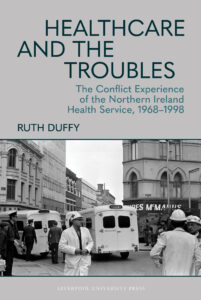
Liverpool: Liverpool University Press, 2024, 264pp, £92 (hardback), ISBN: 9781802074468
That ‘community relations’ are a problem in Northern Ireland, and that the problem requires the balm of policy, has been a hegemonic idea about the region from the 1960s through to the present day. The creation of a state in 1921 with a Protestant, unionist majority and a Catholic minority made for an unstable situation, exacerbated by various forms of direct and indirect discrimination against the minority population. An anxious awareness of this instability, and connected anxieties about legitimacy and citizenship, are the genesis of thinking about the relationship between Protestants and Catholics in the North. But it was the emergence of the civil rights movement in the 1960s, alongside Terence O’Neill’s efforts to modernise and reform aspects of the Northern Irish state apparatus, that marked the beginning of ‘community relations’ as a discourse and a policy programme.
A notable consequence of this discourse is that the Troubles, the war that took place in Ireland and Britain between 1969 and 1998 and led to the deaths of more than 3,800 people, is framed as entailing a conflict between two communities – Protestants and Catholics, unionists and nationalists, loyalists and republicans – although this framing can often obscure rather than clarify an analysis of why and how the conflict happened. In particular it tends to downplay the longer colonial relationship between Britain and Ireland and the active participation of the British state in the war, instead presenting Britain as a reluctant arbiter between two implacably-divided ethnic or sectarian groups.
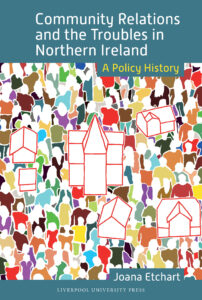
Joana Etchart’s thoughtful and engaging new book is a useful intervention in the history of community relations in the North for three reasons.
First, it makes the hegemonic ‘community relations’ position newly-visible by historicising it and by analysing its genealogies, its presuppositions and its objectives. Second, it highlights the internal debates and frictions within community relations as a model, showing that competing ideas of community and of policy were consistently at odds with one another in different phases and moments of the Troubles. Third, it supplements a fine-grained analysis of policy and policy-making with a post-positivist oral history method that draws out the complex relationship between state-led initiatives, non-state actors like charities and community groups, and individual people’s actions on the ground.
As a history of Northern Ireland, there is much to commend in this book. It avoids one-dimensional analyses of state policy, instead using a detailed engagement with archival sources to unpick the conflictual desires and ideas animating the Stormont regime and the post-1972 direct rule regimes. It emphasises the ‘rich, sophisticated role’ of non-state organisations of various kinds in shaping and informing approaches to community relations, even though their aims or methods were not always aligned with official community relations policy (p231). And it makes some subtle arguments about the British state’s perception of its role in Ireland, connecting this interestingly to the paradigm of the ‘nightwatchman’ identified by Linda Colley and David McCrone as key to Britain’s imperial identity as a light-touch referee in the affairs of its colonies (p10). Finally, it also draws on an exciting batch of under-used sources, notably Michael Hall’s Island Pamphlets series of small-group discussions and the Northern Visions archive of interviews with community workers.
I hope, though, that Etchart’s research finds an audience outside of the specific niche of historians interested in policy, community relations, sectarianism and the Troubles. Oral historians in particular will be intrigued by Etchart’s attempts to combine fine-grained analyses of policy debates and legislation with fragments of personal memories and narratives. I was convinced by her proposition that putting ‘experiential truths’ into conversation with archival traces of governance and policy can illuminate something about experiences of alienation and marginality but also about the drivers, mechanics and consequences of state decision-making (p217).
A minor disappointment is that this method is only partly developed in the text as stands. As Etchart points out herself, ‘many pertinent testimonies and accounts had to be left out in the process [of developing the analysis],’ although the reason for these exclusions is not made explicit (p217). Chapter Two, which draws on archival documents from the Northern Ireland Community Relations Council and the Community Development Journal but also the British Diplomatic Oral History Programme, the Northern Visions archive and Michael Hall’s group discussions with community workers, seems to me to be the section that most successfully integrates these different sources into a thick, textured narrative. The part of Chapter Four analysing Etchart’s own oral history interviews with Community Relations Officers in Dungannon also suggests a model for how an awareness of narrative composure, memory, subjectivity and emotion can be integrated into histories of policy and the state. Elsewhere in the book the experiential or subjective sometimes recedes into the background and a tighter focus is placed on debates within the community relations field, particularly on the level of state policy.
Ultimately, the book shows that different types of ‘community relations policy’ have been mobilised in Northern Ireland since the 1960s and that we should not treat these policies as one-dimensional. Radical, liberatory or ‘comprehensive’ approaches, drawing on left-wing social work and community development ideas, co-existed with more reformist and paternalistic discourse, and with forms of ‘fieldwork’ that augmented British state counterinsurgency practices (p97). Images of community in Northern Ireland as containing the potential seeds for a new society could be mobilised as utopian expressions of working-class solidarity, for instance, as in some of the projects undertaken by the Worker’s Educational Association in the North. But as Etchart shows, they could also be mobilised as a form of ‘abeyance’ that ascribe what she calls a ‘causal’ role to community division in the North, allowing Britain to perform its favourite role as a supposedly neutral arbiter (p118). The fundamental argument that community relations policy was an ‘element of the conflict’ that could ‘[nurture] dissension’ but also ‘improve people’s lives’ is sound and expressed clearly across the text (p20).
At times, however, Etchart’s admirable commitment to detail, granularity and nuance left some larger strands unpulled. Connections between British imperialism, the decolonial period, counter-insurgency and community relations, for instance, are apparent in places here (p98); a broader argument could be made about how state-driven understandings of community in the North tended to be predicated on an essentially colonial imaginary. Marc Matera’s recent work on the beginnings of race relations discourses in late colonial Africa, for instance, makes a firmer case for understanding the depoliticising tendencies of this model as a deliberate feature of how it works, and as a deliberate means of undercutting the power of anticolonial and Black Power movements in the 1960s. Etchart’s tightly-focused argument that we can see nuance in community relations policy in Northern Ireland and that oral histories of community workers allow us to do so is useful and clear, but perhaps makes it harder to widen the lens out towards the wider context in which this policy was developed.