One aspect of running an archive of any sort is that it is often difficult to keep up with the preservation work. With a sound archive this work may involve taking in collections, examining old tapes, digitising them, cataloguing them, and checking them for any sensitivities before making them available to the public.
At the East Midlands Oral History Archive (EMOHA), at the University of Leicester, the list of uncatalogued material has been growing steadily for many years. From 2018-2021 we were the Midlands Hub for the British Library’s Unlocking Our Sound Heritage (UOSH) project. This enabled us to digitise and catalogue over 4,000 recordings from across the Midlands, but it didn’t help us deal with our own collections as none of them were deemed to be ‘at risk’, unlike the other collections with which we worked.
Towards the end of the UOSH project we saw that the equipment and procedures we had inherited from the British Library would be ideal for working with our own collections, so we applied to the National Lottery Heritage Fund (NLHF) for just under £250,000 to create the Sounds for the Future project (SFTF).
This gave us 18 months to do the following: Digitise all our remaining analogue recordings and rip the audio off several hundred CD-Rs before they become unplayable; catalogue all the uncatalogued material and add this, along with the data from the existing catalogue, to the University’s Archives & Special Collections (A&SC) Calm catalogue; move all the master files into the Arkivum digital preservation system used by A≻ rights clear and sensitivity check 250 recordings to add to our online collection; create an outreach programme that would involve volunteers and include training, talks, events, podcasts, blogs and web exhibitions; create online oral history materials for teaching Key Stage 3 pupils. We also preserved a large collection of oral histories from Northampton Central Library that had slipped through the net when we did UOSH.
Thanks to the UOSH project we were able to call on both an experienced audio engineer and an experienced cataloguer who was willing to learn the rights clearance process. We then brought in another cataloguer and budgeted for 12 weeks of extra help towards the end of the project as the experience with UOSH had taught us that it’s the cataloguing that takes the most time.
Having now worked on two similar projects, I thought it would be worth sharing a few thoughts and lessons learned from both the UOSH and the SFTF projects. The first is the one I’ve already mentioned – cataloguing takes a lot of time! We had to export an existing Access catalogue to Excel and then to Calm, enhance some of the entries, and then create more than 2,500 new entries. All our cataloguers and volunteer summarisers found it difficult to create short summaries; in both projects, the instinct to create detailed summaries with timecodes was strong and, in the end, we decided not to go against nature. We knew we had help coming towards the end of the project, and we needed it.
For putting material online, we realised that we wouldn’t have time to chase permissions from interviews created in the pre-Internet years, so we worked with collections where we had consent to put the interviews online. The sensitivity checks took time, but were manageable, and we sent a polite letter to the interviewees to give them the chance to comment or object. We also did our best to sensitivity check all the collections we are making available to the public onsite. We couldn’t possibly listen to everything, so had to take a risk-based approach and work on those collections that obviously had sensitivities, such as recordings about health issues. We learnt that the redaction process can be time-consuming and we would allow more time for this in future. This was the first time we had formally checked EMOHA’s collections for sensitivities, and it is an ongoing process.
We’ve also learnt that most analogue tape is lasting pretty well, and baking the tapes if they are sticky is very effective. Even the CD-Rs weren’t in as bad condition as we feared and we only had a few that were unplayable. However, the cost of keeping the playback machines working is high and we were grateful to the NLHF for allowing us to spend some of our contingency budget on repairs to the cassette decks, especially, but the reel-to reel players as well. This ongoing cost of repairs is something we will need to budget for in everything we do in future.
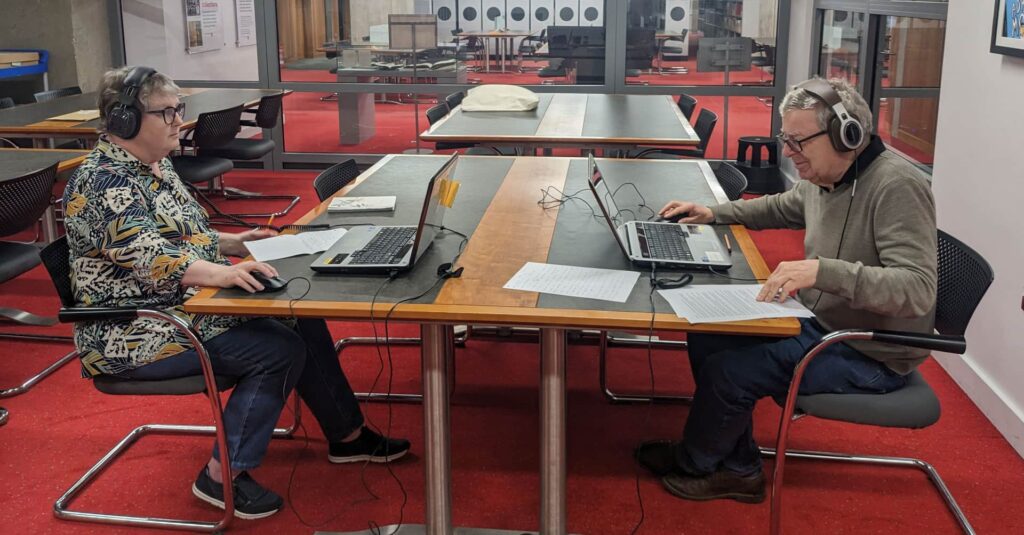
Working with sound is something that many volunteers enjoy, and SFTF worked with 41 volunteers. People from all walks of life wrote catalogue summaries, learnt how to digitise and edit sound to create audio clips for blogs or web exhibitions, wrote material for the exhibitions, and contributed to podcasts. We were sorry to say goodbye to them at the end of the project and hope to start accepting volunteers again soon.
The outreach sessions were fun and we would like to do more of them. It is eye-opening when a 12-year-old has absolutely no idea what a 45-rpm record is. The use of ‘old’ formats, like cassettes, is a great way to introduce young people to issues around archiving and preservation, and we now have a raucous series of brief karaoke sessions recorded by sixth formers on reel-to-reel, cassette, microcassette, and minidisc. When we asked for ideas for sounds that illustrate life in 2023 one of the students used their phone to record the ‘thank you for waiting, you’re third in the queue’ message from one of the major phone companies – brilliant!
As is usual when putting a funding bid together, we promised a lot, but we delivered almost everything we planned. Through all the usual issues such as trying to contact teachers, arrange sessions with community groups, timetable volunteers etc., it is the archival work, particularly the cataloguing and sensitivity checking, that takes up the time. Rights clearance also has the potential to take a lot of time, particularly if there are no permissions in place, and it is these factors that should be planned for from the start of any similar project. That said, the final outcome is very satisfying: engaging with people who don’t know about sound archives to preserve recordings that are safer, more discoverable, and more useful.
The Sounds for the Future team were: Helen Foster, Colin Hyde, Ruth Maguire, Lily Skelton and Richard Wheelband.
Project webpage – https://le.ac.uk/emoha/sounds-for-future
Learning resources for schools – https://le.ac.uk/emoha/learning
Blogs – https://staffblogs.le.ac.uk/library/category/sounds-for-the-future/