Reflections on some of the colourful memories revealed in oral history interviews from the beginning of the radical, new, post-Robbins Scottish university
Almost 20 years ago a group of newly retired staff, many of whom had been at the University of Stirling from its heady beginning, decided to form a retired staff association. Its aim would be to recreate the sense of community, vivid in the memories of those present, which had characterised the new academic kid on the block in 1967. Everyone remembered Gladys, who steered the coffee trolley with its legendary rock buns round the new Pathfoot Building, as they remembered Tommy, the professor of English, who drank his coffee and ate his rock bun in the communal café, and whose conversation beguiled a group of librarians, cleaners, students and new staff. There were no separate facilities for staff and students. In the early days the university car was a Lotus Élan and it would draw up beside other Scottish universities’ sober Rovers, driven by a woman in a trouser suit rather than by a male chauffeur in cap and uniform. How could we recapture those ephemeral but defining moments?
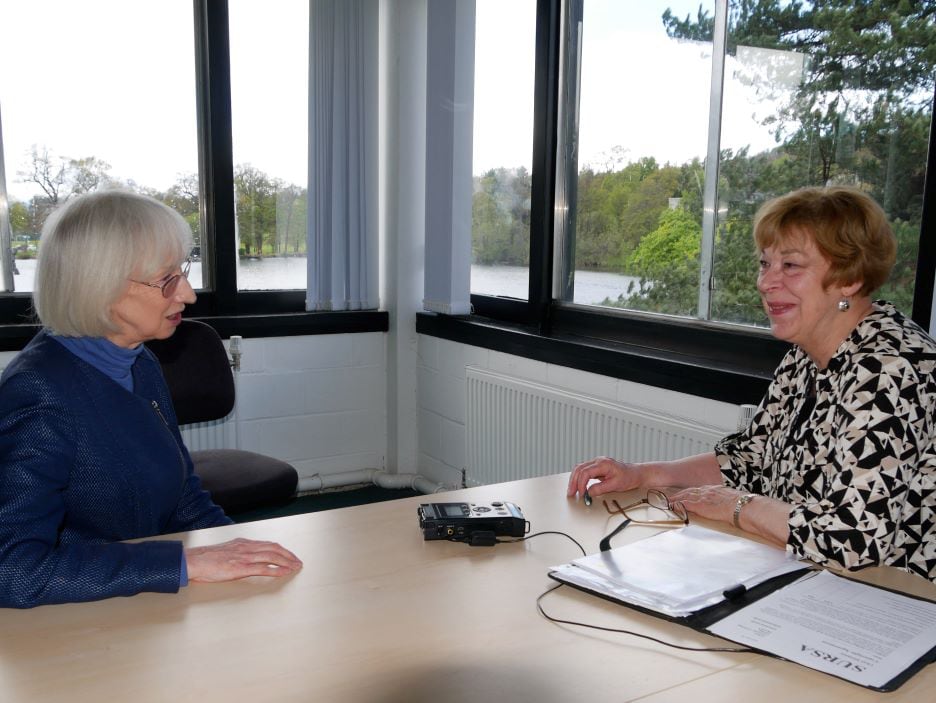
The Stirling University Retired Staff Association (SURSA), was formed then and it flourishes now. Our next initiative was to generate an Oral History of the university and fortunately for us, one of our founding members was Dr Jim Valentine who had wide-ranging experience of conducting an oral history. This became a major SURSA project and Jim taught members how to interview and summarise the interviews. At that stage we were aiming to lodge the recordings in the University Archive, to be accessed by readers who visited the university. The next major development came about when the emeritus professor of aquaculture, Lindsay Ross, offered to create a website for SURSA’s oral history which would make interviews accessible to any reader, with a summary to enable searches and a photograph of the speaker. The website [www.oralhistory.stir.ac.uk] was launched to mark the university’s 50th anniversary at a SURSA lunch for about 150 people in May 2017.
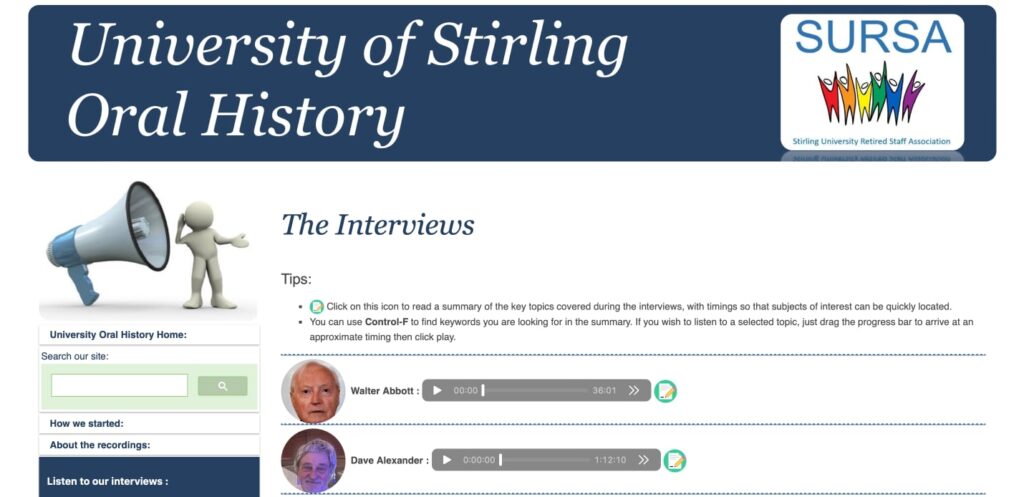
Anyone who visits it will become aware of the sense of community that it celebrates: interviewees include technical, administrative, secretarial, academic and campus services staff – people who maintained and serviced the grounds, the laboratories, the residences, the sports facilities, the art collection and the Macrobert Arts Centre. There are interviews with former students such as Lord Jack McConnell who was First Minister of Scotland from 2001 – 2007. Some of the 1967 intake of students interviewed were encouraged by schoolteachers to avoid established centres of learning and try what was then radical and new; some parents were horrified by their choice. Some were attracted to come to an untried institution by the beauty of the campus, some by the innovative academic structure and admission to the university rather than to a faculty, some by the fact that the university was new and they wouldn’t have to put up with senior students making them feel inept or ignorant. The interviews record frustrations and disappointments as well as self-discovery and academic engagement.
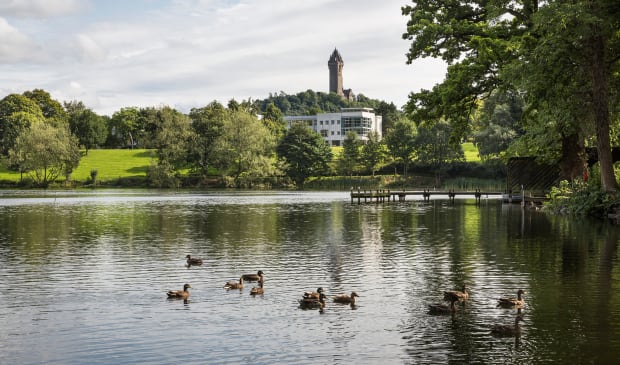
In 1963 the Robbins Report had recommended that six new universities should be created, one of them in Scotland. Many of our interviewees remembered the competition to house the new institution; the eventual finalists were Ayr, Falkirk, Inverness and Stirling. Tam Dalyell described in his interview Falkirk’s ill-fated attempt to woo the members of the UGC committee by taking them up in a helicopter on a day in which “the wind was coming from all directions” and the helicopter was “missing electrical wires by inches”. The august committee members emerged from their ordeal “ashen-faced” and “that was the end of the University of Falkirk”. No wonder that the site at Airthrey in Stirling, with its Adam castle, loch, swans and gracefully wooded park seemed appealing. Decisions, assumed after the event to be based on rational lines, acquire new dimensions through these retrospective insights. Margaret Richards, the widow of the architect of the university’s first building, Pathfoot, and herself an architect, described how she and her husband visited the four possible sites for the only new university in Scotland. They arrived at the Airthrey estate at dusk. As they stood where the Cottrell building now stands a huge stag thundered past them, along the loch and up on to Sheriffmuir. The long low modernist buildings designed by Richards and his colleagues respected the late eighteenth century design of the park, its winding man-made loch and its wildlife. Many of the interviewees were bewitched by the beauty of the campus and by the life in its waters, woods and surrounding hills.
We were able to interview key figures about excitement and innovation, and about disappointments and losses. Some members of the History Department had come to work with the Marxist historian Professor George Rudé but he remained at Stirling for less than a year. The tragic death at 49 of the visionary first Principal, Tom Cottrell, is remembered in the interview recorded by Sir Fred Holliday; he had direct experience of Tom Cottrell’s capacity to imagine and create an institution in which the students would be challenged intellectually and encounter contemporary works of art, and film, music and theatre. Tom Cottrell might well have relished the integration of traditional academic disciplines that proved not to be viable as individual subjects: chemistry, physics and biochemistry evolved into larger boundary-crossing departments such as ‘Biology and Environmental Sciences’ and ‘Aquaculture’. The interviews with those whose lives helped to create the institution give an illuminating kaleidoscope of perspectives on the past and the present, and our Oral History celebrates the university’s survival and growth, challenges and innovations, idiosyncrasies and delights, using manifold voices to take the past into the future.