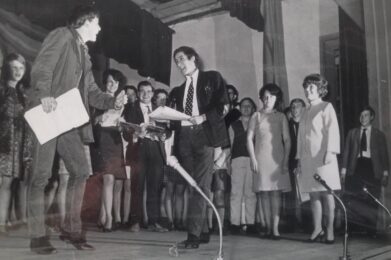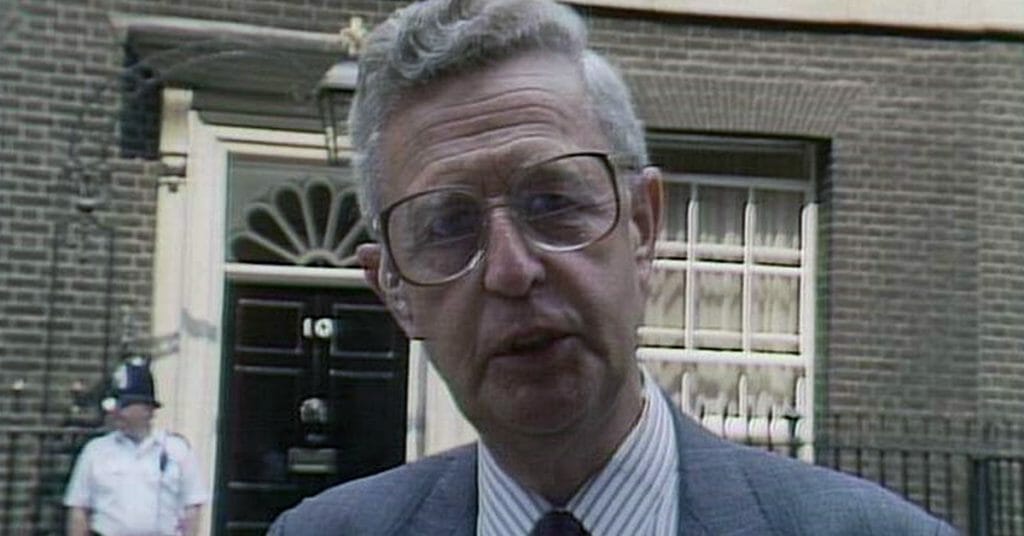
Featured image: The legendary broadcaster John Cole was interviewed by Frank Gillard for the BBC Oral History Collection, 1996. Image: ©BBC
Working at The Keep archives in Brighton (2018-2022) as Project Manager for Unlocking Our Sound Heritage (UOSH), I immersed myself in historic sound recordings from around the South East. I loved the BBC Radio Brighton recordings, donated by Bob Gunnell, the original station manager. Now held by the Royal Pavilion & Museum Trust1The catalogue records for this collection can be found on the British Library’s Sound and Moving Image Catalogue – sami.bl.uk – under the reference UTK006. The collection comprises 732 open reel tapes digitized and catalogued by UOSH containing a broad selection of local radio output from 1968-1983. For access to the recordings, please contact the Archivist for Brighton and Hove at The Keep, www.thekeep.info. , this collection from 1968 to 1983 takes us back to when official antipathy to commercial radio led to the creation of eight BBC local radio stations. Radio Brighton was the fifth to launch in February 1968.
Listening to local radio from 50 years ago emphasises the extent of the BBC’s role over the last 100 years, from household names, famous programmes and historic moments, to the jingles of local radio, stories of big dogs and mysterious sounds, real-life drama and local passions. Through the recordings, we gain a rare and captivating glimpse into the pace and tenor of life in the 1970s-80s.
Exploring the archive
A year later I have been delighted to explore another world of BBC audio through the website and catalogue of the Connected Histories of the BBC project, available online at connectedhistoriesofthebbc.org.2The website and catalogue were created by David Hendy, Margaretta Jolly, Tim Hitchcock, Denice Penrose, Alban Webb, Ben Jackson, Mike Hammond and Anna-Maria Sichani, Connected Histories of the BBC, (https://connectedhistoriesofthebbc.org) <19/10/2022> This brings together seven separate oral history collections of interviews, helping to shed new light on the development of the corporation and on the programmes and personalities that have shaped its reputation. It takes you as well the other side of the broadcast, to the people whose technical vision and expertise made it all happen.
Where do you start with a collection of over 400 catalogued and digitized interviews? Well, with my Radio Brighton enthusiasm, I searched ‘Brighton’ and two records came up, both from the Oral History of the BBC collection. The first is with the political correspondent John Cole, and the second is with John Drummond, who joined the BBC in 1958 and rose to become the Controller of Radio 3.
Dipping into these interviews, both recorded in the 1990s by Frank Gillard, I heard Cole’s perspective on the IRA bombing of the Grand Hotel during the 1984 Conservative Party annual conference. He recounts going to bed early because he was still recovering after a heart attack and being jolted awake by the blast. In a time before digital communication, he rang the BBC in London to leave messages for colleagues elsewhere in Brighton. He recalls seeing the Vice-Chairman of the Tory Party – ‘a friend of mine’. I wonder if today’s BBC political correspondents would describe senior politicians as friends?
By contrast, the interview with John Drummond is a deep dive into the world of Radio 3 and classical music broadcasting. He refers to the Brighton Festival when outlining a dispute about the balance of speech and music on Radio 3:, his view was that the then Controller ‘knew nothing of music and cared less and was deeply, deeply convinced that all musicians were stupid and all artists were not worth talking to’. During a broadcast from the Brighton Festival of the cycle of Sibelius’s symphonies, Drummond is disgusted that the intervals were filled with unrelated speech programmes: Six Continents, covering world news, Democracy Romanian Style and Aspects of Egypt.
What I hear in these random snippets is how the oral histories can communicate the culture and language of the BBC, its complexity and the complexities of the times, the anecdotes that illuminate the bigger picture. And if you click on the quotes above, you can hear this directly too, as well as the accents and terminology of the interviewees, for one of the joys of the catalogue is the ability to ‘audio quote’.
Connected Histories of the BBC
The six-year Connected Histories of the BBC project behind the catalogue was funded by the AHRC, in part to widen access to existing oral history collections about the BBC, and to add new interviews to the collection. I like the fact that the interviews are bookended by women from the first Janet Adam Smith, assistant editor of The Listener, interviewed in 1979 for The Oral History of the BBC Collection to the last: Annie Nightingale, first full-time female presenter on Radio 1, interviewed in 2018 for the Sussex-BBC Centenary Collection. In between we meet high-profile radio presenters, producers, managers, unnamed studio engineers (304), the producer of the Kyrgz Service (364) on the World Service and behind-the-scenes workers such as Dorothy Wood, an orchestra coordinator. The breadth reflects the scale of the BBC, though the absence of interviews with key support workers such as secretaries, receptionists, cleaners, caterers must be acknowledged.
Within the Collection Notes it is refreshing to read a statement about the nature of oral history that emphasises its strength as a resource, while acknowledging the challenges:
The interviews vary in style, in the power of recall on display, and in their degree of openness. As with all oral history, many of the interviews are more revealing about impressions, feelings, and emotions than about hard facts: dates, names, and the precise sequence of events are occasionally remembered slightly inaccurately – and cross-checking with other evidence is always advisable. But the accounts included here – with staff ranging from Directors-General, senior programme-makers and managers, reporters, presenters and engineers, to behind-the-scenes administrative and technical staff – provide vivid ring-side accounts of some of the major events in BBC history.3Collection Note, ‘BBC Oral History Collection’, Connected Histories of the BBC, https://chbbc.sussex.ac.uk/collections.php<19/10/2022>
All the interviews in the collections can be watched and/or listened to via the website, alongside transcripts and collection descriptions. Such a rich resource and, best of all, easy to search and navigate around, which is not always the case with archive catalogues.
Perhaps of most significance is the opportunity to link to the sound recording via the machine-generated transcript of the interview. This allows the user to skim the transcript or use the search function, pick out particular elements of the text and then jump to that part of the recording. As someone who has scrolled back and forth endlessly on a recording, trying to find the 30 seconds where the interviewee mentions something critical, this is wondrous. The transcripts vary in quality, with more mistakes in the older recordings, but this is still an excellent facility that opens up the potential to explore the many hours of recordings.
Complementary to the catalogue is an extensive tour through the BBC’s history via curated oral history and programme clips, hosted on the BBC’s site: Voices that Made the BBC. These offer nine critical interpretations and debates including Pioneering Women; People, National and Empire; Radio Reinvented; the birth of TV and, in Inventing the Future, pondering where the BBC may be going.
Save Our Sounds, Listen to Our Sounds
The British Library’s #SaveOurSounds campaign has been promoting awareness of the power and significance of our sound archives, and warning of their fragility due to decaying formats, loss of playback equipment and the challenges of accessing them within the archive. Just as the 950 recordings of the BBC Radio Brighton Collection reveal details of the content of local radio, so the 471 hours of audio and 161 hours of video in the Connected Histories of the BBC shine new light on the national and international world of the wider BBC dominion. Digitisation and cataloguing are the prerequisites for preserving these recordings; transcripts and online access provide the next step for ensuring ease of access and use. For anybody researching, writing about or just plain interested in the history of the BBC, its culture and the people behind it for over the last 100 years, I recommend that you start listening.
Footnotes
- 1The catalogue records for this collection can be found on the British Library’s Sound and Moving Image Catalogue – sami.bl.uk – under the reference UTK006. The collection comprises 732 open reel tapes digitized and catalogued by UOSH containing a broad selection of local radio output from 1968-1983. For access to the recordings, please contact the Archivist for Brighton and Hove at The Keep, www.thekeep.info. ↩︎
- 2The website and catalogue were created by David Hendy, Margaretta Jolly, Tim Hitchcock, Denice Penrose, Alban Webb, Ben Jackson, Mike Hammond and Anna-Maria Sichani, Connected Histories of the BBC, (https://connectedhistoriesofthebbc.org) <19/10/2022> ↩︎
- 3Collection Note, ‘BBC Oral History Collection’, Connected Histories of the BBC, https://chbbc.sussex.ac.uk/collections.php<19/10/2022> ↩︎