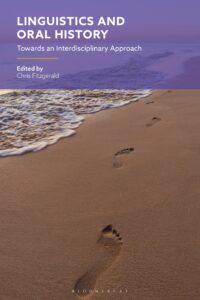
Chris Fitzgerald (editor)
London: Bloomsbury, 2025, 272pp, £28.99 (paperback), ISBN: 9781350458246
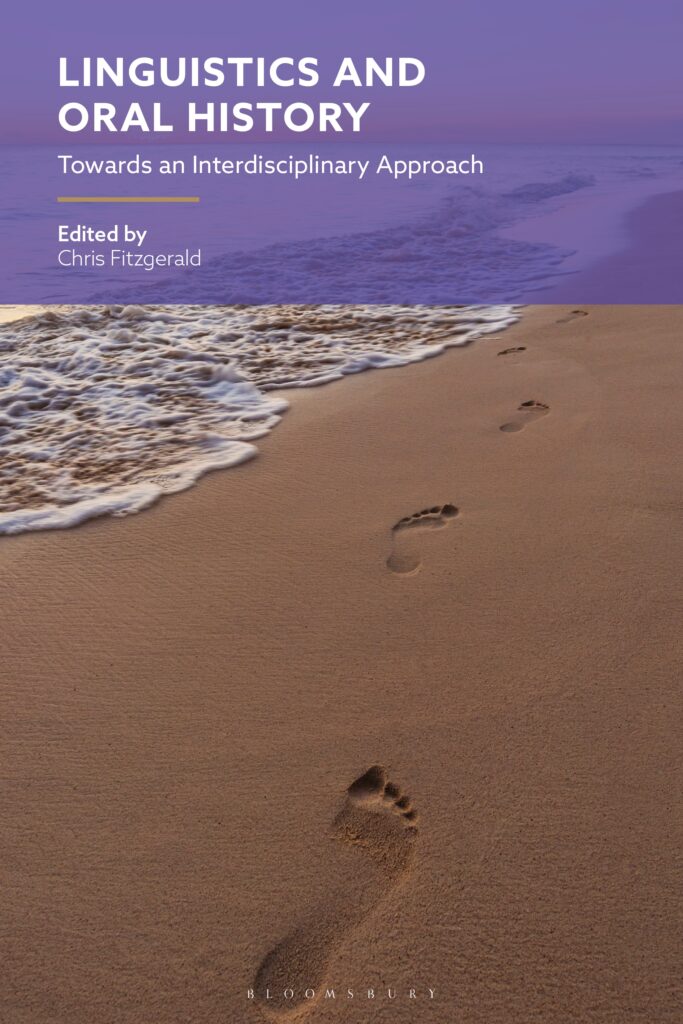
Relatively little has been done in the past few decades to bridge the gap between linguistics and oral history since Deborah Schiffrin observed in 2001 that there has been ‘surprisingly little reciprocity’.[i] Jennifer Clary-Lemon pointed out almost a decade later, in 2010, that scholarship linking the uniqueness of the oral history genre with the rigour of linguistic analysis remains scarce.[ii] This volume edited by Chris Fitzgerald is a timely and valuable contribution aiming to bring together these areas of scholarship. The book comprises twelve chapters from contributors across a range of backgrounds, including linguists, oral historians, archivists, teachers and speech therapists, and establishes how the intersection of these disciplines can enrich both historical understanding and linguistic theory.
The book takes as its starting point the unique nature of the oral history interview. Unlike other forms of recorded speech, these interviews often take place in intimate settings, allowing participants to access memories and narratives that otherwise tend to remain inaccessible. Fitzgerald notes in his introductory chapter that while oral historians are frequently drawn to linguistic features such as dialect and word choice, they have rarely applied formal linguistic frameworks. Conversely, linguists have often regarded oral histories as a valuable form of spoken discourse data but tend to treat them as static repositories rather than dynamic interactions. This volume draws on multiple perspectives to demonstrate how linguistic analysis can deepen the interpretative power of oral history, whilst oral history provides rich, contextualised data for linguistic enquiry.
The initial chapters of the book focus on methodological intersections and theoretical frameworks. Natalie Braber’s opening chapter emphasises the substantial contribution that sociolinguistic methods can make towards our understanding of memory and identity. Drawing on a case study of coal miners in the UK, she explains how specific lexical items function as performative markers of local identity and collective memory. Braber contends that these linguistic choices actively shape how experiences are recalled, offering linguists valuable data on regional variation and language change. The following chapter by Mary Larson examines the challenges and opportunities presented by ‘datafication’. She distinguishes between mere digitisation and the transformation of oral histories into computational corpora, warning that the latter risks stripping away vital contextual nuances of language and the dynamics of the interviews. However, Larson also argues that big data approaches can reveal hidden linguistic patterns that traditional close reading might overlook, provided that ethical issues of using these datasets are appropriately taken into account. Similar tensions are further explored in Gili Diamant’s chapter on transcription practices. Analysing Irish English ethnographies from the National Folklore Collection, Diamant illustrates how transcriptions can be interpretive acts that potentially reflect the collector’s biases. By comparing manuscripts with original audio, she shows how collectors like Tom Munnelly balance readability with authenticity, often avoiding stigmatising phonetic respellings to prevent marginalising informants.
Steven High shifts the focus to digital tools, explaining innovations such as Stories Matter and Atlascine. This software allows for scaling up analysis by transforming interviews into searchable datasets and mapping narrative spatialities. High argues that while technical limitations exist, these computational techniques foster a deeper engagement with interview dynamics, revealing tensions and agency that might remain obscured in standard verbatim transcripts. Elizabeth Kiely complements this in her chapter by introducing resistance frameworks from Critical Discourse Studies. Analysing oral histories of Irish women workers from the 1930s to the 1960s, she identifies subtle forms of everyday resistance, such as performing busyness and defying patriarchal norms, that challenge dominant power structures. Kiely establishes how linguistic analysis can uncover these mundane yet significant acts of agency, further showing how language and action can co-constitute resistance.
The middle sections of the volume predominantly explore practical applications in professional and educational contexts. Carol McKirdy addresses the logistical and ethical challenges of interviewing second-language narrators. Emphasising narrator agency, she evaluates the use of professional interpreters and plain English strategies to ensure that migrant voices are appropriately recorded with accuracy, respect and empathy. Similarly, Mary Romney-Schaab explores intersections between oral history and English language teaching (ELT). She argues that integrating oral history into ELT promotes culturally sustaining pedagogies by validating students’ home cultures and linguistic pluralisms. By engaging in student-led interviews and transcription exercises, learners not only improve their language skills but also reclaim their narratives. Jois Stansfield applies an interdisciplinary lens to oral histories of speech therapy. By collecting oral histories from practitioners who qualified between 1945 and the 1970s, she traces the profession’s evolution from a focus on articulation and Received Pronunciation to one grounded in modern linguistic theory. These narratives reveal the personal experiences of professional transformation, including the gradual adoption of linguistic theories like those of Noam Chomsky and M. A. K. Halliday, ultimately demonstrating how linguistics has reshaped clinical practice and assessment tools.
The final chapters of the book collectively cover large-scale corpus projects that bridge oral history and linguistics. Sarah O’Brien and Chris Fitzgerald offer a case study on public art and cultural memory in County Clare, Ireland. By combining oral histories with corpus linguistic analysis of social media discourse surrounding a controversial statue, they reveal that tensions and resident objections stemmed not from superstition but from a perceived erasure of local folkloric and historic culture. Their mixed-methods approach demonstrates how combining qualitative narratives with quantitative linguistic data can provide a nuanced understanding of public sentiment and collective memory. Sarah Kirk-Browne describes the Regional English Dialects Diachronic (REDD) corpus project, which leverages existing oral history recordings from the British Library to create a longitudinal resource on spoken English. She outlines the challenges of selecting suitable audio based on sound quality and accessibility rights, as well as developing transcription schemes that balance linguistic detail with readability. Similarly, Nuria Hernández and Susanne Wagner provide a comprehensive account of the Freiburg Corpus of English Dialects (FRED) and highlight how using existing archives can serve to mitigate some of the effects of the observer’s paradox, yielding data that is more natural, whilst also being rich in non-standard morphosyntactic features. Despite challenges related to copyright and digitisation, FRED has facilitated research on dialect grammar and the interplay between language and identity. Finally, Annette Gerstenberg analyzes keywords related to the French épuration(‘purges’ of suspected collaborators following the occupation of France during the Second World War) in the LangAge corpus. Distinguishing between eyewitnesses and ‘time witnesses’, she observes how linguistic choices, such as distancing strategies using the deictic expressions this and that, reveal how people construct meaning around traumatic historical events decades later. Her work underscores the dynamic nature of memory and the value of corpus linguistics in exploring intersections between personal experience and history.
A particular strength of the volume is its diversity of geographical contexts and professional perspectives. Over the course of the book, the chapters cover the theoretical and the conceptual, whilst providing concrete examples throughout of how linguistics and oral history can inform one another. Whether through the analysis of transcription practices, the construction of digital corpora or the application of resistance frameworks, each chapter offers a distinct methodological contribution. The chapter authors effectively address technical challenges and also strive for a degree of representativeness, particularly regarding minoritised groups. Linguistics and Oral History effectively makes the case for the reciprocity that Schiffrin and Clary-Lemon identified as lacking. By substantiating how linguistic analysis can uncover hidden layers of meaning in oral histories, and how oral histories can provide rich, contextualised data for linguistic research, this volume inspires progress in an area ready for further exploration. It is useful reading for scholars interested in memory studies, sociolinguistics, digital humanities and oral history.
[i] Deborah Schiffrin, ‘Linguistics and history: oral history as discourse’, in Deborah Tannen and James E. Alatis (eds), Georgetown University Roundtable on Languages and Linguistics 2001: Linguistics, Language, and the Real World: Discourse and Beyond, Washington, DC: Georgetown University Press, 2001, pp 84–113.
[ii] Jennifer Clary-Lemon, ‘“We’re not ethnic, we’re Irish!”: Oral histories and the discursive construction of immigrant identity’, Discourse & Society, vol 21, no 1, 2010, pp 5–25.
John Bellamy is a senior lecturer at Manchester Metropolitan University and his research is informed predominantly by approaches and concepts from sociolinguistics. Recent projects that he has been involved in are the ‘Huế English’ project in Vietnam and the ‘Linguistic practices of coal mining communities in the post-industrial era’ project between the UK and Germany.