As a new project set out to collect oral histories of rewilding at a national scale, how could it make sure it gathered new stories? Reflections from a scoping phase.
An exciting project on the ‘History of Rewilding’ has been unfolding this year, after Clapham Film Unit successfully secured a National Lottery Heritage Fund grant to gather the stories of people who have been involved in rewilding in England. The work will result in a documentary film and thirty life story recordings to be archived in the British Library’s National Life Stories collection.
The early stages involved some scoping work with a simple brief: to map out a picture of relevant pre-existing oral history work to ensure the project would bring new voices and geographies into the collections. As this turned out to be a deceptively simple brief, this blog shares something of the approach and reflections.
Casting around initially for resources giving methodological guidance or precedent for the scoping research yielded the first observation: that there aren’t many. Most guidance is primarily concerned with the actual delivery of projects (project management, interviewing best practice etc), skipping over the prior step of scoping out your project. NHLF guidance itself only touches very lightly how to ensure ‘there is a need for your project’ and avoid duplication. This lack of advice may reflect the fact that NHLF projects tend to be localised in communities, such that establishing a ‘need’ is more about grassroots demand than addressing gaps in social history records at a national level. The ambition of the ‘History of Rewilding’ – which will be archiving the interviews in the British Library’s ‘National Life Stories’ collection therefore brought it closer to larger research council-funded or academic projects such as Oral History of the Environmental Movement (OHEM), or ‘NHS Voices’. These provided useful precedents and underlined the importance of knowledge-sharing activities. However, the availability of practical advice suitable for community projects (i.e. friendly towards budget, time, resource-access and skill constraints) is a gap which could be worth filling, especially as oral history projects proliferate.
As I was seeking to help guide the project rather than comprehensively map this terrain it warranted a search strategy which balanced being both systematic and pragmatic. The first task was setting out the search scope’s venn-diagram overlap between rewilding and oral history, and as with any review study the devil was in the definitions when it came to inclusion/exclusion. What should ‘count’ as oral history? Sarah Lowry, guided this: interviews which took a life-biography approach which were recorded and archived.1 This meant ruling out a substantial body of interviews with other media outputs (only as podcasts etc) which was a subjective decision taken to render the scope manageable.2
Rewilding proved the knottier concept, as there are few terms as potent in wildlife conservation. Since its origins in the 1990s academics and practitioners alike have grappled with its definitions, dimensions and debates, which despite being termed a ‘new paradigm’ proves continually tricky to pin down.3 It has been cast as a ‘Pandora box’4 with a plasticity of the highest order. For policy-makers, for example, it may mean landscape-scale recovery, for farmers it may mean agroforestry or land-abandonment, to conservationists it may be an era or hope or simply repackaging of old-school afforestation and translocations.5
We decided to first see how much material existed in the venn-diagram, and record project information (name, focus, geography, dates, key contacts) and interview information (who was interviewed, their names, roles, topics covered, where interviews archived), along with the environmental project context details.
Having laid out roughly what we were looking for, the question was where to look? The OHS ‘Map of Environmental Projects’ came into its own as a fantastic starting point, after which I combed through the lists of projects on funding bodies’ websites and within the accumulated ‘Current British Work’ Oral History Journal project reports. Alongside this I searched local and national archives, and finally a web-search (including Scholar and social media) with various concoctions of search terms.
But no sooner had this masterplan been devised than it needed to be revised, as a few head-scratchers emerged which may be common to anyone seeking to map a specific part of the OH landscape.
Firstly, the challenge of refining the search criteria and scope. It quickly became apparent that the net was being cast too strictly: just because very few projects included the term ‘rewilding’ this was missing potentially hundreds of relevant interviews. The challenge was gathering material on a ‘movement’ which has evolved so rapidly and carries such expansive interpretations. It meant broadening the search to encompass a looser definition of rewilding (e.g including restoration, re-introductions, re-naturing, re-afforestation etc.) while still considering projects on more general conservation, agricultural, landscape or natural history to be out of scope.
Secondly, as we were interested in interviews rather than projects it meant ensuring we didn’t miss interviews collected and concealed under a broader project. These may be interviews within an environmental project (such as ‘An oral history of farming, land management and conservation in post-war Britain’) or a non-thematic project (such as locals interviewed for Ambleside Oral History Group).
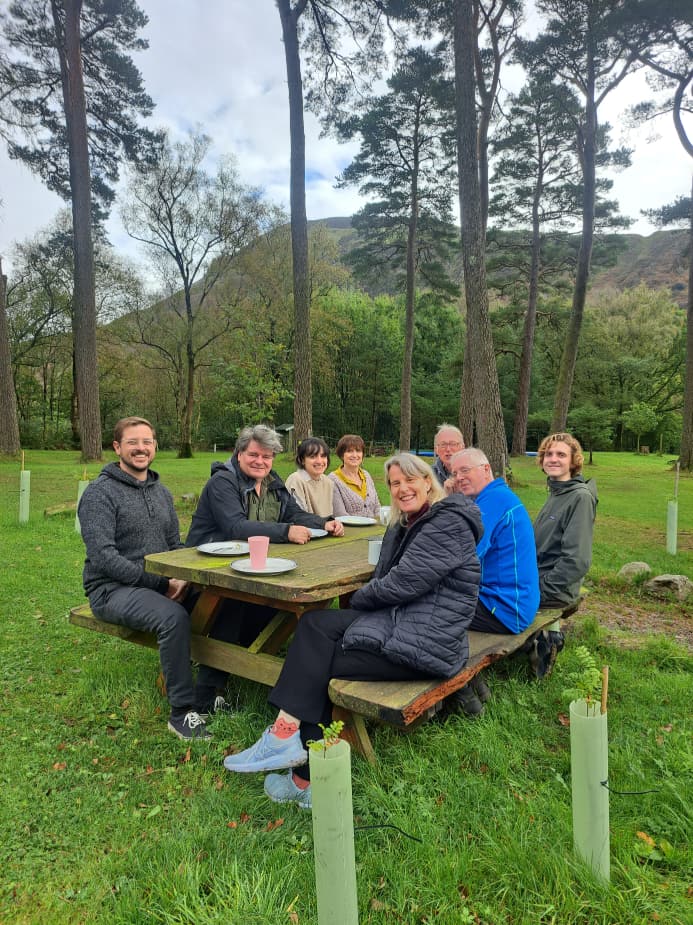
Credit: Charlotte Bill
The upshot was four categories of material: (1) OH collection about or (2) related to rewilding (3) single rewilding-relevant interview within an environmental or (3) non-environmental wider OH project, plus a (large!) reference category for ‘interesting but out of scope’. It is also worth noting that the oral history activity frequently formed just one aspect of wider community or heritage engagement work within the broader social-environmental project.
Thus ensued an enjoyable ‘ferret-mode’ phase of systematically scouring archives using the keyword search terms and logging findings in excel. And a personal side-reflection here, on how lucky we are in the UK to have such extensive and longstanding oral history records. You can tune in to bear witness to the incredible last 150 years, from the origins of nuclear to the rise of the railways, these voices provide a porthole to things changed and gained. And when it comes to those things ‘lost’, whether they be ways of life, trades, crafts, landscapes etc, hundreds of people have been diligently and lovingly recording these along the way. Milkmaids, mayors, marathon runners: the sum total of stories archived is astonishing.
However, being archived is the clincher – as all the above was a search only so far as digitisation and metadata allowed. So having completed the online search reasonably thoroughly I moved into ‘asking people’ phase, since internet < reality. This involved sharing a list of projects found so far with the OHS Environment Special Interest Group and relevant regional advisors, to see if they knew of any projects over and above. It also involved contacting some of the projects to enquire about details of their oral history work.
Sarah led on collaborating with key oral history figures active in this field, and received invaluable support from Toby Butler in particular who advised on the scoping approach as well as the design of the oral history project.
The scoping work supported the project in targeting their collaborations and interviewing, as well as producing an overview of projects which have successfully employed oral history in conservation contexts. The first ‘History of Rewilding’ interviews took place in late Summer this year which hopefully should be adding new voices to the archives. With thanks to the volunteers, interviewees, project partners, and players of the National Lottery who made this work possible.
For further project info please see: The History of Rewilding – Clapham Film Unit | Storytelling, workshops, screenings, commissions and contact project lead Charlotte Bill of Clapham Film Unit ([email protected]) and Sarah Lowry ([email protected]).
For questions/comments on the blog: [email protected]
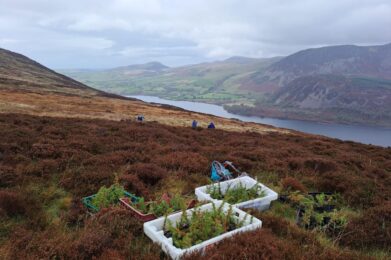
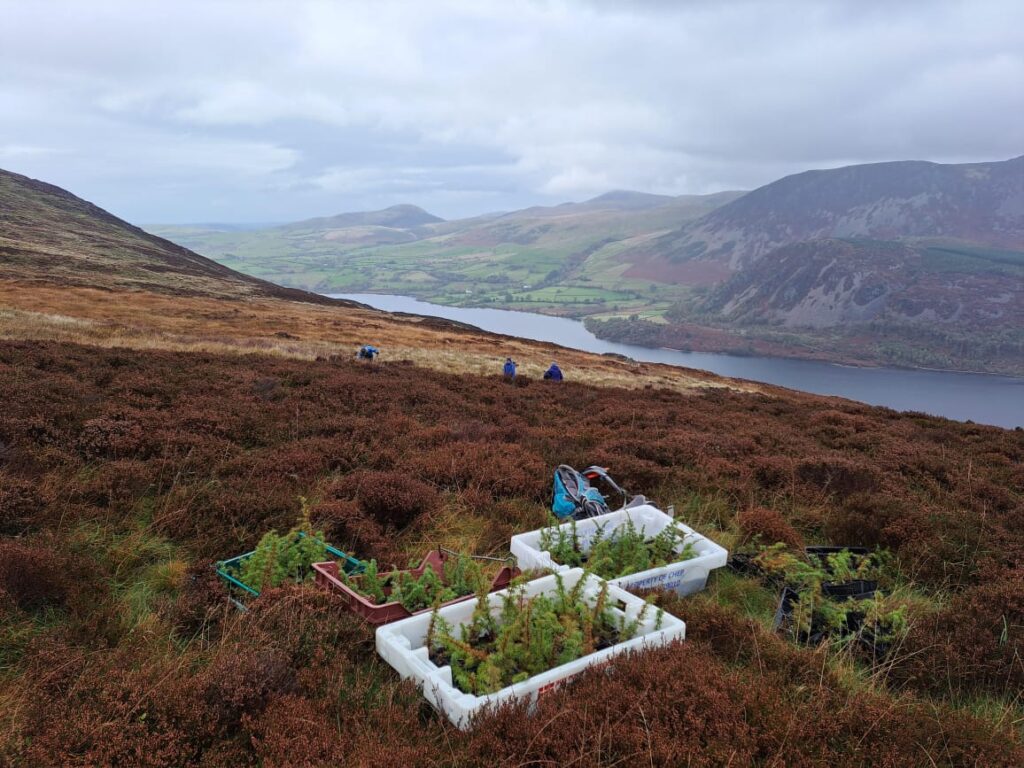
Featured image: Volunteers planting junipers at Wild Ennerdale. Credit: Charlotte Bill.
- When searching, keywords alongside ‘Oral history’ included ‘Narrative life story interviews; biographical; personal histories; memories; eye-witness; lived experience.’ ↩︎
- As it turned out, many of the projects located through this search did have podcasts as the output from the oral history interviews, with or without an accompanying longer form interview going into an archive. ↩︎
- The 2022 article ‘The policy consequences of defining rewilding’ provides a good overview of these complexities. Open access here: https://link.springer.com/content/pdf/10.1007/s13280-021-01560-8.pdf ↩︎
- Nogués-Bravo, D., Simberloff, D., Rahbek, C., & Sanders, N. J. (2016). Rewilding is the new Pandora’s box in conservation. Current Biology, 26(3), R87–R91. https://doi.org/10.1016/j.cub.2015.12.044 https://www.cell.com/current-biology/fulltext/S0960-9822%2815%2901575-4 ↩︎
- The project decided to include people who self-identify as rewilding rather than having any other definition. We also emphasised that interviewees must be happy to be included in a History of Rewilding. ↩︎