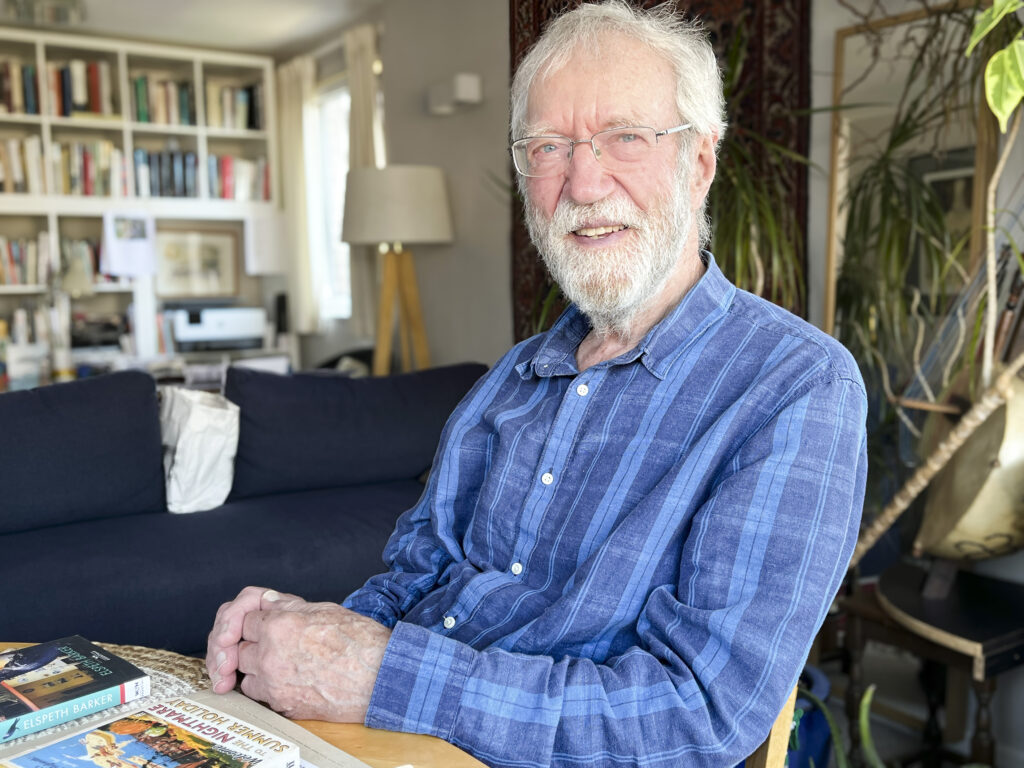
Photo © Olga Saaverdra
Paul Thompson, the founder editor of this journal, reaches his ninetieth birthday in August this year. It is fifty-five years since Oral History: An Occasional News Sheet, optimistically identified as ‘Number 1’, appeared. Edited by Paul, it was intended for ‘those scholars known to be using the interview method in social and political history, and to discover whether any further liaison would be valuable’. The UK’s first journal dedicated to oral history was born and Paul’s pioneering role at this key turning point is now widely acknowledged and celebrated.
The basic elements of the journal we recognise today were set in that first news sheet. We find an article by George Ewart Evans reflecting self-critically on his early experiences interviewing East Anglian farm workers, news of a conference, and accounts from people in various parts of the UK: archivists, folklorists, academics, librarians and schoolteachers describing oral history projects in communities as well as academic settings (an enduring feature of the journal). What comes through those early pages is the excitement and commitment to hearing ‘the voice of the past’, the title of Paul’s pioneering book (1978, fourth edition 2017) which drew on his and others’ experiences of actually doing oral history in those first years. All these features continue to structure and inform Oral History, although changes in print technology and the opportunity presented by digital formats now mean that we reach readers, and illustrate the creativeness of authors and practitioners, in community and academic settings across the world.
None of this would have been possible without Paul’s drive, depth of knowledge, endless curiosity and commitment to including and celebrating oral history activity, both within academe but especially beyond, in communities however large, small, established or new. The journal was quickly followed in 1973 by the Oral History Society, which grew in membership both in the UK and abroad, and by annual conferences, frequently themed and pushing oral history into new disciplinary areas and specialisms. Paul’s interest in innovating and engaging with people of all ages and experiences continues to inspire, and now, in his ninetieth year, he is still actively engaged in doing oral history. He is currently working on the Wivenhoe Artists Community Voices project involving the Wivenhoe Artists Group in Essex.
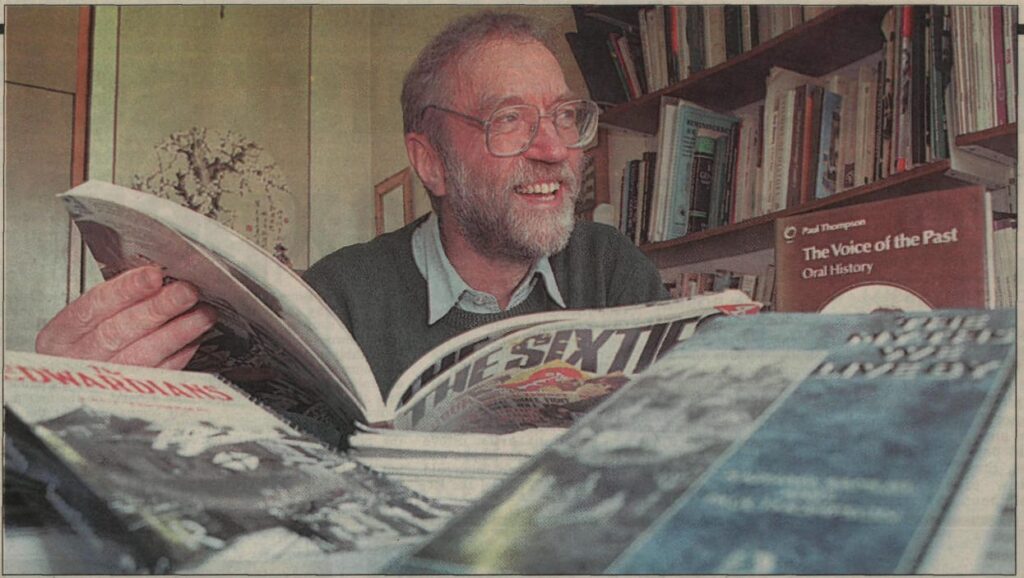
Paul Thompson in 1997 taken by Nigel Brown for a newspaper article ‘Professor behind £4m memory brainchild’. Courtesy of the Department of Sociology, University of Essex.
That first news sheet also included items such as Hywel Francis’ interviews with Welsh miners who went to Spain with the International Brigade to fight in the Spanish Civil War against Franco, and Raphael Samuel’s interviews with the older people of Headington Quarry. These were two among many oral historians who would go on to have lifelong commitments to oral history research and as OHS committee members. Also reported was news of Paul’s unexpected success in securing funding from the Social Science Research Council (now the Economic and Social Research Council) to carry out, with his then wife Thea Thompson, interviews with 500 people for a pioneering survey, ‘Family Life and Experience before 1918’. The quest for government funding was suggestive of a significant shift at higher levels towards the acceptance of a past which was historically inclusive and critical of narratives which ignored the daily lives of people and lost communities. Oral history was developing a method as well as a goal, and Paul’s ambitious vision led to the creation of both the National Life Story Collection (now National Life Stories) in partnership with the British Library (which Paul himself generously endowed), and Qualidata at Essex University, which aimed to preserve interview-based data sets for future research.
Paul was already a published historian by 1970 with books on London’s working-class politics before 1914 and on William Morris. Many more publications followed, arising from projects as varied as fishing communities, car workers in Oxford and Turin, development work in Africa, stepfamilies, migration, and myth and memory. Some were international initiatives as Paul worked with oral historians in the US and across Europe to forge an international oral history movement, leading ultimately to the International Oral History Association. Outside oral history his interest and enthusiasm for art and architecture continues, with historical walks in a wide variety of settings and his own art.
We hope our readers will join us in conveying to Paul the warmest of best wishes for his landmark birthday and the heartfelt thanks of countless oral historians worldwide who have been inspired by his work.