South Asian Britain: Connecting Histories, launched in July 2025, is a free online platform that reveals the interconnected, rich presence of South Asians in Britain, spanning from the 1830s to today. A major output of the research project Remaking Britain: South Asian Connections and Networks, 1830s to the Present — a collaboration between Queen Mary University of London, the University of Bristol, in partnership with the British Library and funded by the Arts and Humanities Research Council — the digital resource showcases around 750 entries on individuals, key events and organisations. Users can explore digitised archives, photographs, and maps, as well as themed pages on topics such as education, family life, and the world wars. Together, these materials showcase a nuanced picture of the many ways South Asians have shaped and been shaped by life in Britain.
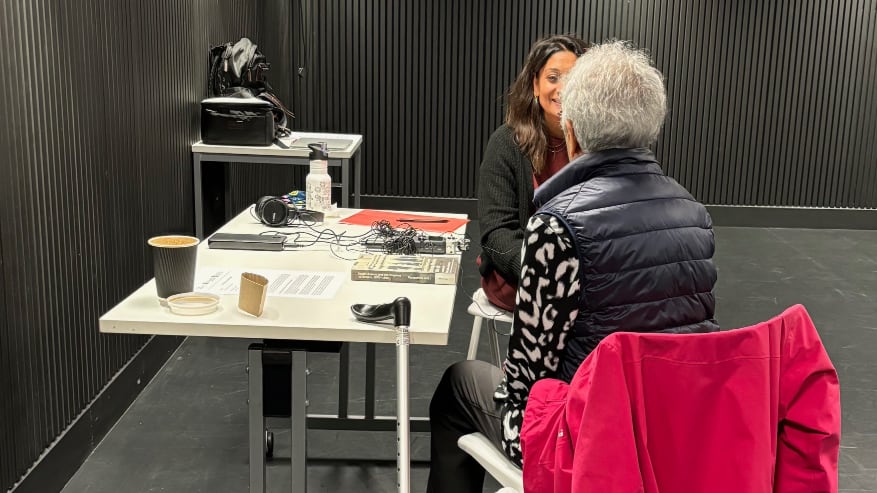
Amongst the 750 entries, are oral testimonies. We recorded nearly 100 hours of interviews, from which we carefully selected excerpts to showcase on the oral history hub. These clips are accompanied by transcripts, photographs, and short biographies of each interviewee. The hub also features material beyond our own collection, from existing British Library archives, the British Ugandan Asian 50 project, Hidden Heritages, and The Museum of Youth Culture. Together, these voices provide an intimate and layered portrait of South Asian lives, histories, and communities in Britain.
Our 30 interviewees reflect the richness of the diaspora and were deliberately selected to be as inclusive as possible. Interviewees, of a range of religious backgrounds, were based across all four nations of the UK, with the youngest being in their 20s, and the oldest in their 90s. Their families had travelled from South Asia to the UK in some instances, and in others they had come via Africa or East Asia. Intentionally moving beyond dominant or familiar narratives surrounding British Asian experiences, we have foregrounded voices often underrepresented in public discourse: individuals from varied class positions, those living in both urban and rural areas, people who identify as LGBTQIA+, those of mixed heritage, and participants whose family roots in Britain stretch back to the early twentieth century.
The diversity of the collection came about through conversations with the Oral History team at the British Library. Our original plan was to focus on specific areas with large and long-established communities of British Asians, including Tower Hamlets (where our institution, Queen Mary University of London, is based) and Leeds and Bradford (where we have connections). But our oral history colleagues at the BL steered us in a different direction, encouraging us to focus on ‘cold spots’ – areas which are not usually associated with South Asians but where there are compelling and often less familiar stories to uncover. For example, one of our interviewees, Rafait O’Rourke, lives in a small coastal town in County Down, Northern Ireland, while another, Rosy Chetal, is an entrepreneur in Thetford in Norfolk. As well as targeting geographical cold spots or margins, we sought other kinds of underrepresented narratives. These include testimonies by: Tayabba, a member of WEIRDO zine which represents South Asians belonging to subcultures such as punk or goth; Rosheen Khan, the first female football referee for Football Association Wales; Shani Dhanda, a disability activist and broadcaster; and Vinay Jobanputra, founder of LGBTQIA+ affirming Bollywood dance space Bollyqueer.
On reflection, as we close the project, we are proud of the depth and breadth of the South Asian Britain collection. It brings to light many unheard and hidden voices, and we are especially pleased to have captured lesser-known stories on topics such as disability, caste oppression, and subcultures. Unearthing these narratives was not always easy, and, like many oral history archives, ours cannot claim to be exhaustive in its representation. In hindsight, we can identify gaps—many of which reflect common challenges faced by oral historians, such as gathering testimonies in languages other than English (in this case, South Asian languages), or building long-term relationships within communities to access harder-to-reach stories. Given the project’s scope and resources, some of these more time — and budget — intensive efforts were simply beyond our capacity.
Our work on the South Asian Britain collection has only deepened our awareness of the numerous, varied and unexpected stories that remain to be uncovered. We are keen to capture more of these from across the generations but also to equip young people with the skills to conduct their own interviews with family members to preserve their lived experiences. Through conversations with students at Queen Mary, many of whom trace their heritage to South Asia and share stories of parents and grandparents in the classroom, it has become clear that there is a desire to explore and capture these testimonies. There is thus potential, and arguably an urgency, for developing further research through an intergenerational oral history project or projects. We hope to facilitate this work, through co-production with students and their families, as well as through collaboration with community organisation Hadithi C.I.C (led by project researcher Maya Parmar) which specialises in this cross-generational model of heritage preservation via oral history.
For more information, visit South Asian Britain: Connecting Histories at southasianbritain.org or contact the authors at [email protected] and [email protected].