It’s a January evening and outside the window orange streetlight radiates off the usually grey stone of Kirkpatrick Presbyterian Church. Caomhie and I sit in Ballyhackamore Library. I start the recorder and we joke about breakfast—the lack of it—before we reflect on a period of rapid change, physical and social, in East Belfast. But, the more things change they stay the same: ‘It’s the cranes, like. The cranes are that colour, so it was black and yellow and that does us.’
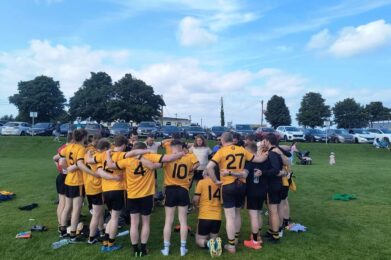
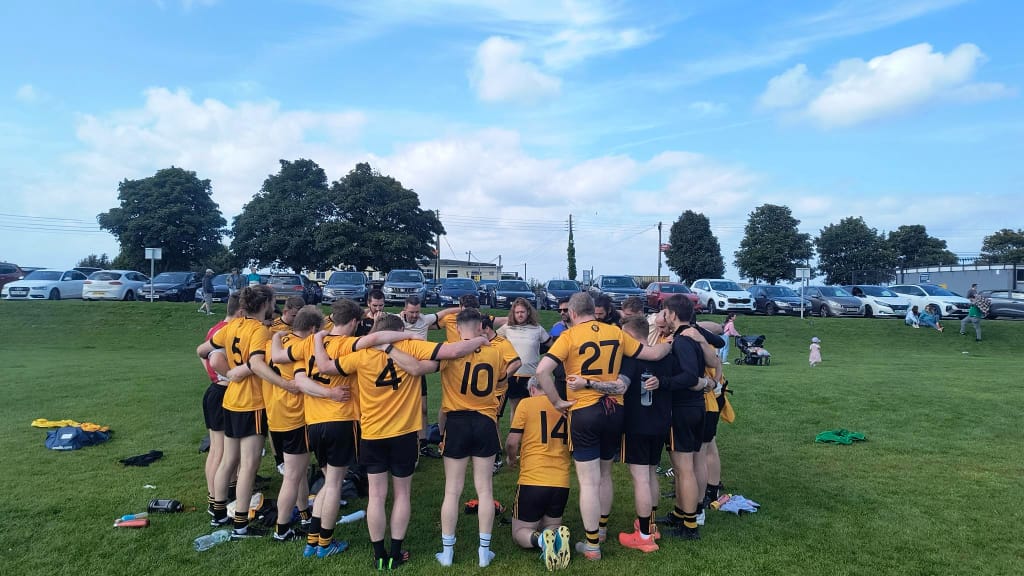
Adopting the colours of the Harland & Wolff shipping company—a talisman of the industrial past of Belfast—was a no-brainer when East Belfast GAA was formed in 2020. The first Gaelic Athletic Association club to exist in the area for fifty years, however, remains essentially, and purposefully, nameless. While a small minority proposed the name Con O’Neill for the club (in recognition of the last Gaelic lord of Ulster), it was a foregone conclusion that the club would emphasise place through nomenclature. This was emphasised during an interview with David McGreevy, one of the club’s founders. He argued that the club wasn’t ‘the agent of change [but] a reflection of’ the ongoing, community-led reinvention of East Belfast fuelled by what Ulster-Scots would term “incomers”. 1
Echoes of the Field was an oral history project undertaken to celebrate the fifth anniversary of East Belfast GAA. Originally proposed by David, who has championed the use of existing, internal talent to pursue new community and placemaking initiatives. Hence, I was approached to oversee a small project and a group of interested club members that was assembled via WhatsApp group. We developed a list of possible interviewees, spread evenly across codes, genders, and community backgrounds, and a group of volunteers to support the project.
Interviewees were invited to select from available 90-minute sessions. Libraries NI provided our location for most of the interviews, with two final sessions undertaken at Queen’s University.2 QUB PhD candidate Charlie Finucane undertook interviews when I was unavailable. Due to my own travel between London and Belfast time was limited, so I provided space for two participants per timeslot. The result was a series of unique pairings providing colourful results and new avenues through which to explore the changing nature of East Belfast.
Thirteen interviews were conducted across 9 sessions, averaging about 45 minutes in length. Undertaken in a semi-structured format, the interview process focused on individuals’ perspectives on Gaelic games and their experiences from the establishment of the club in May 2020.
Volunteers were mobilised to assist transcribing, with positive results; draft transcripts were compiled, offline, with the assistance of WhisperX AI, and volunteers, provided with a style guide, edited these while listening to the interview before additional quality control. Results were outstanding. Transcripts and recordings have been donated to PRONI.
Ulster is a province with a deep tradition of storytelling: Modern Northern Ireland is littered with oral history projects (both official and unofficial) exploring myth and memory in a “post-peace” society. It is little wonder that the ceasefire generation membership of East Belfast GAA are well-equipped narrators. Their story—the club’s story—focused on contemporary forms of social and community resilience, personal and shared experiences of cultural reclamation, and belonging.
Establishing a GAA club in traditionally unionist East Belfast is a conscious challenge to perceived cultural boundaries. This was especially true for club members from Protestant/Unionist/Loyalist backgrounds.3 Dan, a PUL participant recalled ‘sitting there in a Gaelic top across the road from’ a Loyalist bar on the Newtownards Road and thinking it was ‘like society is moving on, finally.’4 PUL participants frequently reported that they also actively engaged with other aspects of traditional Irish culture including dance, language, and music; each act of engagement was a tiny rebellion against a status quo that sat uncomfortably in the wake of the Good Friday Agreement. As Paula articulated, ‘no, we’ve had enough of this bollocks, we’ve had enough of being told, no, that’s for Catholics and that’s for Protestants or that’s for Nationalists and that’s for Unionists!’5
Members, however, were adamant that the club was not the progenitor of change in East Belfast, instead they felt the club was a symptom of social change that existed within the community. Central to this was the normalisation of an idea and a sentiment of a “fair go” for all within the community, a belief that a community was built by its members. The club was quick to establish free programmes to benefit the wider community: Gaeltots for under-5s, youth teams, Gaelic for mothers & others, and sporting camps for refugees and asylum seekers. The club, however, has faced backlash from a Loyalist minority; cross-community events have been threatened, and the club’s home ground has been attacked. David McGreevy reflected on the ethos driving the club: ‘there’s no handbook for this … no handbook on how to deal with the kind of different attacks we’ve had … but [we] just kind of crack on. It’s [the] mantra that’s developed with the board…’.6
Although the primary focus of the club is on the development and growth of Gaelic games locally, its subsequent impact is through positive social change throughout East Belfast. Participants in the project often described the importance of place and placemaking to their understanding of belonging. Many reported that their experience with the club encouraged further local volunteering. For the club success is achieved through the growth of, access to, and participation in Gaelic games, but visibility and interest in the topic—kits worn in public, unfamiliar sports on familiar fields, and fresh events in old community spaces—signal the impact of the club on the gradual and meaningful shift in the social landscape of East Belfast. Today East Belfast GAA boasts 656 members.
For me, Echoes of the Field was supposed to be a little farewell to East Belfast, but it’s something I’ve kept returning to. The project has shaped work I’ve undertaken since in contemplating community, place, and memory in London and Australia. Academically, the recordings are a valuable snapshot of the composure of individual and collective memory amongst Northern Ireland’s ceasefire generation, but they also offer avenues for creative interpretation. And the project now has an afterlife: partnering with Vittoria Caffola A Reflection of Change, a new project interpreting oral histories of the club through theatre, has recently been funded by Belfast Stories community funding.
- Interview with David McGreevy. ↩︎
- Charlie Finucane’s dissertation focuses on shared space and transformation in East Belfast. ↩︎
- PUL and its binary, Catholic/Nationalist/Republican (CNR), have been adopted as imprecise but widely accepted technical descriptors for the traditional Catholic and Protestant divide in Northern Ireland. ↩︎
- Interview with Cabrini Brown and Dan Stewart. ↩︎
- Interview with Kimberly Robertson and Paula Stevenson. ↩︎
- Interview with David McGreevy. ↩︎