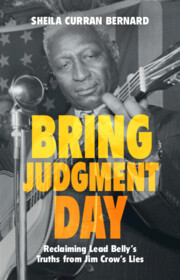
by Sheila Curran Bernard
Cambridge: Cambridge University Press, 2024, 243pp, £25.00 hardback, first edition, ISBN: 9781009098120.
Encountering Lead Belly’s recorded legacy for the first time can be an emotional experience. Personally, this arrived through the filter of watching Nirvana’s haunting 1993 MTV Unplugged live performance of ‘Where Did You Sleep Last Night?’, itself based on Lead Belly’s interpretation of the traditional folk song ‘In the Pines’. The band erroneously credited the song entirely to Lead Belly, praised as one of their favourite artists. The work appears in his discography under ‘Black Girl’ and other variations of the above two titles. Nirvana’s version has taken on an immense popular cultural significance after lead singer Kurt Cobain committed suicide, between his remarkably raw performance and the song’s release. That an all-white American group used Lead Belly’s arrangement on their critically acclaimed and commercially successful concert recording exemplifies Bernard’s central argument that historians need to unravel the multiple layers of white interpretation through which one experiences the talent and charisma of Huddie Ledbetter (1889-1949).
As its subtitle suggests, Bring Judgment Day attempts to separate fact from fiction and establish an accurate, revised narrative of Ledbetter’s life. Its dedication to the late Texan oral historian and judge Joni Tidwell Haldeman reflects the central importance of countless other archivists, librarians, and interviewers, whose work Bernard has comprehensively compiled to correct the official record (pp178-9). Popular knowledge of the musician still derives from the accounts of John Lomax, the white Southern musicologist and folklorist who introduced Ledbetter’s music to broader audiences. Most biographical information has been lifted from a single book produced by Lomax and his son, Alan, entitled Negro Folk Songs as Sung by Lead Belly (1936). Significantly, this sensationalist account ‘purports to tell the story of Ledbetter before he met the Lomaxes, primarily in Ledbetter’s own words’ (pp1-2). Here Ledbetter is presented as an uncivilised and violent criminal, allegedly redeemed from his incarceration by John, who has to remain vigilant in the presence of his ungrateful and volatile performer (p27). Yet Bernard argues that the presentation of Ledbetter’s transcribed speech as verbatim demands clarification and that the Lomaxes’ interpretation of his life was a clear product of deeply entrenched racism present within the Jim Crow South.
Bernard’s work serves as an excellent case study for some of the problems and paradoxes within the practice of oral history. Bring Judgment Day itself relies upon interviews undertaken by others in the decades since Ledbetter’s death, to supplement an original biographical oral history which had long been regarded as a verifiable primary source and verbatim account. Bernard writes that – despite the assertions of recent historians, biographers, and public commentators – Negro Folk Songs cannot possibly have been an accurate ‘transcript because there was no recording of an autobiography’ (p3). The popular narrative of Ledbetter’s life has been entirely shaped by the deliberate interpretative choices and racialised attitudes of John Lomax, as well as the broader historical context of white domination over the post-Reconstruction South. Such a narrative was then entrenched by the willingness of national audiences to accept and disseminate racial tropes which confirmed their preconceptions and prejudices. This argument is demonstrated through a detailed focus on the corrected drafts and manuscripts of the Lomax book, court records, chronologies, newspaper articles, and numerous transcribed interviews with African Americans connected to Ledbetter. Revealingly, the performer himself dismissed the Lomax oral history in 1947, writing that he ‘“don’t think nothing of that book”’ (p168).
Bernard’s project does not simply reject the Lomax narrative entirely, but appreciates the complexities and contradictions of the juxtaposed sociopolitical contexts which produced both Ledbetter and the Lomaxes. The narrative presented in the Lomax book proves most accurate when Ledbetter discusses ‘music, storytelling, and good times with family and friends’, yet is ‘often demonstrably false when he is quoted as describing terrible acts of violence’ (p6). Interestingly, such violence was always directed against other African Americans, as violent depictions of Ledbetter had to be tempered to allow the Lomaxes to effectively market him to white audiences. Throughout these performances, he was always ‘presented in terms of his race and imprisonment’ (p112). Such perceptions of Ledbetter were reinforced in popular culture through a 1935 episode of The March of Time documentary film series, where John Lomax and Ledbetter played screen versions of themselves. Here Lomax claimed credit for organising the pardon for ‘Lead Belly’ and presented his performer as a simple, knife-wielding criminal, desperate to work for him (pp137-40).
It is the exploitative relationship between John Lomax and Ledbetter, focused specifically on the years 1933 to 1935, which forms the heart of the book. Visiting Ledbetter in ‘Angola’, the notorious Louisiana maximum-security prison and former plantation, Lomax was able to catalogue a rich folk tradition – a process unthinkable had he tried to approach local African American communities to archive their music (p19). Unequal from the very start, Lomax expected the pardoned Ledbetter to act as his personal servant and repeatedly altered the dubious contracts between them to increase his ownership over the performer and his work. Lomax exhibited little human compassion for Ledbetter, bringing him to visit a prison where he had previously been incarcerated between 1920 and 1925, and even sending a telegram to Martha Promise on Ledbetter’s behalf offering a convenient marriage proposal (pp60, 123-5). Both Martha and Ledbetter were expected to perform unpaid live-in servant duties for the Lomaxes at their house in Wilton, Connecticut. The tense and fragile understanding between artist and patron further deteriorated, as Ledbetter ‘found himself imprisoned by the dual, demeaning roles of servant and primitive artifact, each of which was sharply contradicted by the enthusiastic response his performances elicited from audiences’ (p153).
Whilst Bernard successfully reframes historical understandings of Ledbetter’s life, there are no easy conclusions as to the complexities of his character. His various convictions are set against the backdrop of a criminal justice system which was demonstrably racist, and the sensationalist popular mythology about his wild personality is dispelled. Ultimately, the truth behind his convictions and extent of his innocence remains impossible to prove. It is clear, however, that Ledbetter was a remarkable figure. Removing the veil of Jim Crow’s lies, the book leaves us with an autodidactic musical prodigy. Ledbetter had the talent to tap his feet at different tempos whilst singing and playing his 12-string guitar, and the charisma to sing for his pardon. It was often in his own interest to follow Lomax’s wishes and Bernard finds space to praise the archival effort of the Lomaxes in preserving his music for future generations (pp176-7). Despite being modified for the white audiences he performed or recorded for, and perfected under unimaginably difficult personal circumstances, it is this music that reverberates. Encapsulating uniquely American contradictions, Ledbetter’s life is worthy of sustained scholarly attention; to understand him, we must listen to him.