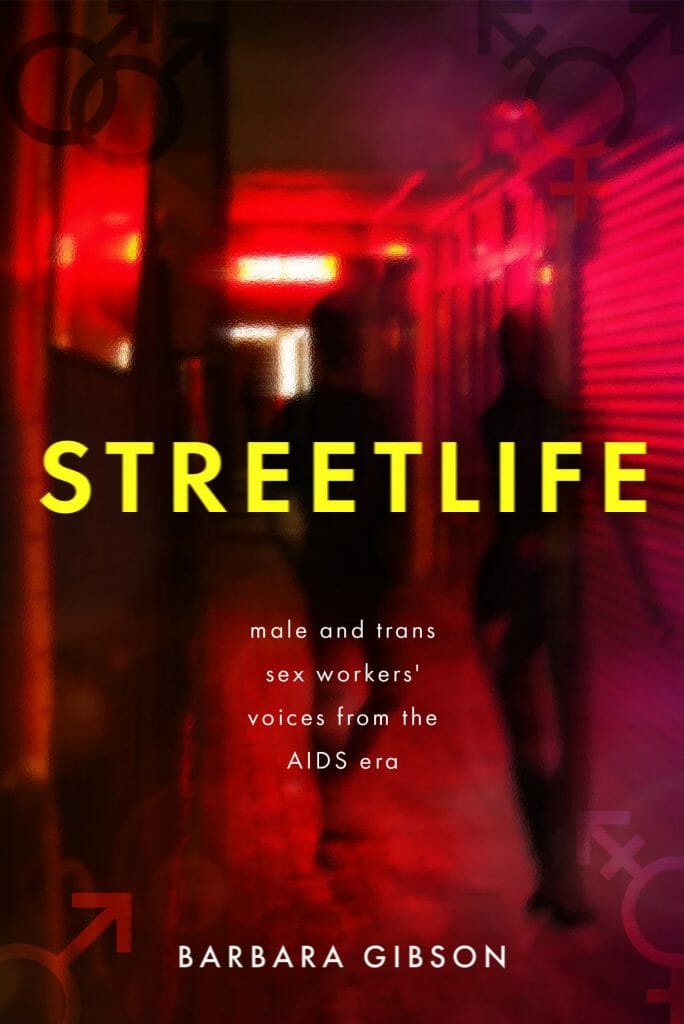
by Barbara Gibson
London: Lume Books, 28 July 2022, 200 pp, paperback £8.99.
Barbara Gibson’s Streetlife: Male and Trans Sex Workers’ Voices from the AIDS Era presents the edited and condensed life stories of six individuals, four men and two trans women, who sold sex at the height of the HIV/AIDS epidemic in the UK. It is a welcomed re-publication that speaks to the current resurgence in historical academic interest of the epidemic and is accessible to both the general reader and historians or researchers interested in social histories of the 1980s, London, sex work, sexuality or HIV/AIDS. This book is significant not only in contributing to marginalised histories of the epidemic but, further, in centring male and trans perspectives within histories of sex work. Thus the book is especially valuable for historians and oral historians by offering insight into an area with notoriously limited source base or archived documentation.
Each chapter of the book follows the life story of each of the interviewees, titled by a pseudonym. Gibson met the interviewees while she was employed at Streetwise, a London charity that provided a range of services for men and trans women involved in sex work, as a specialist HIV and AIDS worker from 1988 until its closure in 1993. Following Streetwise’s closure, Gibson trained as an oral historian and the interviews that form the basis of this book were her first. In the introduction, she explains that the book was a largely collaborative effort, and that in exchange for the interviews she continued to provide counselling and support for the individuals. Not only this, but Gibson notes that the interviewees, as well as herself, felt it was important to keep a record of their experiences. The uncut interviews themselves are secured at the British Library in the ‘HIV/AIDS Collection’ alongside interviews of Wendy Rickard and Jean Jones.
The depth and emotional intensity of the chapters are testimony to Gibson’s considerable skill as an oral historian. Through these life stories, the book demonstrates the varying experiences of sex work in 1980s and early 1990s Britain. Though expected due to the location of the charity, the centrality of London to both sex work and queer experiences nevertheless appears dominant, with only one of the interviewees having grown up in London, the rest having moved there for the assumed freedoms it might offer. The interviews are especially insightful in detailing explorations of sexual and gender identities and the varying and changing impact sex work had on these identities. Some of the experiences also highlight the relationship between drug addiction and sex work, demonstrating this was only at times directly entangled.
Further, the book attests to the differing reactions to the emergence of HIV/AIDS in the 1980s.
For most, HIV was just one of many challenges they faced during these years and appears within their narratives as a peripheral concern. Yet, its presence is also pressing, impacting their choices, work and communities. Two of the six interviewees, ‘Madser’ and ‘Paul’, were diagnosed with HIV and discuss their emotional reactions and experiences to this diagnosis. The interviews themselves also demonstrate just how significant and important HIV/AIDS outreach groups like Streetwise were to many. Through these interviews, it is possible to glean part of London’s social landscape in the late twentieth century.
The life story chapters are bookended by on the one side an author’s note and introduction and on the other a conclusion, all written by Gibson. The author’s note aims to justify specific language choices and highlight the general value of oral histories to historical interpretation. This discussion especially could have been more elaborate in demonstrating the immense importance of oral history specifically to histories of HIV/AIDS and/or sex work or included reference to the theoretical implications and challenges of such histories, such as those by Wendy Rickard. It may also have been useful for Gibson to have outlined the process through which these life histories have been condensed or edited, something that is only alluded to and leaves questions as to the process through which Streetlife was crafted from the transcripts. It is unclear, for example, how much has been cut from the original interviews or the questions or outline that Gibson gave to each of her interviewees to prompt their elaborations.
The conclusion remains unchanged from the original 1995 publication and details selected themes that Gibson reads from the interviews which were agreed upon with the interviewees. It is perhaps a testament to the time period that the first and most developed theme is ‘role models’ within which Gibson analyses the behaviour of the interviewees’ parents (predominantly their mothers). This seemed a little outdated and it would, perhaps, have been more significant to consider the wider state failings around many of their childhoods (for example, around domestic violence, poverty, the foster care system). Many of the discussions around themes are very short and given the emotional depth and complexity of many of these, these felt slightly underdeveloped. The three paragraph discussion of ‘racism’, for example, appears pale in contrast to the considerable potential to discuss intersections of race, HIV/AIDS and sex work. Overall, I think the conclusion could have offered an overarching argument of Gibson’s or at the very least developed the areas of analysis she identified.
It is significant that this book is a republication of the formerly titled Male Order: Life Stories from Boys who Sell Sex, published in 1995. This reflects a necessary attempt to acknowledge the changing landscape of gender politics and taxonomy in the last twenty-six years by acknowledging the trans identities of two of the interviewees. These attempts were partially stymied, however, by the designation of both a male and female name to the two transgender women interviewed. This felt especially out of touch as both ‘Zoe’ and ‘Simone’ detailed explicitly their desires to be known and recognised as trans women.
Streetlife, and the interviews it contains, has much to offer historians and researchers and is significant in widening the historical actors acknowledged within histories of HIV/AIDS and histories of sex work in Britain. It is an important and accessible account of the diversity of the experience of sex workers in 1980s and 1990s Britain and offers critical insight into perspectives that so rarely appear in historical archives.