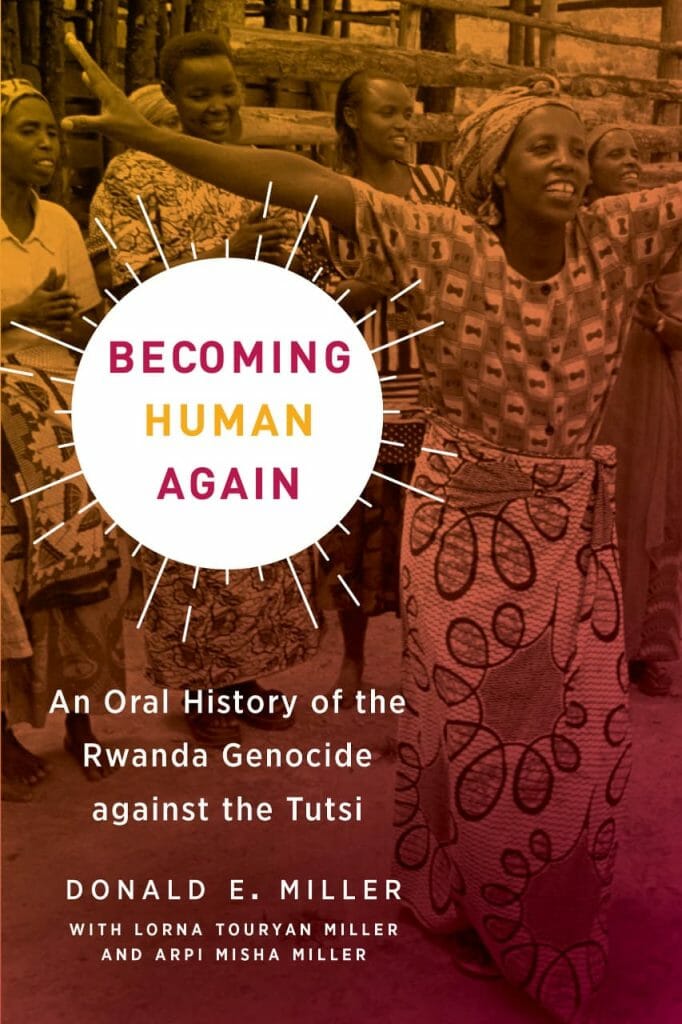
by Ronald E Miller with Lorna Touryan Miller and Arpi Misha Mille
University of California Press, 2020, 248 pp.
There is no shortage of written testimonies and academic studies on the genocide against the Tutsi which claimed the lives of at least 500,000 and probably as many as one million Tutsi people between April and July 1994. Deemed to be ‘accomplices’ of the Rwandan Patriotic Front (RPF), an armed movement of Tutsi refugees which had invaded the country in October 1990, they were massacred for the only reason that they were Tutsi. Most of them lived far away from the frontline and had nothing to do with the RPF. Children, women and elderly people were not spared.
Becoming Human Again, the oral history-based narrative written by Donald Miller, a Professor of Religion at the University of Southern California, in association with his wife Lorna and his daughter Arpi, does not claim to offer new knowledge on the genocide against the Tutsi. It is an important book, however, for two reasons. The first is that it gives a voice to ordinary survivors, and in particular orphans, interviewed eight years after the massacre of their parents, and women. Their raw stories, presented in a simple style, are compelling. They speak for themselves. The second reason is that, incredible as it may seem, the genocide against the Tutsi has been the object, since the time it was perpetrated to the present day, of a massive enterprise of denial. This denial continues partly because of the sentiments of guilt and shame felt by those who organised the genocide or remained silent while it happened, and partly because the ethnicist ideology which caused it has not disappeared. While the genocide against the Tutsi cannot be denied outright, given the multiplicity of witnesses, it can be trivialised and relativized.
We refer here to the so-called double genocide theory according to which the RPF would have committed clandestinely and therefore without leaving any evidence as many crimes as the Hutu extremists and their followers who slaughtered the Tutsi in huge numbers. Some authors put so much emphasis on the problems of governance in post-apartheid Rwanda, which, as the authors of the book point out, are real but need to be contextualised, that their denunciation of the genocide against the Tutsi becomes inaudible. An Oral History of the Rwanda Genocide against the Tutsi is a welcome antidote to these forms, avowed or not, of denial.
In 2001, Lorna Miller, the daughter of survivors from the Armenian genocide, and her husband Donald, had just completed an oral history project on the Armenian genocide when, at a conference in Kigali, they heard first-hand testimonies of the genocide against the Tutsi. They decided to put their experience at the disposal of Rwandan survivors who were keen, despite the risk of retraumatisation, to put their stories on record. What we have here is, in fact, the result of a triple oral history project. The first, conducted with the help of an orphans’ support group in 2002, involved about a hundred survivors who were children during the genocide and saw the murder, often in horrific circumstances, of their parents. The second, conducted with the support of AVEGA, an organisation of widow survivors, in 2004 focused on the experiences of about sixty women before, during and after the genocide. In both cases the interviewers were survivors, duly trained by the project’s managers. The third project, jointly run by Solace Ministries, a faith-based organisation established by a genocide survivor in 1995, spans a longer period of time and involved a hundred members of this organisation. This time Miller and his team did the interviewing. In total about 260 survivors were interviewed.
The third and fourth chapters, which record the traumatic memories of these orphans and widows are hard to read. They show that the Tutsi were victims of multiple acts of violence, humiliation and segregation long before 1994. During the genocide these men and these women witnessed atrocities which were to haunt them for years. One is struck by sadistic tendencies displayed by some of the perpetrators. Some children were forced to kill their own parents. Among women, rape, often repeated, was a common occurrence. The fifth chapter, novel in many ways, describe the struggles of the survivors after the genocide in a landscape of desolation. Children had to look after children with no money and no homes. A certain number of survivors received support from NGOs and faith-based organisations established during this period, but not all.
The second part of the book, also based on interviews but with more input from psychologists and social scientists, looks at the issues of trauma, healing, forgiveness and reconciliation. The story of Solace Ministries is prominent. To describe the effect of the genocide on the survivors, the authors speak of moral rupture. Everything which made sense to them, including their belief in God and in human fraternity, had collapsed. The interviews show how long it takes to ‘become human again’, as a survivor said in a phrase which gave the book its title. Forgiveness in the context of the genocide is a debated topic. Some choose to forgive to avoid being trapped by resentment. Others do so for religious reasons. Genuine forgiveness is rare, especially in an environment where survivors regularly meet people who have killed their parents or relatives. The interviews document the mixed feelings of the survivors during the gacaca, local courts which put on hundreds of alleged perpetrators of genocide on trial. For some it was a relief. But when a perpetrator lies or only tells half the truth, the pain becomes bigger.
I have conducted, for another project, about a hundred interviews with genocide survivors or people with a story to tell about Rwanda at the time of the genocide. I came to the same conclusion as Donald Miller, his wife and his daughter: faced with this apex of horror and violence, and without ignoring the other acts of mass violence in the Great Lakes Region or elsewhere, the best one can do is to listen to the genocide survivors. Dismissing their stories because of their alleged links with the current government is an insult. Their voice deserves to be heard.
My only regret is, with only two or three exceptions, the complete anonymisation of the testimonies. Without breaking the rules of confidentiality, the authors could have said a bit more about the chronological and geographical contexts of the narratives. At best we know that the interviewee is an orphan or a widow. One would have liked to know when and where the episodes that are narrated took place. The genocide against the Tutsi has a specific chronology and a specific topography. The interviews could have provided useful information on a history that is still being written. But this is a minor comment. It does not remove anything from the value of the book.
That it is well written is a considerable advantage. Let us hope that it will have a wide readership. The first step on the road to peace and reconciliation in the Great Lakes Region is an unmitigated and unconditional admission of the horror of the genocide against the Tutsi in Rwanda which profoundly destabilised the entire area. This is what the book under review is doing.